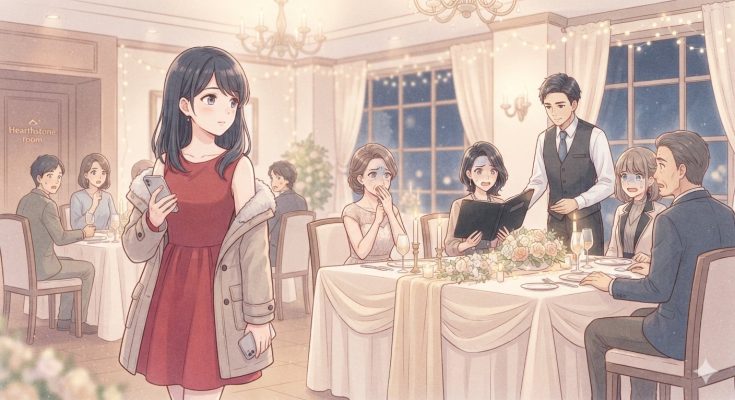
PART 3
My mother frowned.
“There must be some mistake.”
“There isn’t.”
Daniel slid one page forward.
“This event was reserved four months ago under Miss Doyle’s name. The deposit, room fee, floral arrangements, menu selection, and payment authorization are all registered to her account.”
Camille’s fingers tightened around her wineglass.
“That’s impossible.”
Daniel remained calm.
“Miss Doyle contacted us a few moments ago. She instructed us to remove her payment authorization from the reservation and asked that the remaining balance be presented to the family.”
He gently turned the folder so it faced my parents.
The total filled the page.
$8,742.16
My father actually laughed.
Not because it was funny.
Because his mind refused to believe what his eyes were seeing.
“What remaining balance?” he asked. “Olivia already paid.”
Daniel nodded.
“She paid the deposit.”
He pointed to another line.
“The final payment was scheduled to process after dinner. Her authorization has now been canceled.”
Silence.
Across the room, someone quietly put down a champagne flute.
Another guest whispered, “Olivia paid for all of this?”
No one answered.
Because suddenly every flower, every candle, every polished silver tray looked different.
They weren’t Camille’s thoughtful touches.
They were receipts.
Outside, I sat in my car without starting the engine.
The restaurant windows glowed against the winter evening. Snow drifted lazily beneath the streetlights.
My phone buzzed almost immediately.
Mom Calling.
I watched it ring.
Then stop.
Two seconds later—
Camille Calling.
Then Dad.
Then Mom again.
Twenty-three missed calls arrived within twelve minutes.
For the first time in my adult life, I didn’t answer.
Instead, I looked at the little paper bakery box on the passenger seat.
When I had picked up the anniversary cake that afternoon, the baker had quietly handed me a second box.
“You always buy everyone else’s favorite,” she’d said. “This one’s chocolate raspberry—the one you order every year but never keep for yourself.”
She had remembered.
My own family never had.
I smiled through tears, opened the tiny box, and ate one slice sitting alone in my parked car.
It tasted like freedom.
Back inside the restaurant, panic spread far faster than embarrassment.
My mother pushed the folder toward Camille.
“Fix it.”
Camille blinked.
“With what?”
“You said you planned this!”
“I planned the decorations!”
“No,” Aunt Ruth said from across the room.
“You accepted the credit.”
Every head turned.
Great-Aunt Ruth slowly stood.
At eighty-one years old, she leaned on her cane, but her voice carried farther than anyone else’s.
“I’ve watched this family for forty years.”
She looked directly at my mother.
“You’ve been introducing the wrong daughter all evening.”
Nobody moved.
Ruth continued.
“Who booked the room?”
Daniel answered quietly.
“Olivia.”
“Who paid the deposit?”
“Olivia.”
“The flowers?”
“Olivia.”
“The catering?”
“Olivia.”
Ruth nodded once.
Then she looked at Camille.
“So what exactly did you do?”
Camille opened her mouth.
Nothing came out.
The humiliation grew worse when relatives began comparing memories.
“Oh…”
“I remember Olivia asking everyone about dietary restrictions.”
“She was the one emailing us.”
“She chose Uncle Frank’s gluten-free meal.”
“I thought Camille was just helping.”
Each sentence stripped another layer from the illusion.
My cousin Julia quietly pulled out her phone.
Within seconds she found the anniversary invitation email.
From: Olivia Doyle
Not Camille.
She turned the screen toward the table.
No one argued anymore.
My father hated public embarrassment more than anything.
He stood abruptly.
“Daniel, give us a moment.”
“I’m afraid I can’t, sir. The balance must be settled before the party concludes.”
Dad lowered his voice.
“We’re celebrating our anniversary.”
Daniel remained sympathetic.
“And we sincerely wish you a wonderful evening. But restaurant policy applies equally to every guest.”
The sentence landed harder than anyone expected.
Because fairness had just entered a family built on favoritism.
Meanwhile my phone vibrated again.
This time it was Hannah.
Not Camille.
Her daughter.
I answered.
“Hi.”
She sounded nervous.
“Aunt Liv?”
“Yes, sweetheart.”
“I’m sorry.”
Those two words broke something inside me.
“You have nothing to apologize for.”
“I knew.”
I closed my eyes.
“Knew what?”
“That Mom didn’t really make the party.”
I stayed silent.
“She practiced the speech in our kitchen,” Hannah whispered. “I asked why your name wasn’t in it.”
“What did she say?”
“She said…” Hannah hesitated.
“She said nobody notices the person who pays. They only remember the person holding the microphone.”
Tears slipped down my face.
Not because it hurt.
Because a twelve-year-old had already learned the family’s worst lesson.
“Hannah?”
“Yes?”
“Promise me something.”
“Okay.”
“Never confuse applause with kindness.”
She cried quietly.
“I won’t.”
Inside the restaurant, the financial reality became unavoidable.
Dad checked his banking app.
His expression changed.
My mother leaned closer.
“What?”
He whispered.
“We don’t have enough.”
The upgraded champagne.
The extra guests.
The premium seafood.
Every addition Camille insisted upon had increased the final bill by thousands.
Ironically, the only person who had budgeted responsibly had been me.
Camille stared at her father.
“You have your business card.”
“It’s near the limit.”
“Use Mom’s.”
“She paid for the cruise yesterday.”
For several painful minutes, the family that constantly assumed I would quietly cover the difference had to confront an unfamiliar experience:
Paying their own bill.
Then something unexpected happened.
Uncle George stood.
He walked over to Daniel.
“I’d like to pay for Ruth’s dinner.”
Daniel nodded.
George smiled sadly.
“Only Ruth’s.”
One by one, relatives followed.
“I’ll cover my wife and myself.”
“Our table too.”
“We’ll pay for our meals.”
Nobody offered to pay for my parents.
Not out of cruelty.
Out of principle.
People were willing to pay for themselves.
They were no longer willing to participate in someone else taking credit for another person’s generosity.
Within fifteen minutes, nearly every guest had individually settled their portion.
The enormous bill shrank.
But the head table still owed over $3,900.
Exactly the portion created by the upgrades Camille had ordered.
Camille finally broke.
She burst into tears.
“I was only trying to make it beautiful!”
Ruth answered gently.
“No.”
She pointed toward the empty chair where I should have been sitting.
“You were trying to make yourself visible.”
The room fell silent again.
Because everyone knew the difference.
At 10:42 p.m., my father used three different credit cards to pay the remaining balance.
The payment finally went through.
Daniel thanked them politely.
The anniversary dinner ended without cake.
Not because there wasn’t one.
Because nobody felt like celebrating anymore.
I drove home instead.
My apartment was warm, quiet, and beautifully ordinary.
No speeches.
No criticism.
No pretending.
I changed out of the red dress, folded it carefully, and hung it in my closet.
For years I had imagined revenge would feel loud.
Instead, it felt peaceful.
I slept for nearly ten hours.
The next morning, I woke to 117 unread messages.
Family group chats had exploded overnight.
Some apologized.
Some demanded explanations.
Some insisted I had humiliated my parents.
One message came from someone I hadn’t expected.
My father.
It contained only one sentence.
I think we need to talk about what really happened in this family.
I read it twice.
Then set the phone down.
Because for the first time, the conversation would happen on equal ground—not at a table where I had paid for everyone else, and not in a room where I didn’t even have a chair.
