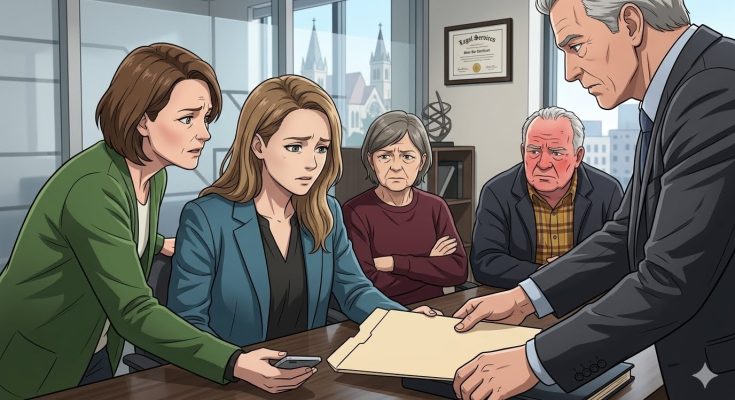
My sister said I owed her my inheritance because she has a family.
I booked a flight instead.
Hours later, my mother texted, “Transfer it to her or don’t bother coming home.” By midnight, I had forty-three missed calls and one voicemail from my father that changed the way I heard every family story I’d ever been told.
The first call came on a Tuesday afternoon while I was finishing work in my apartment in Chicago.
Outside my window, the skyline was glowing gold in the last light of day.
Inside, I had three tabs open, two deadlines hovering, and the kind of exhaustion that makes you promise yourself you’ll close the laptop after one more task.
Then my phone lit up with my mother’s name, and that familiar knot pulled tight in my stomach.
My mother never called to ask how I was.
She called to assign a role.
When I answered, she skipped hello and went straight to business.
“Your grandmother left you everything in her will,” she said.
“The house.
The accounts.
All of it.
Your father and I think you should split it with Olivia.
It’s only fair.”
Fair.
In my family, that word always meant my sister wanted something.
I told her, as calmly as I could, that Grandma Ruth had made her own choices.
If she wanted Olivia to receive part of the estate, she would have written Olivia into the will.
“I can’t believe how selfish you’ve become,” she said.
“Olivia has two children.
You’re single.
No responsibilities.
What do you even need that money for?”
I should say that by the time I was thirty-four, none of this was new.
My older sister, Olivia, had been the center of gravity in our family for as long as I could remember.
She wanted.
Everyone provided.
She cried.
Everyone rearranged themselves around her feelings.
If she succeeded, it was proof of her star quality.
If she struggled, it was proof she needed more support.
If I succeeded, it was because I was “independent.” If I struggled, it was because I was “cold” or “too proud to ask for help.”
Growing up, Olivia got cheer camps and competition uniforms.
I got told there were books at the library if I was serious about art.
Olivia’s college was paid for.
Mine came with loans I carried for years.
My mother once thanked Olivia for being “so generous” about giving me old clothes.
I was thirteen, standing in a pair of jeans too loose in the waist and too short in the ankles, and everyone acted like I’d been gifted treasure.
So when my mother told me I should hand over half of what my grandmother had left me, I heard all the old machinery turning back on.
After the call, Olivia texted exactly what I expected.
Not grief.
Not memory.
Not love.
A carefully warm message about how expensive preschool was and how the kids needed winter coats and how we should meet for coffee to “talk about how to handle everything.”
I deleted it and pulled up the email from Lawrence Whitfield, my grandmother’s attorney.
I had barely absorbed it when it first came after the funeral.
Reading it again, I realized the estate was substantial.
The Stillwater house
was worth around four hundred thousand.
The investment accounts held roughly six hundred thousand.
There were smaller assets too, and one specific charitable gift of twenty thousand dollars to the animal shelter where Grandma had volunteered for years.
Everything else came to me.
Not because of a typo.
Not because she forgot anyone.
Grandma Ruth had been the least accidental person I’d ever known.
I booked a flight to Minnesota for Friday evening and arranged to meet Whitfield at the house Saturday morning.
Then the pressure escalated.
That same night, my mother texted, “Transfer half to your sister before the weekend or don’t bother coming home.” Olivia called twice.
My father called once, then left a voicemail so angry it made my skin go cold.
He said Grandma would be ashamed of me, that family came first, that I’d always been jealous of Olivia.
Then he said, low and sharp, “You think you can come here and walk into that house after what you’re doing? Try it.
See how that goes.”
I forwarded the voicemail to Whitfield the next morning.
He replied almost immediately.
Do not meet them alone at the property.
I will be present when you arrive.
There is something your grandmother instructed me to give you privately before anyone else enters the house.
Then another email followed.
Your grandmother anticipated conflict.
That sentence sat with me all day.
She anticipated conflict.
Not hoped.
Not feared.
Anticipated.
Friday night, I flew into Minneapolis, rented a car, and drove east toward Stillwater under a low gray sky.
Every mile back toward Minnesota brought old feelings with it.
That shrinking sense of being reduced to who I used to be.
The daughter who should keep the peace.
The sister who should give more because asking less had become her identity.
By the time I checked into a hotel, my mother had sent three more messages.
Olivia sent a photo of her kids in matching pajamas with no caption, as if their existence alone should settle the argument.
Saturday morning, I drove to my grandmother’s house with my pulse beating hard in my throat.
There were already three cars in the driveway.
My father’s truck.
My mother’s sedan.
Olivia’s minivan.
And on the porch stood Lawrence Whitfield, one hand holding a leather case, his expression so grave it made me stop before I reached the steps.
Before anyone could speak, he said, “Your grandmother asked me to play you something she recorded the week before she died.
You are to hear it first.”
My mother objected instantly.
Olivia laughed in that brittle way people do when they’re trying not to panic.
My father said the house belonged to the family.
|Whitfield corrected him in a tone so dry it sounded like paper.
“No, Mr.
Bennett.
As of the filed probate documents, the property belongs to Amelia.”
Then he handed me two things.
A sealed envelope with my name on it in Grandma Ruth’s handwriting.
And a small locked metal box.
I saw Olivia’s face change when she looked at the box.
It was quick, but unmistakable.
Fear flashed there and vanished.
Whitfield led me inside while my family argued on the porch.
The house smelled exactly the way I remembered: tea, cedar, lemon polish, and the faint sweetness of old books.
My chest tightened so fast I had to stop in the entryway.
Grief had a way of hiding until it found a room it recognized.
We went into the study.
Whitfield shut the door, set a small recorder on the desk, and nodded toward the envelope.
My hands shook as I opened it.
Inside was a single page.
Amelia,
If you are reading this before hearing my recording, then events unfolded exactly as I expected.
I am sorry for the pain that means has already begun.
I left my estate to you because you are the only person in this family I trust to tell the truth, even when the truth costs you comfort.
You have also been asked to carry a burden I should have forced into the light myself while I was still alive.
The key to the box is taped beneath the third drawer in my bedroom dresser.
Do not open it until after you hear me speak.
Whatever they say, remember this: love does not demand that you surrender what was given to you in honesty.
Grandma.
By the time I looked up, my vision had blurred.
Whitfield pressed play.
My grandmother’s voice filled the room.
Frailer than I remembered, but unmistakably hers.
“If Amelia is hearing this first,” she said, “then Olivia, Ellen, and Robert have done exactly what I knew they would do.”
I closed my eyes.
She went on slowly, pausing for breath.
She said she had changed her will two years earlier after discovering that money had been disappearing from one of her accounts.
At first she assumed it was a banking mistake.
Then she noticed small withdrawals, then larger ones, all timed around visits from Olivia.
When she confronted her privately, Olivia admitted she had taken Grandma’s debit card from her purse, used it for groceries, then bills, then daycare, then credit cards.
She cried.
She apologized.
She promised it was temporary.
Grandma said she didn’t report it because she was ashamed and because Olivia begged her not to “destroy the family.” Instead, she demanded repayment and told Olivia never to touch her finances again.
Then Grandma’s voice hardened.
“But she did it again,” she said.
“Not with my card.
With pressure.
With tears.
With her mother translating theft into need and her father calling it help.
They all wanted me to smooth it over.
To call it family.
I refused.”
I opened my eyes and stared at the recorder like it had become a living thing.
Whitfield’s face remained professionally still, but he wasn’t surprised.
He had heard this before.
Grandma continued.
She said she had watched the same pattern for years: Olivia wanting, my parents excusing, me being expected to accept less because I would “be fine.” She said she left the estate to me not to reward me for being alone, but because I had built a life without feeding on anyone else’s.
She said if my parents tried to shame me into giving it away, I was not to mistake manipulation for morality.
At the very end, her voice softened.
“Amelia, if you choose to help your sister someday, let it be because you freely wish to, not because anyone has convinced you that your life matters less.
And if they deny what I say here, the
box contains records.”
The recording ended.
For a long moment, the room was silent except for the ticking wall clock in the hall.
My grandmother had known everything.
Not just guessed.
Known.
The key was exactly where she said it would be, taped beneath the third dresser drawer in her bedroom.
Inside the metal box were bank statements, photocopies of checks, handwritten notes, and printed emails.
Some were from Olivia.
Some were from my mother.
A few, shockingly, were from my father.
They documented years of “loans” that were never repaid, payments made after emotional meltdowns, and one furious email from my mother telling Grandma it would be “cruel” to keep “holding old mistakes over a young family.”
Old mistakes.
The total was far higher than I expected.
More than seventy thousand dollars over several years.
I sat on the edge of my grandmother’s bed and felt something inside me go still.
Not shattered.
Still.
Like the last shaky piece had finally locked into place.
All those years of being told I was imagining things, exaggerating, holding grudges, misunderstanding family dynamics—suddenly there it was in black and white.
The pattern had been real.
Worse than real.
It had been organized.
Whitfield asked what I wanted to do.
I said, “I want them to hear her voice.”
We went back to the porch.
My family looked up in practiced outrage, but the moment they saw my face, their confidence shifted.
Whitfield said, “Mrs.
Hayes left a recording.
We are going to listen to it now.”
My mother started talking over him.
My father said he’d heard enough.
Olivia said this was cruel and invasive and unnecessary.
Then my grandmother’s voice came through the portable speaker.
That stopped them.
I watched my mother’s expression collapse first.
Not into guilt.
Into calculation.
She was trying to guess how much had been said.
My father’s face went dark red, then gray.
Olivia folded her arms so tightly across her chest it looked like she was holding herself together.
When the recording reached the part about the debit card, Olivia snapped.
“That was years ago,” she said.
“And I paid some of it back.”
“You paid back almost none of it,” Whitfield said.
My mother turned on him instantly.
“She was under pressure.
She had children.
Ruth understood that.”
I laughed before I could stop myself.
The sound startled everyone, including me.
“Did she?” I asked.
“Because from where I’m standing, what she understood was that all of you called theft love if Olivia was the one benefiting.”
My father took a step toward me.
“Watch your mouth.”
“No,” I said, and for the first time in my life, I didn’t lower my voice to make him comfortable.
“You watch yours.
You left me a voicemail threatening me if I came here.
You spent my whole life teaching me that keeping the peace meant giving Olivia whatever she wanted.
You told yourselves it was because she needed more.
But the truth is, you just found it easier to take from me.”
Olivia’s eyes filled with tears so quickly it might have worked on me once.
“Amelia, I was drowning,” she whispered.
“You don’t know what it’s like.”
I looked at her and finally understood the difference between pain and entitlement.
“I believe you were struggling,”
I said.
“I do not believe that made this mine to fix.”
My mother started crying then, but even her tears felt angry.
“So that’s it?” she said.
“You’re going to humiliate your sister over money? After everything this family has done for you?”
That sentence might have broken me years ago.
Instead, I heard how empty it was.
“What exactly did this family do for me?” I asked.
“Besides teach me to survive on less and call it character?”
No one answered.
Whitfield stepped in and explained, calmly and clearly, that the will would be executed exactly as written.
Any attempt to challenge it would bring the financial records into formal proceedings.
If anyone entered the property without my consent, he would document it immediately.
He spoke the way people do when they know the law is on their side and emotion no longer matters.
My father muttered something under his breath and walked to his truck.
My mother went after him, still crying, still furious.
Olivia stayed on the porch.
For a moment, it was just the two of us.
She looked smaller than I’d ever seen her, but smaller didn’t mean innocent.
“I really did need help,” she said.
“I know,” I answered.
She swallowed.
“Are you going to tell everyone?”
The question sat between us, raw and revealing.
Not Are you okay?
Not I’m sorry.
Just Are you going to expose me?
“I’m not interested in destroying you,” I said.
“But I’m done protecting lies that were built on taking from me.”
She looked away first.
Over the next three months, the estate closed.
I sold the house to a retired couple who loved the garden and promised they’d keep the maple tree.
I kept my grandmother’s journals, her teacups, the cedar chest, and the quilt from her bedroom.
I funded the shelter donation exactly as she requested and added a little more in her name.
I paid off my condo.
I invested most of what remained.
I set aside money for my future the way no one in my family had ever bothered to imagine it deserved.
I did not give Olivia half.
I did, months later, send one check.
Not to her.
To a licensed financial counselor and debt attorney whose office specialized in family debt, budgeting, and crisis restructuring.
I mailed the information with a note that said, This is the only help I’m willing to give.
Use it or don’t.
She never thanked me.
My mother didn’t speak to me for eleven months.
My father sent one birthday text that said only, Hope you’re well.
And maybe the strangest part was this: the silence hurt less than pretending ever had.
A year after the probate closed, I made tea in my Chicago kitchen using one of Grandma Ruth’s blue cups and looked out at the city she always said suited me.
I thought about the recording, the box, the way she had seen me clearly even when no one else in that family would.
People like to say inheritances reveal character, but that isn’t quite true.
They reveal patterns that were already there.
Who feels entitled.
Who gets protected.
Who is expected to surrender.
Who mistakes being less demanding for being less deserving.
I still don’t know whether Olivia ever truly believed
she was owed what wasn’t hers or whether my parents taught her that so thoroughly she couldn’t see the line anymore.
I don’t know whether my mother cried because she was ashamed or because she was caught.
I don’t know whether my father’s anger was loyalty, pride, or fear that the family story had finally cracked open where everyone could see inside.
But I know this.
My grandmother left me more than money.
She left me proof.
And once you’ve heard the truth spoken plainly by the only person who never asked you to become smaller, it gets a lot harder to return to the old lie and call it love.
The Box Grandma Ruth Hid From Everyone
The silence after probate did not feel like peace at first.
It felt like a house after a storm, where nothing is actively breaking anymore, but every room still smells like rainwater and damage.
For the first few weeks after I returned to Chicago, I kept expecting my phone to explode again.
I expected my mother’s name.
My father’s anger.
Olivia’s soft little messages wrapped in guilt.
Photos of her children.
Long paragraphs about family.
Some new version of the same old demand.
But nothing came.
That was almost worse.
Because silence from my family was never empty.
It was always a room where punishment sat quietly in the corner.
I went back to work.
I answered emails.
I reviewed reports.
I attended meetings where people argued about budgets and deadlines and quarterly performance like my life had not just cracked open in Stillwater.
My colleagues asked if I was okay after “family stuff.”
I said yes.
That is what adults say when the real answer requires too much history.
Yes.
Fine.
Managing.
Back to normal.
But normal had become a strange word.
Because once you realize your family has been training you to give up your place for years, you cannot return to the old version of yourself.
You notice everything.
The way your body tenses when a message arrives.
The way you rehearse explanations before anyone even asks.
The way guilt appears even when you have done nothing wrong.
Grandma Ruth had left me an inheritance, yes.
But what she really left me was proof.
And proof changes the shape of memory.
I started replaying my whole childhood differently.
Olivia crying at the kitchen table because she wanted the pink bedroom instead of the smaller blue one.
My mother saying, “Amelia is easier, she won’t mind.”
My father telling me, “Your sister is sensitive, don’t make things harder.”
Olivia borrowing my clothes without asking.
My mother saying, “Don’t be petty.”
Olivia wrecking my bicycle when we were teenagers.
My father saying, “It was an accident, Amelia, stop keeping score.”
Keeping score.
That was what they always called memory when memory did not favor them.
But Grandma Ruth remembered too.
That was the part that kept sitting beside me in my apartment at night.
She had seen it.
All of it.
And she had written my name anyway.
Two weeks after I returned to Chicago, Lawrence Whitfield called me.
His voice was formal as always, but there was something careful underneath it.
“Amelia, I apologize for calling after business hours.”
I was standing at my kitchen counter, holding one of Grandma’s blue teacups.
I had started using them every morning, even though they felt too delicate for daily life.
“It’s okay,” I said.
“Is something wrong?”
There was a pause.
Not long.
Long enough.
“I received a package today from a safe deposit facility in Stillwater,” he said.
“My office was listed as the receiving address upon completion of the initial probate steps.”
My fingers tightened around the cup.
“A package from Grandma?”
“Yes.”
“What is it?”
“I have not opened it.”
His answer came quickly.
“Your grandmother’s instruction was that it be delivered to you unopened after the estate transfer began and only after the initial family confrontation occurred.”
I stared out at the lights of Chicago.
The city looked steady.
My chest did not.
“There’s more?”
“I believe so,” he said softly.
“The package is marked private and personal.”
Private and personal.
Those words felt like a door opening into another room I had not known existed.
“I can come to Minnesota,” I said.
“That won’t be necessary. I can courier it securely to you.”
“No,” I said before I thought better of it.
“I want to come.”
Whitfield was quiet for a moment.
Then he said, “That may be wise.”
I flew back that Friday.
I told no one.
Not my mother.
Not my father.
Not Olivia.
Not even my closest friend at work, who already knew enough to stop asking questions when I said, “I have to handle one more estate matter.”
Minnesota looked colder this time.
The trees had lost nearly all their leaves.
Stillwater felt grayer, quieter, like the town itself had turned its face away from what happened on Grandma’s porch.
Whitfield met me at his office Saturday morning.
He had placed the package on the conference table before I arrived.
It was not large.
A rectangular archival box, sealed with brown tape and tied with string because Grandma Ruth believed in doing certain things the old-fashioned way.
My name was written across the top.
Amelia.
Not Ms. Bennett.
Not beneficiary.
Not trustee.
Just Amelia.
I sat down slowly.
Whitfield placed a small envelope beside it.
“This was attached to the box.”
I recognized Grandma’s handwriting immediately.
For after the first truth.
My throat tightened.
“The first truth?”
Whitfield nodded once.
“I assume she meant the recording and financial records.”
I let out a breath that almost became a laugh.
“Of course she did.”
Grandma had organized even the breaking of our family secrets in stages.
One truth at a time.
As if she understood I might not survive all of it at once.
I opened the envelope first.
My dear girl,
If you have reached this box, then you already know about Olivia and the money.
You know I did not leave you everything by accident.
But there is another reason I chose you.
Not because you are the only responsible one.
Not because you are single.
Not because you are easier.
Because you are the only one who ever asked what happened to your Aunt Claire.
I stopped breathing.
Aunt Claire.
The name landed in my body before my mind could organize it.
I had not heard that name in years.
When I was little, I found a photograph tucked into one of Grandma’s cookbooks.
A young woman with dark hair, laughing beside Grandma Ruth near a lake.
I asked who she was.
Grandma said, “My daughter Claire.”
Then my mother walked into the room and said sharply, “We don’t talk about her.”
Later I asked again.
My father told me Claire had “made bad choices.”
Olivia said she was probably dead.
My mother said if I kept digging through old things, I would only upset people.
I was nine.
So I stopped asking out loud.
But I never stopped wondering.
Whitfield watched my face carefully.
“You knew about Claire?”
“Barely.”
I looked back at the letter.
Grandma continued:
Your mother told the family that Claire abandoned us.
That is not the truth.
Claire was pushed out.
There are records in this box.
Letters.
Photographs.
Copies of legal documents.
And one journal.
I could not fix what happened while I was alive because I was a coward for too long.
I let shame and pressure silence me.
But silence has already cost this family too much.
I am trusting you to decide what must be done.
Do not let Ellen tell you Claire was nothing.
She was my daughter.
She was your aunt.
And she was the first person your mother learned to erase.
The page blurred.
I put it down slowly.
Whitfield said nothing.
Good lawyers understand when silence is the only respectful response.
I untied the string.
The box opened with a soft sigh of old paper.
Inside were stacks of letters tied with ribbon.
A leather journal.
A manila folder.
A small velvet pouch.
And a photograph.
The same woman from the cookbook.
Claire.
Young.
Bright-eyed.
Standing beside my mother.
Only my mother looked different in this photo.
Not older.
Not younger.
Different.
Her smile was tighter.
Her hand rested on Claire’s shoulder, but it looked less like affection and more like possession.
On the back, Grandma had written:
Before Ellen decided love was competition.
I read it three times.
Before Ellen decided love was competition.
That was my mother in seven words.
I opened the manila folder first.
Inside were legal documents from more than thirty years earlier.
A guardianship petition.
A property dispute.
A hospital record.
A police report.
I looked up at Whitfield.
“Did you know what was in here?”
“No,” he said.
“But I know the name Claire Hayes.”
“How?”
His expression turned grave.
“Your grandmother consulted my predecessor about her once.”
“What for?”
He hesitated.
“To locate her.”
My heart began to beat harder.
“She was alive?”
“At the time, yes.”
I gripped the edge of the folder.
“When?”
“About twelve years ago.”
Twelve years ago.
I had been twenty-two, finishing college, drowning in loans, trying to become someone my family could not shrink.
And Grandma Ruth had been trying to find her missing daughter.
I opened the journal.
The first page began in Grandma’s handwriting.
March 8, 1991.
Claire called today.
Ellen says not to answer if she calls again.
Robert agrees.
They say Claire only wants money.
But she was crying.
She said she never signed the papers.
I do not know what to believe.
I felt cold spread through my hands.
Signed what papers?
I turned the page.
March 13.
Ellen brought documents.
Said Claire transferred her share of the lake property willingly before leaving.
The signature looks wrong.
I told Ellen.
She became furious.
Said I was choosing Claire over the family.
Robert says I should let it go.
Let it go.
There it was again.
The family anthem.
A command disguised as peace.
I read faster.
March 20.
Claire came to the house while Ellen was out.
She looked thin.
Terrified.
She said Ellen and Robert told everyone she was using drugs.
She said it was a lie.
She said she was pregnant.
I nearly dropped the journal.
Pregnant.
I looked at Whitfield.
“My aunt had a child?”
He looked genuinely troubled.
“I don’t know.”
I turned the page with shaking fingers.
March 21.
Ellen found out Claire came.
There was screaming.
Robert took Ellen’s side.
Claire left before supper.
She begged me to believe her.
God forgive me, I did not stop her.
The next pages were worse.
Small entries.
Guilt growing like mold.
Claire calling from different towns.
Claire saying she had nowhere safe to go.
Claire insisting she never gave up her property share.
Claire saying my mother had forged her signature.
Then suddenly, the entries stopped for almost three months.
When they resumed, Grandma’s handwriting looked different.
June 2.
Claire is gone.
Not dead.
Gone.
Ellen says she ran off with some man.
Robert says good riddance.
I asked about the baby.
Ellen said there was no baby.
But I saw Claire.
I know what I saw.
I sat back in my chair.
The room felt airless.
All my life, my mother had been rewriting people.
Me.
Olivia.
Grandma.
Now Claire.
And maybe a child.
A cousin.
Someone erased before I even knew they existed.
Whitfield slid a glass of water toward me.
I had not realized my breathing had changed.
“What does the legal folder say?” I asked.
My voice sounded far away.
Whitfield put on his glasses and began reviewing the documents carefully.
His brow furrowed.
Then deepened.
Then he went completely still.
“What?”
He lifted a page.
“This appears to be a quitclaim deed transferring Claire’s interest in the lake property to your mother.”
“The signature is forged?”
“I cannot determine that by sight.”
“But?”
He turned the document toward me.
“The notary was Robert Bennett.”
My father.
I stared at the page.
My father notarized a deed transferring Aunt Claire’s property share to my mother.
And Grandma’s journal said Claire denied signing anything.
The room seemed to tilt.
I heard Dad’s voicemail again.
Try it.
See how that goes.
Not just rage.
Fear.
He knew this box existed.
Maybe not the details.
But something.
I opened the velvet pouch because my hands needed something else to do.
Inside was a necklace.
A small silver locket.
I pressed the clasp.
It opened.
Two tiny photographs.
Claire on one side.
A baby on the other.
A baby wrapped in a yellow blanket, eyes closed, mouth slightly open.
On the back of the locket, engraved:
M.L.H.
I stared at the initials.
“Did Grandma mention this?”
Whitfield shook his head.
“No.”
The final stack of letters was tied with faded blue ribbon.
Most were addressed to Grandma Ruth.
The first one was from Claire.
Mom,
If Ellen tells you I abandoned you, don’t believe her.
She said if I came back, she’d make sure they took my baby.
She said Robert would testify that I was unstable.
I know you don’t want to believe she’d do that.
But she already has.
Please keep the locket.
If anything happens, her name is Mara Louise Hayes.
My daughter.
Your granddaughter.
My cousin had a name.
Mara Louise Hayes.
For a long moment, I could not move.
I had grown up believing I had one sister.
One golden sister.
One impossible family structure.
But somewhere, maybe, there had been another girl.
A cousin.
A child born into the same family machine and pushed into silence before she could become inconvenient.
I looked at Whitfield.
“We have to find her.”
He nodded slowly.
“If she is alive, yes.”
If she is alive.
The words hit hard.
Grandma’s box had been waiting for years.
Maybe too many years.
I kept reading letters until my eyes ached.
Claire moved between shelters.
Then stayed with a woman named Marjorie in Duluth.
Then planned to come back and confront the family after Mara turned one.
The last letter was dated almost thirty-one years ago.
Mom,
I’m coming next Friday.
Not to fight.
To make you look at me.
Mara deserves a family that knows she exists.
I’m tired of being the shame everyone points at so Ellen can stay clean.
If I don’t make it, ask Robert what he did.
I read that last sentence over and over.
Ask Robert what he did.
Whitfield was already on his phone, quiet but urgent, asking an investigator he trusted to begin locating records for Claire Hayes and Mara Louise Hayes.
Birth records.
Death records……………
PART2: My Sister Demanded My Inheritance “Because She Has a Family”—So I Booked a Flight, Locked Every Account, and Let My Parents Panic When They Realized I Was Done Funding Their Lives
Name changes.
Social services.
Anything.
While he worked, I sat in the conference room surrounded by the remains of another buried woman and understood something with absolute clarity.
Grandma Ruth had not left me everything simply because she trusted me with money.
She trusted me with memory.
With names.
With the people my family had tried to turn into blanks.
By the time I left Whitfield’s office that afternoon, the sky had darkened with the threat of snow.
My phone had been silent all morning.
Then, as I reached my rental car, it buzzed.
My father.
For several seconds, I just stared.
Then I answered.
He did not say hello.
Just like my mother.
“We need to talk,” he said.
His voice was different now.
Not angry.
Tight.
Controlled.
Afraid.
I looked at the box on the passenger seat.
“Yes,” I said.
“We do.”
He exhaled slowly.
“Where are you?”
“Stillwater.”
A pause.
Then:
“You opened the second box.”
Not a question.
My blood went cold.
He knew.
My fingers tightened around the phone.
“You knew about Claire.”
Silence.
Then my father said the one sentence that made the snow begin to fall around me like ash:
“Amelia, your aunt didn’t disappear.”
My breath stopped.
“What does that mean?”
His voice cracked slightly.
“It means your mother knows exactly where she is buried.”
The Grave Behind Blackwater Lake
For several seconds after my father said those words, I forgot how to breathe.
Snow drifted slowly across the parking lot outside Whitfield’s office while I stood frozen beside my rental car with my phone pressed against my ear.
“It means your mother knows exactly where she is buried.”
Buried.
Not missing.
Not disappeared.
Buried.
My knees nearly gave out.
“What are you talking about?” I whispered.
Dad inhaled shakily.
“You need to leave Stillwater.”
I laughed once.
A horrible sound.
“That’s your concern right now?”
“Amelia, listen to me carefully.”
“No,” I snapped.
“You listen to me.
My entire life you people told me Aunt Claire abandoned the family.
You let Grandma die carrying this secret.
You let me believe she vanished.
Now suddenly she’s buried?”
Silence.
Then my father said quietly,
“I never thought your grandmother kept those records.”
I closed my eyes.
Of course.
That was his fear.
Not Claire.
Not Mara.
Evidence.
“What happened to her?”
Another pause.
Long enough to make me feel sick.
Then:
“Your mother found out Claire planned to contest the property transfer.”
I gripped the car door harder.
“She forged the deed.”
“Yes.”
The word landed like concrete.
No denial.
No excuse.
Just yes.
I leaned against the freezing metal and stared at the falling snow.
My entire childhood had been built inside a story maintained by fraud.
Dad continued before I could speak.
“Claire came back to Stillwater thirty-one years ago.
She wanted her share of the lake property restored.
She threatened legal action.”
“And?”
“And Ellen panicked.”
Of course she did.
My mother’s greatest terror was never morality.
It was exposure.
“What happened?”
Dad’s breathing roughened.
“They met near Blackwater Lake.”
My stomach dropped instantly.
Blackwater Lake sat fifteen minutes outside town.
Remote.
Dense woods.
Old cabins.
The kind of place families vacationed in summer and avoided in winter.
“Who met?”
“Your mother.
Claire.
And me.”
My heartbeat turned violent.
“You were there?”
“Yes.”
His voice cracked again.
“God help me, yes.”
I could barely hear the wind anymore.
Only blood rushing through my ears.
Dad spoke quietly now, like a man confessing from underwater.
“Claire arrived carrying Mara.
She was exhausted.
Cold.
Scared.
She wanted money and legal recognition.”
“She deserved both.”
“I know.”
That shocked me.
Not because it redeemed him.
Because hearing him admit truth felt unnatural.
“What happened?”
Dad swallowed audibly.
“Ellen accused Claire of trying to destroy the family.
Claire threatened to go to police over the forged documents.
They started screaming at each other.”
Snow gathered along the windshield.
The world felt unreal.
Then Dad said:
“Claire slipped.”
I went completely still.
Slipped.
The favorite word of guilty people everywhere.
“She fell near the lake embankment.”
I said nothing.
Because silence forces liars to keep talking.
Dad rushed onward.
“It was icy.
She hit her head.
It happened fast.”
“And then?”
Another silence.
This one worse.
Because I already knew.
“We panicked.”
There it was.
Not grief.
Not horror.
Panic.
About themselves.
“What about the baby?”
“Mara wasn’t hurt.”
My chest tightened painfully.
“Where is she?”
Dad hesitated.
“I don’t know.”
“You’re lying.”
“No,” he said desperately.
“Claire left the baby with a woman named Marjorie before coming to meet us.”
I remembered the letters.
The shelter woman in Duluth.
“Oh my God.”
“We buried Claire near the old boat launch.”
My hand slipped off the frozen car door.
Buried.
Secretly.
Like evidence.
Not family.
Not daughter.
Evidence.
“Mom did this?”
“She said if the truth came out, everything would collapse.”
I laughed again.
Broken this time.
“And you helped her.”
His voice lowered.
“I was afraid.”
That sentence might have earned sympathy from someone else.
Not me.
Because cowardice becomes cruelty when people build entire lives around protecting themselves from consequences.
“You buried your wife’s sister.”
“I know.”
“You let Grandma believe Claire abandoned her.”
“I know.”
“You let me grow up inside this lie.”
“I KNOW.”
His sudden shouting echoed through the phone.
Then came sobbing.
Actual sobbing.
I stood motionless while my father broke apart three decades too late.
But even then…
I noticed something.
He cried hardest when describing his guilt.
Not Claire’s death.
Not Mara.
Himself.
That’s the problem with selfish people.
Even confession revolves around their own suffering.
Finally he whispered,
“Your mother cannot know you opened that box.”
Too late.
Because at that exact moment, another car pulled into the lot beside mine.
My mother’s sedan.
My blood turned to ice.
Dad heard my silence instantly.
“What’s wrong?”
I stared through the windshield.
“She’s here.”
“What?”
“She followed me.”
My mother stepped out wearing black gloves and a camel-colored coat like she was arriving for brunch instead of confrontation.
Even from twenty feet away, she looked immaculate.
Controlled.
Elegant.
Dangerous.
Dad’s voice became frantic.
“Amelia, get away from her.”
For the first time in my life, fear moved through me so hard it felt physical.
Not childhood fear.
Not emotional fear.
Survival fear.
Because suddenly my mother was no longer simply manipulative.
She was a woman capable of hiding a death for thirty-one years.
I ended the call immediately.
Mom walked toward me calmly through the snow.
No rush.
No panic.
Just certainty.
She stopped beside my car.
“You shouldn’t have opened things that weren’t meant for you.”
I stared at her.
“My aunt was your sister.”
Mom’s expression barely flickered.
“Claire was unstable.”
“She was robbed.”
“She was dangerous.”
“She was pregnant!”
Her jaw tightened sharply.
People exited nearby stores, unaware history was collapsing twenty feet from them.
“She wanted to ruin everything.”
I stepped closer before I could stop myself.
“You buried her.”
For the first time…
my mother lost control of her face.
Only briefly.
But enough.
Fear.
Real fear.
Then instantly—
anger.
“Your father spoke to you.”
Not a question.
I realized something chilling then:
she wasn’t shocked he confessed.
She was furious he chose me over her.
Even now.
Even after murder.
Control remained the center of her emotional universe.
“She was your sister,” I whispered.
Mom looked at me coldly.
“No.
Claire stopped being my sister the moment she threatened this family.”
That sentence hollowed me out.
Because suddenly every childhood memory rearranged itself.
The favoritism.
The manipulation.
The obsession with appearances.
My mother didn’t love conditionally.
She loved transactionally.
People existed only while useful.
Then she noticed something through my windshield.
The metal box on the passenger seat.
And for the first time since arriving—
she panicked.
“What else did Ruth keep?”
I said nothing.
Wrong answer.
My mother grabbed my arm hard enough to hurt.
“WHAT ELSE?”
Before I could react, another voice cut through the snowfall.
“Take your hand off her.”
Lawrence Whitfield stood outside his office entrance holding his phone.
And beside him—
two sheriff’s deputies.
Mom released me instantly.
Fast.
Too fast.
Like instinct.
Whitfield’s expression had gone completely rigid.
“Mrs. Bennett,” he said calmly,
“I strongly suggest you return to your vehicle.”
Mom straightened her coat slowly.
Recovering herself.
Performing composure.
But I saw the crack now.
And once you see a crack in someone powerful, you never unsee it.
Deputy Collins approached carefully.
“Everything alright here?”
Before I could answer, my mother smiled politely.
“Of course.
Family disagreement.”
I looked directly at the deputy.
“She admitted knowing where my missing aunt is buried.”
The entire parking lot seemed to stop breathing.
My mother’s eyes snapped toward me.
Collins frowned.
“What?”
I repeated every word.
Clearly.
Slowly.
And while I spoke, I watched something happen to my mother for the first time in my life:
she realized she might actually lose.
The Woman Beneath The Ice
The deputies separated us immediately.
Not dramatically.
No handcuffs.
No shouting.
Just careful distance and suddenly formal voices.
The kind police use when ordinary situations stop feeling ordinary.
Deputy Collins guided me toward Whitfield’s office while another deputy spoke quietly with my mother near her sedan.
Snow continued falling in soft, steady sheets, covering the parking lot in deceptive calm.
Inside the office conference room, my hands shook so violently I could barely hold the paper cup of coffee Whitfield placed in front of me.
“Start from the beginning,” Collins said.
So I did.
The inheritance.
The recording.
The forged documents.
The journal.
The letters.
The phone call from Dad.
Claire.
Blackwater Lake.
The burial.
Everything.
Collins took notes without interrupting.
Only once did he pause.
“When exactly did your father say the burial happened?”
“Thirty-one years ago.
Near the old boat launch.”
Collins exchanged a look with the second deputy.
A look that made my stomach twist.
“What?”
Deputy Ramirez spoke carefully.
“There was a missing persons investigation back then.”
“For Claire?”
Collins nodded.
“But it never went anywhere.”
Of course it didn’t.
Families like mine survive through reputation.
Money smooths edges.
Charm rearranges facts.
And women like my mother weaponize respectability better than most criminals weaponize guns.
Collins closed his notebook.
“If your statement is accurate, this moves beyond probate and fraud.”
I laughed shakily.
“You think?”
Whitfield finally spoke.
“There’s more.”
He handed Collins copies of the forged property transfer documents and several of Claire’s letters.
Collins read silently for nearly two minutes.
Then his expression hardened.
“This deed should’ve triggered investigation decades ago.”
Whitfield adjusted his glasses.
“It likely would have if anyone had contested it formally.”
“But Claire disappeared.”
Exactly.
Dead women rarely file lawsuits.
The realization hit me so hard I had to look away.
Outside the conference room window, I could still see my mother standing near her car.
Perfect posture.
Perfect coat.
Perfect mask.
If someone photographed her right then, they would see an elegant woman inconvenienced by family drama.
Not someone possibly connected to her sister’s death.
That’s the thing about monsters.
Most don’t look monstrous.
Collins eventually stepped outside to speak with my mother directly.
Whitfield stayed with me.
For several minutes neither of us spoke.
Then quietly, he asked:
“Did you know your father suspected your mother followed you here?”
I looked up sharply.
“He said get away from her.”
Whitfield nodded slowly.
“That concerns me.”
“Because he thinks she’ll hurt me?”
Whitfield chose his words carefully.
“Because frightened people become unpredictable when secrets this large begin collapsing.”
I understood immediately.
My mother wasn’t dangerous because she lost control.
She was dangerous because she would do anything to regain it.
Twenty minutes later Collins returned.
His face told me everything before he even spoke.
“She denies all of it.”
Of course she did.
“She says your father is emotionally unstable and feeding you delusions because of guilt over financial issues tied to the estate.”
The speed of the counterattack almost impressed me.
Instant reframing.
Immediate character assassination.
Classic Ellen Bennett.
“She also claims Claire suffered from addiction problems and vanished voluntarily.”
I laughed bitterly.
“There it is.”
Collins studied me carefully.
“You expected that?”
“She rewrites people.
That’s what she does.”
Whitfield handed Collins Grandma Ruth’s journal.
“Then perhaps Mrs. Bennett can explain why her mother privately documented concerns about forged signatures and threats.”
Collins accepted the journal slowly.
That changed things.
Because journals feel human in ways legal documents sometimes don’t.
Especially handwritten ones.
Especially from grieving mothers.
Especially when the dead can no longer be manipulated into silence.
Deputy Ramirez entered moments later.
“We checked county archives.
Claire Hayes was declared voluntarily missing after fourteen months.
No body.
No charges.”
Voluntarily missing.
Such clean language for disappearing someone inconvenient.
Collins stood.
“We’re reopening the case.”
My pulse jumped violently.
Real.
This was becoming real.
Not family conflict.
Not inheritance drama.
Criminal investigation.
My mother entered the conference room before anyone could stop her.
No longer calm.
No longer polished.
Anger radiated off her like heat.
“This is insanity.”
Collins immediately straightened.
“Mrs. Bennett—”
“My sister was unstable,” Mom snapped.
“She disappeared after threatening everyone around her.
Now suddenly my emotionally fragile daughter finds old letters and decides to destroy her family?”
Emotionally fragile.
Interesting.
Because powerful manipulators always downgrade people before discrediting them.
I looked directly at her.
“You buried her.”
Mom’s eyes sharpened instantly.
“No.
Your father filled your head with fantasies because he’s weak.”
Weak.
There it was again.
My mother’s deepest contempt reserved for people who failed her.
I stood slowly.
“You forged Claire’s signature.”
“She signed willingly.”
“She said she didn’t.”
“She lied.”
“She wrote letters.”
“She manipulated people.”
“She had a baby.”
That landed.
Mom froze almost imperceptibly.
Tiny.
But visible.
“You found the locket.”
Not surprise.
Recognition.
She knew exactly what was in Grandma’s box.
“How long did you know where Mara was?”
My mother’s face changed completely then.
Not guilt.
Not sadness.
Something colder.
Calculation.
“Mara should never have been born.”
The room went silent.
Even the deputies stopped moving.
I stared at her in horror.
That sentence revealed more than anything else she’d said all day.
Not just resentment toward Claire.
Resentment toward the child
Toward evidence.
Toward complication.
Toward anything threatening her version of order.
Collins spoke carefully now.
“Mrs. Bennett, are you refusing to answer questions regarding your sister’s disappearance?”
Mom lifted her chin.
“I’m refusing to participate in my daughter’s emotional breakdown.”
There it was.
The final strategy.
Invalidate.
Pathologize.
Reframe.
Classic.
Only now it sounded desperate.
Whitfield suddenly opened another folder.
“I wasn’t planning to introduce this until probate completed.”
Mom turned sharply toward him.
“What is that?”
“A second codicil.”
My heart skipped.
“There’s another will document?”
Whitfield nodded.
“Added eighteen months before Ruth Hayes died.”
Mom’s face drained of color for the first time all day.
Real color.
Not performance.
Fear.
Whitfield continued:
“It includes instructions regarding disclosure if Claire’s disappearance was ever formally questioned.”
My mother whispered,
“No.”
Whitfield unfolded the document carefully.
Then read aloud:
If my daughter Claire is ever located deceased or evidence emerges suggesting coercion surrounding her disappearance, all remaining family assets under my authority are to bypass Ellen Bennett entirely and transfer instead into trust for any surviving descendant of Claire Hayes or, if none can be found, to Amelia Bennett as acting trustee until further legal determination.
Silence detonated inside the room.
Mom actually staggered backward.
Not because of grief.
Money.
Always money.
Grandma had anticipated this too.
God.
She knew.
Maybe not every detail.
But enough.
“She can’t do that,” Mom whispered.
Whitfield looked directly at her.
“She already did.”
My mother turned toward me then with an expression I will never forget.
Not maternal.
Not human, almost.
Predatory.
Like I had personally ruined her life by refusing to remain quiet.
“You think this makes you righteous?” she hissed.
“You think you’ve won something?”
I said nothing.
Because suddenly I understood something terrifying:
people like my mother experience accountability as violence.
To them, consequence feels like persecution.
Collins stepped forward.
“Mrs. Bennett, until we clarify several matters, I strongly advise you not to leave the county.”
Mom laughed sharply.
“Am I under arrest?”
“Not currently.”
She smiled then.
And somehow that frightened me more than her anger.
Because it meant she still believed she could control the ending.
As deputies escorted her outside, she paused at the door and looked back at me one final time.
Then she said quietly:
“If you go digging near Blackwater Lake, Amelia…
make sure you’re prepared for everything you find.”
And somehow…
deep in my bones…
I knew she wasn’t only talking about Claire.
The Bones Beneath Blackwater Lake
The excavation began three days later.
By then, the entire county knew.
News vans parked along the frozen shoulder near Blackwater Lake before sunrise.
Reporters wrapped in heavy coats stood beside cameras whispering updates into microphones while police taped off the old boat launch area.
And somewhere beneath the thin layer of snow and frozen earth…
my aunt might still be waiting.
I stood beside Deputy Collins near the perimeter tape while excavation crews unloaded equipment.
The lake looked gray and endless beneath the winter sky.
Silent.
Cold.
Like it had spent thirty years swallowing secrets.
“You don’t have to stay for this,” Collins said quietly.
“Yes,” I replied.
“I do.”
Because someone should have stayed for Claire the first time.
That thought haunted me constantly now.
The journal entries.
The letters.
The baby.
The fear.
All those years my aunt spent trying to be believed while my family erased her piece by piece.
And underneath all of it was one unbearable truth:
the family story I grew up inside had only survived because one woman disappeared.
Whitfield arrived shortly after with Evelyn Mercer, the forensic attorney he had quietly retained after the probate hearing exploded into criminal investigation territory.
Evelyn was in her early sixties, silver-haired, sharp-eyed, and frighteningly calm.
The kind of woman who looked like she had spent forty years watching rich people lie under oath.
She shook my hand firmly.
“You Amelia?”
“Yes.”
She nodded once toward the lake.
“Your grandmother was smarter than all of them.”
I looked at the frozen shoreline.
“She still couldn’t save Claire.”
“No,” Evelyn said softly.
“But she made sure the truth survived.”
That sentence stayed with me all morning.
Because survival and justice are not always the same thing.
Around ten-thirty, the first significant discovery happened.
One of the excavation workers called out sharply.
The entire shoreline seemed to stop moving.
Collins walked quickly toward the partially dug area near the collapsed remains of an old dock.
Then his posture changed.
Subtly.
But enough.
I knew immediately.
Human remains.
My knees weakened so hard I had to grab the metal barrier beside me.
Evelyn steadied my arm without speaking.
The crews worked carefully after that.
Brushes.
Small tools.
Photographs.
Evidence markers.
Every movement suddenly deliberate.
Respectful.
Almost reverent.
Thirty-one years late.
But reverent.
By noon they uncovered a rusted necklace chain tangled beneath layers of soil and roots.
Collins showed me the evidence photo privately.
A small silver locket.
My breath shattered instantly.
The locket from Grandma’s box.
Or rather—
its twin.
The one Claire wore in the photograph.
There was no longer any doubt.
They found her.
The official confirmation came at 2:17 PM.
Female remains.
Approximate age consistent with Claire Hayes.
Blunt force trauma to the skull.
My mother’s version of “she slipped” began dying right there beside the lake.
Reporters exploded with updates.
Phones rang constantly.
Deputies moved faster.
And through all of it, I stood staring at the excavation site while grief arrived in waves too large to process all at once.
I never knew Claire.
Not really.
Yet somehow I missed her terribly.
Because grief is strange that way.
Sometimes you mourn not only the person…
but the years stolen from knowing them.
Evelyn guided me toward one of the heated county tents once the forensic team began transporting evidence.
Inside, Collins removed his gloves slowly.
“We found more than remains.”
He placed a sealed evidence bag on the table.
Inside was an old leather wallet.
Water-damaged.
Cracked.
And partially preserved.
“Claire’s?” I whispered.
Collins nodded.
“There’s identification.
Some photographs.
And this.”
He slid forward another bag.
A cassette tape.
My stomach dropped immediately.
“What is that?”
“No idea yet.”
But Evelyn stared sharply at the tape.
“Wait.”
She leaned closer.
“That brand stopped manufacturing in 1990.”
Collins frowned.
“And?”
“That means the tape was likely placed there around the time of burial.”
My pulse jumped violently.
Something buried with Claire intentionally.
Not random.
Not accidental.
Collins immediately called evidence techs to prioritize audio recovery.
While he handled that, I stepped outside the tent alone.
Snow drifted softly across Blackwater Lake.
And for one impossible second, I imagined Claire standing beside me.
Young.
Pregnant.
Terrified.
Believing maybe her family would finally hear her.
Instead, they buried her.
My phone buzzed suddenly.
Dad.
I almost ignored it.
Then answered.
His breathing sounded ragged instantly.
“They found her.”
Not a question.
“Yes.”
Silence.
Then:
“I never touched her.”
I closed my eyes.
“What?”
“After she fell.
I swear to God, Amelia, I never touched her.
Your mother handled everything.”
The phrasing hit me hard.
Handled everything.
Like logistics.
Like cleanup.
Not death.
“You still buried her.”
“I know.”
He sounded broken now.
“I know.”
I wanted to scream at him.
Instead I asked:
“What happened after?”
A shaky inhale.
“Ellen told me if I went to police, you’d grow up without parents.
She said she’d blame me for everything.
And I believed her.”
Coward.
The word sat heavy inside my chest.
But so did something else.
Fear.
Because suddenly I realized my father had spent thirty years trapped inside the same prison my mother built for everyone around her.
Only his prison was guilt.
“Where is Mara?” I asked quietly.
“I don’t know.”
“You expect me to believe that?”
“I helped Claire disappear from records.
Not the baby.”
His voice cracked.
“Marjorie took Mara before Claire came to the lake.”
I remembered the letters again.
If anything happens…
her name is Mara Louise Hayes.
“Dad.”
“Yes?”
“If you knew all this…
why tell me now?”
Long silence.
Then the truth.
“Because your mother said something yesterday.”
My stomach tightened.
“What?”
“She asked if you found the second tape.”
Every molecule of air vanished from my lungs.
“Second tape?”
Dad exhaled shakily.
“There were two recordings the night Claire died.”
The lake suddenly felt colder.
“What recordings?”
“Claire wore a handheld recorder in her coat pocket.
She said she wanted proof.”
I felt dizzy.
“There’s audio?”
“Yes.”
“And?”
“We destroyed one tape.”
Destroyed one.
Meaning another existed.
The cassette found beside Claire.
“Oh my God.”
Dad’s voice lowered to almost nothing.
“If that tape survived…
your mother is finished.”
When the call ended, I stood staring at the frozen lake while something terrifying settled inside me:
my mother hadn’t spent thirty-one years protecting a lie.
She’d spent thirty-one years hiding evidence.
The Tape Claire Never Meant Us To Hear
The audio restoration took forty-eight hours.
Forty-eight unbearable hours where reporters camped outside Whitfield’s office and online speculation exploded across every corner of the internet.
MISSING WOMAN LINKED TO POWERFUL FAMILY FOUND DEAD AFTER THREE DECADES.
SOCIALITE UNDER INVESTIGATION.
POSSIBLE COLD CASE COVER-UP.
Every headline reduced Claire’s life into scandal shorthand.
But for me, she was becoming painfully human.
A woman writing letters in shelters.
A mother trying to protect her child.
A daughter begging to be believed.
By the second night, I barely slept.
I stayed at Grandma Ruth’s house because returning to Chicago felt impossible now.
Every room carried echoes.
Her knitted blankets.
Her recipes.
Her careful little notes inside kitchen drawers.
And underneath it all:
the unbearable realization that she spent decades carrying this grief almost alone.
At 7:42 PM Friday evening, Collins called.
“We recovered the tape.”
My pulse instantly spiked.
“Is it usable?”
“Yes.”
Pause.
“But Amelia…
you need to prepare yourself.”
Those words never mean anything good.
Whitfield arranged for us to meet privately at the sheriff’s office.
No media.
No public disclosure yet.
Just me.
Whitfield.
Evelyn.
Collins.
And my father.
When I saw Dad sitting in the interview room, I almost stopped walking.
He looked older than I remembered from just one week earlier.
Not physically.
Spiritually.
Like guilt had finally become visible on his skin.
He stood awkwardly when I entered.
“Amelia—”
“Don’t.”
My voice came out sharper than intended.
“I’m here for Claire.”
That landed.
Good.
We sat around a metal conference table while Collins placed the recovered cassette player in the center.
Nobody moved.
Nobody breathed normally.
The tape hissed softly before audio emerged.
Static first.
Wind.
Footsteps crunching snow.
Then Claire’s voice.
Clear.
Alive.
“Oh God.”
My chest collapsed inward instantly.
She sounded young.
Nervous.
Trying to sound brave.
“I’m recording this because Ellen lies.”
Silence filled the room.
Then another voice:
My mother.
Cold even through degraded tape quality…
PART3 : My Sister Demanded My Inheritance “Because She Has a Family”—So I Booked a Flight, Locked Every Account, and Let My Parents Panic When They Realized I Was Done Funding Their Lives
“You shouldn’t have come back.”
Claire laughed shakily.
“I’m not asking for charity.
I’m asking for what’s legally mine.”
Then my father’s voice entered.
Tighter.
Anxious.
“Claire, let’s calm down.”
The recording crackled with movement.
Claire again:
“No.
I’m done being quiet.
Mom deserves the truth.
And Mara deserves a future.”
Hearing my cousin’s name spoken aloud after existing only in letters felt surreal.
Then came the sentence that changed everything:
“You forged my signature, Ellen.”
Silence.
Wind.
Then my mother:
“You signed willingly.”
“I was drugged!”
Every person in the room froze.
Even Collins.
Claire continued, voice trembling now:
“You gave me pills after the hospital.
You said they’d help me sleep.
I woke up and the papers were filed.”
My stomach lurched violently.
Drugged.
My mother drugged her own sister to steal property.
Dad buried his face in his hands.
The tape continued.
“You were always weak,” Mom snapped.
“Dad loved me because I knew how to protect this family.”
Claire’s breathing became uneven.
“You destroy everyone around you.”
Then movement.
Sharp.
Chaotic.
Shouting overlapping.
Dad yelling:
“Stop!”
Claire crying:
“Don’t touch me!”
And then—
a scream.
A horrible, abrupt scream cut short by impact.
The room went completely still.
No one moved.
The tape crackled softly with wind.
Then my father’s voice.
Panicked.
“Oh my God.”
My mother breathing hard.
Then:
“She slipped.”
No grief.
No horror.
Only calculation already forming.
Dad whispered on the tape:
“We need an ambulance.”
Mom immediately:
“No.”
That single word chilled every cell inside me.
“No?”
Dad sounded horrified.
“She’s bleeding!”
“She’s dead.”
“She could still—”
“LOOK AT HER.”
Silence.
Then my father crying.
Actually crying.
And my mother saying the sentence I will hear for the rest of my life:
“If this comes out, we lose everything.”
Everything.
Not Claire.
Not Mara.
Not family.
Everything.
Money.
Status.
Control.
The tape continued for another twenty-one unbearable minutes.
Dad begging to call police.
Mom threatening divorce.
Threatening prison.
Threatening custody battles.
Threatening scandal.
Threatening ruin.
And slowly…
horribly…
Dad surrendered.
You could hear it happen in real time.
Fear replacing morality minute by minute.
Then came the worst part.
The sound of them digging.
I covered my mouth immediately.
Evelyn looked physically ill.
Collins stopped the tape briefly.
Nobody spoke.
Dad sat motionless with tears running down his face.
I stared at him.
Not as my father anymore.
As a man who listened to dirt hit his sister-in-law’s body and chose survival anyway.
Collins resumed playback.
Near the end, Claire’s recorder shifted.
Muffled voices.
Then my mother one final time:
“Marjorie won’t talk.
Nobody will believe a runaway addict.”
Runaway addict.
That was the story.
The version they fed the town.
The version they fed me.
The version Grandma Ruth spent decades silently choking on.
The tape clicked off.
Nobody moved for several seconds.
Then Dad whispered:
“I wanted to go back.”
I looked at him slowly.
“What?”
“The next morning.
I wanted to dig her up and confess.”
His voice cracked apart.
“But your mother said if I destroyed this family, you’d grow up hating me.”
I stared at him in disbelief.
“She was already dead.”
“I KNOW.”
His shouting echoed painfully off the metal walls.
“I KNOW.”
Silence returned heavily afterward.
Then Collins spoke carefully.
“This recording changes the investigation substantially.”
Substantially.
Such sterile language for catastrophe.
Evelyn folded her hands slowly.
“This isn’t accidental death anymore.”
No.
It wasn’t.
Because once my mother prevented medical aid…
once she buried Claire…
once she spent decades maintaining the lie…
intent stopped mattering.
Cruelty became choice.
I stood abruptly.
The room tilted slightly beneath me.
“I need air.”
No one stopped me.
Outside the sheriff’s office, snow covered everything in white silence.
I stood beneath the parking lot lights shaking violently for the first time since this nightmare began.
Not because of the murder.
Not even because of Claire.
Because of the tape’s final lesson:
evil rarely arrives screaming.
Sometimes it arrives organized.
Reasonable.
Practical.
Sometimes it sounds exactly like family.
My phone buzzed in my coat pocket.
Unknown number.
I almost ignored it.
Then answered.
A woman’s voice spoke carefully:
“Is this Amelia Bennett?”
“Yes.”
Pause.
Then:
“My name is Mara.”
My entire body went numb.
“I think…
I think I’m Claire’s daughter.”
The Daughter Claire Left Behind
For several seconds after hearing her voice, I could not speak.
Snow drifted through the parking lot lights outside the sheriff’s office while my entire body seemed to forget how to function.
“My name is Mara.”
The world narrowed around those four words.
Not theory anymore.
Not a name inside letters.
Not a baby in a locket.
Real.
Alive.
Breathing into my ear from somewhere unknown.
I gripped the phone harder.
“Where are you?”
The woman hesitated.
“I don’t think I should say yet.”
Fair.
Honestly, after what she had probably discovered today, I wouldn’t trust me either.
Or anyone connected to my family.
My voice softened carefully.
“How did you find me?”
“I saw the news.”
She inhaled shakily.
“They showed your picture leaving the sheriff’s office.”
I closed my eyes briefly.
Media.
Always media.
“I recognized your grandmother’s name.”
Grandmother.
Not Ruth.
Not Mrs. Hayes.
Grandmother.
The word hit somewhere deep inside me.
Mara continued quietly:
“My adoptive mother kept a box.”
Marjorie.
It had to be.
“She told me if anything ever happened to her, I should open it.”
My pulse pounded harder.
“And?”
“She died six months ago.”
I leaned against the cold brick wall outside the station.
“Oh.”
There are moments when grief compounds itself unexpectedly.
A woman I had never met was gone, and somehow that loss mattered too.
Mara’s voice trembled now.
“The box had letters.
Photos.
My birth certificate.”
I swallowed hard.
“Claire Hayes.”
“Yes.”
The name seemed fragile coming from her.
Like something hidden too long.
“I thought maybe it wasn’t real at first.
Then your family appeared all over television.”
I looked back through the sheriff’s office windows where silhouettes moved inside.
My father.
Collins.
Evidence.
The tape.
Everything unraveling.
“Did Marjorie tell you what happened?”
“No.
Only that my mother loved me and wanted me safe.”
Tears burned suddenly behind my eyes.
Because even hunted.
Even terrified.
Claire protected her daughter first.
Meanwhile my own mother protected money.
“Mara…”
I didn’t know how to finish the sentence.
How do you introduce yourself to a cousin raised inside exile because your family buried her mother?
Finally I whispered:
“I’m sorry.”
Silence.
Then softly:
“I think you mean it.”
That nearly broke me.
Because apparently sincerity itself was unfamiliar enough to surprise her.
We spoke for almost forty minutes in the freezing parking lot.
Mara was thirty years old.
She lived outside Milwaukee.
Worked nights as a neonatal nurse.
Had no children.
No spouse.
No relationship with anyone from the Hayes family because she never knew they existed.
Until now.
“Marjorie always seemed scared,” she admitted.
“She made me memorize fake emergency names when I was little.”
My stomach twisted.
Claire’s fear survived through parenting.
“I thought she was paranoid.”
No.
Just protecting you from my mother.
Mara continued:
“She used to say some families treat love like ownership.”
That sounded exactly like Claire.
Or maybe exactly like women forced to survive people like Ellen Bennett.
Eventually I asked the question sitting between us all night.
“Do you want to meet?”
Long silence.
Then:
“Yes.
But not yet.”
Fair again.
Trust should arrive slowly after this kind of history.
Before hanging up, she asked one final thing.
“Was my mother really unstable?”
The question hollowed me instantly.
Because there it was:
the poison.
Still alive after three decades.
I answered immediately.
“No.
She was isolated.
Manipulated.
Threatened.
But no, Mara.
Your mother was not unstable.”
A shaky breath crossed the line.
“Okay.”
Then quietly:
“Thank you.”
When the call ended, I remained outside several more minutes staring at the snow.
Somewhere out there was the daughter Claire fought to protect.
The child my mother tried to erase before she could speak.
And somehow, against impossible odds…
she survived.
Inside the station, Collins looked up the moment I returned.
“You alright?”
“No.”
Honest answer.
I sat slowly.
“My cousin called.”
Every head turned instantly.
Dad went completely pale.
“Mara?”
I looked directly at him.
“You don’t get to say her name like you know her.”
That landed hard.
Good.
Collins leaned forward.
“She’s alive?”
“Yes.”
Evelyn closed her eyes briefly like relief physically hit her.
“Thank God.”
Dad whispered,
“She’s alive.”
Tears filled his eyes again.
I felt nothing watching him cry now.
Not cruelty.
Exhaustion.
There comes a point where repeated remorse stops feeling meaningful when it arrives decades after courage mattered.
Collins immediately wanted contact information for witness protection reasons.
I refused.
Not aggressively.
Just firmly.
“She’ll decide if she speaks to investigators.
Not us.”
And for the first time in my life…
I realized I was protecting someone from my family instead of protecting my family from consequences.
That distinction changed something fundamental inside me.
The next morning, the media storm worsened.
The recovered tape leaked.
Not officially.
But leaks happen whenever powerful families collapse publicly.
By noon, every news network carried excerpts.
“She slipped.”
“We lose everything.”
“Runaway addict.”
America listened to my mother help bury her sister in real time.
Public sympathy vanished overnight.
So did many of her remaining allies.
Old family friends stopped answering calls.
Business associates issued carefully worded distancing statements.
The country club suspended her membership before formal charges even arrived.
It sounds petty.
But people like my mother build identity through social architecture.
Watching it collapse mattered.
Still…
none of that brought Claire back.
By afternoon, prosecutors formally upgraded the investigation.
Potential manslaughter.
Evidence concealment.
Fraud conspiracy.
Obstruction.
My father was offered conditional cooperation discussions due to the tape and his confession.
When Collins explained this privately, I laughed bitterly.
“So he helps bury her, stays silent thirty years, and maybe avoids prison because he finally panicked enough to confess?”
Collins answered honestly.
“That’s how cooperation works sometimes.”
Justice.
Another word people romanticize until they meet the legal system.
Because real justice rarely feels clean.
Mostly it feels incomplete.
That evening I returned alone to Grandma Ruth’s house.
The rooms felt heavier now.
Not haunted exactly.
Witnessing.
I wandered slowly into the kitchen and noticed something I had missed before taped beneath one cabinet shelf.
A folded recipe card.
Grandma’s handwriting.
For Amelia.
I pulled it down carefully.
Inside was no recipe.
Just a short note.
If you found Mara, tell her I searched longer than she will ever know.
My chest caved inward instantly.
God.
Grandma.
She spent years trying to repair what fear prevented her from stopping.
And maybe that’s the real tragedy of weak families:
good people wait too long to become brave.
I sat at Grandma’s kitchen table crying quietly until headlights crossed the front window.
For one terrible second, I thought:
Mom.
But it wasn’t.
It was Olivia.
The Sister Who Stayed Silent
Olivia stood on Grandma Ruth’s porch looking like someone who had not slept in days.
Her expensive wool coat hung open despite the cold.
Mascara smudged slightly beneath one eye.
For the first time in my life, my younger sister looked uncertain entering a room.
I opened the door slowly.
Neither of us spoke immediately.
Then she whispered:
“Can I come in?”
That question alone told me everything.
Because Olivia Bennett never asked permission growing up.
The family moved around her automatically.
I stepped aside silently.
She entered Grandma’s house carefully, almost like she expected the walls themselves to reject her.
Maybe they would have if houses remembered enough.
Olivia stood in the kitchen turning slowly toward the old family photos on the fridge.
Grandma.
Me.
Her.
Birthdays.
Christmases.
All those smiling little lies.
Finally she looked at me.
“Is it true?”
Interesting question.
Not:
Did Mom do it?
Not:
What happened?
Just:
Is it true?
As if truth itself remained negotiable.
“Yes,” I said quietly.
Olivia sank into one of Grandma’s kitchen chairs immediately like her legs gave out.
“She told me you were having some kind of breakdown.”
Of course she did.
Even now.
Still the same script.
I leaned against the counter.
“And you believed her?”
Olivia looked down.
“That’s the problem.
I always did.”
Silence settled between us.
Not hostile.
Just painfully overdue.
After several minutes she whispered:
“I found something.”
My pulse tightened instantly.
“What?”
Olivia opened her purse slowly and removed an old photograph.
I recognized the lake immediately.
Blackwater.
Then I saw the people inside the frame.
Claire.
My father.
My mother.
And Olivia.
Tiny.
Maybe four years old.
Standing beside them near the cabin.
I stared at the picture in confusion.
“This was taken after Claire disappeared.”
Olivia nodded shakily.
“It was hidden inside Mom’s cedar chest.”
Ice moved through my bloodstream.
“Why would she keep this?”
Olivia laughed weakly.
“Because she keeps trophies.”
The word stunned me.
Trophies.
Not memories.
Proof of survival.
Proof of control.
Proof she won.
I sat across from my sister slowly.
“When did you find it?”
“This morning.”
Olivia rubbed her forehead hard.
“After the news broke, I started going through Mom’s things.”
She looked up at me with tears finally gathering.
“Amelia…
there’s more.”
Every muscle in my body tightened.
“What more?”
Olivia swallowed visibly.
“I think Mom knew where Mara was.”
The room tilted.
“What?”
“She had files.
Private investigator reports.
Addresses.”
My chest tightened violently.
“She tracked her?”
Olivia nodded once.
“For years.”
I actually felt nauseous.
My mother monitored Claire’s daughter for decades.
Not to reconnect.
To control risk.
To ensure silence.
Dear God.
Olivia covered her face briefly.
“I didn’t know.
I swear to God, I didn’t know.”
I believed her.
That was the terrible thing.
Olivia was not malicious like Mom.
She was conditioned.
There’s a difference.
Golden children grow up inside distortion too.
They learn comfort through obedience.
Protection through alignment.
And slowly they stop asking questions because asking threatens access to love.
“I used to think you were dramatic,” Olivia admitted softly.
“Mom always said you looked for reasons to feel rejected.”
I smiled bitterly.
“She said you were fragile.”
Olivia let out a broken laugh.
“Maybe we were both easier to control separated.”
Exactly.
That was always Mom’s genius.
Not creating loyalty.
Creating isolation.
Olivia reached into her purse again.
This time she removed a key.
Small.
Brass.
Old-fashioned.
“What’s that?”
“Storage unit.”
My pulse jumped instantly.
“Mom’s?”
She nodded.
“I found the paperwork hidden in her desk.”
“What’s inside?”
“I don’t know.”
That frightened me more than if she had.
Because my mother spent thirty years hiding bodies, forged documents, and surveillance records.
Who knew what else she preserved?
Olivia looked up slowly.
“I almost destroyed it.”
The honesty startled me.
“What?”
“I found the key and thought maybe…
maybe if I got rid of whatever’s in there…
this could all stop.”
Silence filled the kitchen.
Then I asked carefully:
“Why didn’t you?”
Tears finally spilled down her face.
“Because Claire had a daughter.”
That sentence changed something between us permanently.
Not forgiveness.
Not healing.
Recognition.
For the first time, Olivia understood our family damage reached beyond inheritance and favoritism.
A woman died.
A child disappeared.
Lives were rewritten.
And we all carried pieces of the lie whether we chose to or not.
I stood slowly.
“We need to give this to Collins.”
Olivia nodded immediately.
“No secrets anymore.”
No secrets anymore.
God.
Imagine if someone had said that thirty years ago.
We drove to the sheriff’s office together through falling snow.
On the way, Olivia asked something quietly that stayed with me long afterward.
“Do you think Mom ever loved us?”
I stared out at the white roads before answering.
“Yes.”
Olivia looked surprised.
Then I continued:
“But I think her love was built around ownership.
And ownership always becomes dangerous when people stop obeying.”
Olivia cried silently after that.
At the station, Collins immediately secured the storage unit warrant.
By 11:40 PM, deputies opened it.
The unit contained dozens of banker boxes.
Financial files.
Old photographs.
Legal documents.
And one locked fireproof chest.
Collins forced it open carefully.
Inside sat three items:
Claire’s original driver’s license.
A stack of custody threat drafts involving Mara.
And a handwritten notebook labeled:
CONTINGENCIES.
My blood went cold instantly.
Collins opened it slowly.
Inside were names.
Dates.
Scenarios.
Plans.
What to say if questioned.
What evidence existed.
Who could be manipulated.
Who might need paying off.
It read less like family records and more like operational strategy.
Then Collins reached the final pages.
And stopped breathing.
“What?”
He turned the notebook toward us.
At the top of the page, written in my mother’s precise handwriting:
If Amelia ever discovers the truth.
Underneath were paragraphs.
Detailed paragraphs.
About me.
My routines.
My vulnerabilities.
How to discredit me publicly.
Which therapist I saw after Afghanistan.
Which medications I once took after deployment.
Who among extended family would support Ellen automatically if conflict escalated.
Olivia made a choking sound beside me.
I stared at the page unable to move.
My mother prepared a strategy file against me years before I ever knew the truth.
Not if conflict happened.
If Amelia ever discovers the truth.
As if she always knew this day would come.
And had been preparing to destroy me when it did.
The Trial of Ellen Bennett
The charges became official twelve days later.
State prosecutors announced them during a crowded press conference outside the Ramsey County courthouse while snow drifted through camera lights and reporters spoke over one another trying to capture every detail first.
Fraud.
Evidence concealment.
Witness intimidation.
Forgery.
Accessory charges tied to the concealment of Claire Hayes’s death.
The moment the announcement aired nationally, my mother stopped being “respected philanthropist Ellen Bennett.”
She became a headline.
And strange as it sounds, that transformation frightened me almost as much as the truth itself.
Because monsters hidden inside families survive through intimacy.
Monsters exposed publicly become unpredictable.
By then, the story had grown far beyond Stillwater.
Cable shows dissected the Bennett family for ratings.
Internet strangers debated whether my father deserved prison or pity.
People who had never met Claire suddenly used her name like entertainment.
I hated that part most.
A woman had spent decades erased, and now even her suffering risked becoming spectacle.
Mara finally agreed to meet me three weeks after our first call.
Not at Grandma’s house.
Not at the sheriff’s office.
A small diner outside Madison.
Neutral ground.
I arrived early and sat by the window watching snow melt along the parking lot pavement while my hands trembled around untouched coffee.
Then the bell over the diner door rang.
And for one impossible second, I saw Claire.
Not literally.
But enough to stop breathing.
Mara had Claire’s eyes.
The same dark lashes.
The same cautious posture.
The same expression of someone used to studying exits before sitting down.
She stopped beside the table uncertainly.
“Amelia?”
I stood immediately.
Neither of us knew the rules for this moment.
Were we strangers?
Family?
Victims?
Witnesses?
Finally, Mara smiled faintly and said,
“You look like Grandma Ruth.”
That did it.
I hugged her before I could think better of it.
And after the briefest hesitation…
she hugged me back.
We talked for five hours.
About everything.
About Claire.
About Marjorie.
About growing up poor while my family lived in a mansion built partly on stolen property.
About the strange loneliness of discovering your life was shaped by secrets before you were even old enough to speak.
Mara listened quietly when I told her about Grandma Ruth’s letters.
Then she asked the question I dreaded most.
“Did my mother suffer?”
I could have lied.
I almost did.
But truth had already cost too much in our family.
So I answered carefully.
“I think she was frightened.
I think she felt betrayed.
But I also think she kept fighting until the very end.”
Mara cried silently while staring out the diner window.
Then whispered:
“She sounded brave on the tape.”
“She was.”
That mattered.
Because victims deserve to be remembered as people, not only tragedies.
By spring, prosecutors offered my father a reduced sentence agreement in exchange for full testimony.
He accepted.
Some people called him courageous afterward.
I didn’t.
Confession after thirty years is not courage.
It’s surrender.
Still, his testimony mattered.
Without it, my mother would have continued twisting every fact into uncertainty.
The trial began in September.
National media filled the courthouse every morning.
The State of Minnesota v. Ellen Bennett.
I hated hearing my mother’s name spoken like that.
Not because she didn’t deserve accountability.
Because somewhere underneath the monster was still the woman who once brushed my hair before school and packed my lunches in paper bags with handwritten notes.
That contradiction nearly destroyed me some days.
Trauma is complicated that way.
People want villains to feel simple.
They rarely are.
Inside the courtroom, my mother remained composed almost the entire time.
Elegant suits.
Perfect posture.
Controlled expressions.
Even now, she believed image could save her.
Then Mara testified.
And everything changed.
The courtroom went completely silent while my cousin described opening Marjorie’s box after her death.
The letters.
The fake names.
The fear she grew up sensing without understanding.
Then prosecutors played the recovered tape.
Again.
Claire’s voice filled the courtroom like a ghost finally refusing burial.
“You forged my signature, Ellen.”
“I was drugged.”
“If anything happens to me—”
Even the jury looked visibly shaken.
My mother sat motionless throughout playback.
Only once did her mask crack.
Not during Claire’s scream.
Not during the burial discussion.
During the part where Claire mentioned Mara.
Something moved behind my mother’s eyes then.
Jealousy.
It hit me suddenly and horribly.
My mother hated Claire not only because of property or exposure.
She hated her because Claire still inspired love despite everything.
And people like Ellen Bennett cannot tolerate losing emotional gravity.
When my father testified, he looked decades older than he had at the beginning of all this.
He described the forged documents.
The confrontation at Blackwater Lake.
The panic afterward.
The burial.
The years of silence.
Then the prosecutor asked:
“Why didn’t you go to police?”
Dad looked toward me briefly before answering.
“Because I was weak.”
The courtroom stayed silent after that.
No dramatic music.
No gasps.
Just the ugly truth sitting openly in public air.
Weakness destroys lives too.
My mother finally testified during the sixth week of trial.
And for a moment…
she almost regained control.
She was intelligent.
Measured.
Persuasive.
She described Claire as emotionally unstable.
Described my father as manipulated by guilt.
Described me as resentful after the inheritance dispute.
For several hours, she nearly rebuilt the old reality brick by brick.
Then prosecutor Elaine Mercer asked one question:
“Mrs. Bennett, if your sister’s death was truly accidental, why did you secretly track her daughter for decades?”
Everything stopped.
The courtroom.
The reporters.
The jury.
My mother blinked once.
Only once.
Then came the first unscripted emotion anyone had seen from her in weeks.
Rage.
Not grief.
Not sadness.
Rage at losing control.
“She should have stayed gone,” my mother snapped.
The entire courtroom froze.
And just like that…
the mask shattered.
Mercer moved carefully now, sensing blood in the water.
“Who should have stayed gone?”
My mother realized too late what she’d said.
But narcissistic people struggle most when forced off script.
They become emotional.
Reactive.
Dangerous.
“Claire ruined everything,” she hissed.
“She always needed attention.
Always needed rescuing.
Always making herself the victim—”
“Your sister was nineteen years old and pregnant.”
“She was selfish.”
Mercer didn’t raise her voice.
“Did you forge the property transfer?”
Silence.
Then:
“Yes.”
Gasps erupted throughout the courtroom.
My mother turned toward the jury desperately.
“You don’t understand.
That property would’ve destroyed us financially.
Dad favored her.
Mom favored her.
Everyone always cleaned up Claire’s disasters—”
“Did you help conceal her death?”
Another silence.
Then the sentence that ended her:
“I protected my family.”
Not denial.
Not innocence.
Justification.
That was all Ellen Bennett had left by the end:
the belief that survival excused everything.
The verdict came four days later.
Guilty on nearly every major count.
My mother did not cry when the judge read the decision.
She only looked at me.
Straight at me.
And for the first time in my life…
I saw someone completely alone.
The Things We Carry Forward
One year later, Blackwater Lake looked different in spring.
Not because the lake changed.
Because I had.
The old boat launch area where Claire died had been converted into memorial parkland after the trial ended.
No headlines anymore.
No cameras.
No satellite trucks.
Just trees.
Water.
Wind.
Peace.
Mara stood beside me holding white lilies while workers finished placing the memorial stone.
Claire Hayes.
Beloved daughter.
Beloved mother.
Gone too soon.
Finally found.
Simple.
Human.
True.
That mattered most.
Truth.
Not polished.
Not rewritten.
Not buried.
Mara brushed tears from her face and laughed softly
“She would’ve hated how emotional we are.”
I smiled.
“Probably.”
Over the past year, my cousin had become family in the healthiest way possible:
slowly.
Carefully.
Honestly.
No performance.
No manipulation.
No forced loyalty.
We learned each other gradually through phone calls, awkward holidays, shared grief, and long conversations neither of us rushed.
Sometimes healing isn’t dramatic.
Sometimes it’s just consistency finally replacing fear.
Olivia came too.
That surprised me at first.
But after the trial, she began untangling herself from our mother’s influence piece by piece.
Therapy.
Distance.
Boundaries.
Truth.
Hard things.
Necessary things.
She stood quietly beside the memorial stone for a long time before whispering:
“I don’t know how to mourn someone I never got allowed to know.”
Mara touched her arm gently.
“You start now.”
And somehow that became the theme of our strange little rebuilt family:
start now.
Not perfectly.
Not cleanly.
Just honestly.
My father attended the memorial under supervised release terms from his plea agreement.
Age seemed to arrive all at once after sentencing.
His hair grayed faster.
His shoulders bent.
Guilt finally visible externally instead of hidden behind politeness and routine.
We spoke privately near the lake after the ceremony.
“I don’t expect forgiveness,” he said quietly.
Good.
Because forgiveness demanded like debt becomes another form of control.
“I know.”
He nodded slowly.
Then handed me an envelope.
“What’s this?”
“Letters.”
My chest tightened immediately.
“To Claire?”
“No.”
His eyes filled suddenly.
“To you.”
Thirty years too late.
Again.
Still…
I took them.
Because healing does not always mean reconciliation.
Sometimes it means allowing complexity to exist without letting it excuse harm.
Dad looked toward the memorial stone.
“She deserved better from all of us.”
“Yes,” I said softly.
“She did.”
After he left, Mara and I remained near the water while evening sunlight spread gold across Blackwater Lake.
Beautiful.
Isn’t that strange?
The place holding so much horror still looked beautiful.
Maybe that’s life too.
Terrible things and beautiful things occupying the same ground.
Mara sat on the old wooden bench near the shoreline.
“Do you ever wonder if we’re becoming them?”
The question startled me because I’d wondered it constantly myself.
“Yes.”
She nodded slowly.
“Me too.”
I sat beside her.
“But I think the difference is…
we ask the question.”
That mattered.
People like Ellen Bennett never questioned themselves.
Self-reflection threatens control.
Accountability threatens identity.
The cycle breaks the moment someone becomes willing to look honestly at the damage instead of protecting the illusion.
The trust fund from Grandma Ruth eventually helped establish something unexpected:
The Claire Hayes Foundation.
Legal aid and emergency housing for women escaping coercive family control and financial abuse.
Not charity for appearance.
Real support.
Quiet support.
The kind Claire needed and never received.
Mara helped run it.
Olivia volunteered there eventually too.
And me?
I left corporate consulting six months after the trial.
Turns out surviving your family publicly rearranges your definition of success.
Now I work with trauma advocacy organizations helping adults navigate family coercion, inheritance abuse, and psychological manipulation.
Strange career pivot.
Necessary one.
People often ask whether I hate my mother now.
The truth is more complicated.
I hate what she did.
I hate the lives destroyed.
I hate the years stolen.
But hatred alone keeps people chained to the past too.
What I feel most now is grief.
Not only for Claire.
For all of us.
For the family we could have been if love had not become competition inside my mother’s mind.
Ellen Bennett died three years after sentencing from a stroke in prison medical care.
Olivia cried.
Dad disappeared for almost a month afterward.
I sat alone in my apartment staring at the news notification and felt…
nothing at first.
Then relief.
Then guilt for feeling relief.
Then finally sadness.
Not for the woman she was.
For the woman she could have been if fear and jealousy had not hollowed her out from the inside.
At the funeral, almost nobody came.
No country club friends.
No social circles.
No powerful allies.
Just family.
The real kind.
Small.
Complicated.
Honest.
Afterward, Mara and I visited Grandma Ruth’s grave together.
We brought fresh flowers and sat quietly beneath the maple trees while evening wind moved through the cemetery.
“You think she’d be proud of us?” Mara asked eventually.
I looked at Grandma’s headstone.
Then at the sky above Stillwater turning gold with sunset.
And I remembered the final note she left taped beneath the kitchen cabinet:
Tell her I searched longer than she will ever know.
“Yes,” I said softly.
“I think she finally gets to rest.”
On the drive home, I realized something that took me thirty-six years to understand:
Families are not defined by the people who demand silence.
They are defined by the people brave enough to tell the truth anyway.
And sometimes the greatest inheritance anyone leaves behind is not money.
Not property.
Not power.
Sometimes it’s simply this:
proof that the cycle can end with you.
PART 4: Grandma Ruth’s Last Letter
For almost a year after the trial, I believed there were no more surprises waiting for me.
No more hidden boxes.
No more recordings.
No more secrets buried beneath old lies.
Life had finally become quiet.
And I was slowly learning that quiet did not always mean loneliness.
Sometimes quiet meant safety.
One rainy Saturday morning, I was making tea in Grandma Ruth’s blue teacup when my phone rang.
The caller ID showed Lawrence Whitfield.
I smiled before answering.
For the first time, seeing his name no longer made my stomach tighten.
“Good morning, Amelia,” he said.
“I hope I’m not interrupting.”
“Not at all.”
“I’ve been organizing several of Ruth’s personal files before transferring the final documents to the historical archive.”
I laughed softly.
“That sounds exactly like Grandma.”
“It does.”
He paused.
“While reviewing one of her law binders, I found something hidden inside.”
The smile faded from my face.
“What kind of something?”
“A sealed envelope.”
I closed my eyes.
Another envelope.
Another one in Grandma’s careful handwriting.
“It has your name on it.”
My heart began beating faster.
“Only my name?”
“No.”
Whitfield’s voice softened.
“Your name… and Mara’s.”
An hour later I called Mara.
She answered on the second ring.
“Everything okay?”
“I think Grandma left us one last letter.”
Silence.
Then a quiet laugh mixed with tears.
“Of course she did.”
We agreed to meet in Stillwater the following weekend.
Driving back felt different now.
The roads no longer led me toward fear.
They led me toward family.
When I arrived at Whitfield’s office, Mara was already waiting outside.
She smiled the moment she saw me.
Without thinking, we hugged.
It no longer felt awkward.
It felt natural.
Whitfield welcomed us into the conference room where the envelope rested on the polished oak table.
The paper had yellowed slightly with age.
Across the front, written in Ruth’s familiar handwriting, were six simple words.
For My Two Brave Granddaughters.
Mara stopped walking.
“She…”
Her voice disappeared.
“She called me her granddaughter.”
Whitfield nodded.
“She always did.”
Neither of us reached for the envelope immediately.
Some moments deserve a little silence before they begin.
Finally, Mara looked at me.
“You open it.”
I carefully broke the seal.
Inside was a letter folded twice and tied with a thin blue ribbon.
The first line was enough to bring tears to my eyes.
My dear Amelia and my dear Mara,
If you are reading this together, then God has been kinder to our family than I deserved.
I prayed for this day more times than either of you will ever know.
Mara covered her mouth with both hands.
I kept reading.
Claire was the brightest child I ever raised.
She laughed too loudly, trusted too easily, and loved with her whole heart.
People often mistake kindness for weakness.
They made that mistake with Claire.
Do not make it with yourselves.
There was another pause while both of us quietly wiped away tears.
Grandma continued.
Amelia, from the day you were born, I saw the same quiet strength in you that I once saw in Claire.
You carried burdens that were never yours because you believed peace was something you earned by asking for less.
I am sorry I did not protect you sooner.
Mara reached across the table and gently took my hand.
I squeezed hers without looking away from the page.
Then came the part addressed to her.
Mara, although life kept us apart, there was never a birthday when I failed to wonder where you were.
Every Christmas I bought one extra ornament.
Every spring I planted one extra flower.
Every prayer included your name.
If you ever doubted whether someone loved you before they met you, let that doubt end today.
You were loved from the moment you were born.
Mara broke down completely.
Years of questions seemed to dissolve into quiet tears.
Whitfield quietly stepped out of the room, giving us privacy.
Grandma’s letter continued.
Families often believe they are held together by silence.
They are not.
Silence only protects the person causing the harm.
Truth hurts.
But truth also heals.
If you two choose each other, then everything Claire and I hoped for has finally become possible.
There was one final page.
At the bottom, Grandma had written:
In the cedar chest beneath my bedroom window is one photo album I never showed anyone.
It belongs to both of you now.
Inside are photographs of happier days before fear entered our family.
Do not remember us only for how we fell apart.
Remember that once, long ago, we also knew how to love.
Love deserves to be remembered too.
The room remained silent long after I finished reading.
Finally, Mara whispered,
“I’ve spent thirty years wondering if I belonged anywhere.”
She looked at me with tear-filled eyes.
“I think… I finally know the answer.”
I stood and wrapped my arms around her.
“You’ve always belonged,” I whispered.
“It just took us too long to find each other.”
Outside, the rain had stopped.
For the first time in decades, two branches of the same family walked out of Lawrence Whitfield’s office side by side.
Not carrying secrets.
Not carrying shame.
Only carrying the last gift Grandma Ruth had left behind.
The chance to begin again.
PART 5: The Photo Album
The cedar chest sat exactly where Grandma Ruth said it would.
Beneath the bedroom window.
The afternoon sunlight spilled across its worn wooden lid, warming the faded scratches left by decades of use.
I knelt beside it slowly.
Mara stood quietly behind me, saying nothing.
Neither of us wanted to rush this moment.
Grandma had waited years for us to find each other.
Another few seconds would not matter.
I lifted the heavy lid.
The familiar scent of cedar drifted into the room, carrying memories that felt older than words.
Folded quilts rested neatly inside.
A hand-knitted baby blanket.
Several Christmas ornaments wrapped in yellowing tissue paper.
And beneath them all…
a thick leather photo album tied with a pale blue ribbon.
Mara smiled through tears.
“She really kept it.”
I untied the ribbon carefully.
Inside the front cover, Grandma Ruth had written in neat blue ink.
For the family I always prayed would one day be whole again.
Neither of us spoke.
The first photograph showed two little girls running through the backyard beneath the old maple tree.
Claire couldn’t have been more than eight.
My mother looked about ten.
Claire’s face was bright with laughter.
My mother’s smile was genuine.
For a long moment, I stared at the picture.
It was difficult to imagine there had once been a time before jealousy had changed everything.
“They looked happy,” Mara whispered.
“They did.”
I turned another page.
Summer picnics.
Fishing trips.
Birthday cakes.
School plays.
There was Claire holding a puppy while Grandma laughed beside her.
Claire helping an elderly neighbor carry groceries.
Claire covered in flour after baking cookies.
Every picture showed the same thing.
Kindness.
Not weakness.
Just kindness.
Grandma had been right.
People had mistaken the two.
Halfway through the album, another envelope slipped onto the floor.
This one was much smaller.
Across the front, Grandma had written:
Open after you remember her smile.
Mara picked it up with trembling hands.
“You should read it.”
She shook her head.
“No.
We read everything together now.”
I smiled softly.
“Together.”
I opened the envelope.
Inside was another handwritten note.
My dear girls,
Photographs freeze moments.
They cannot show voices.
They cannot show laughter.
They cannot show the way Claire always sang while washing dishes or danced barefoot in the kitchen when she thought no one was watching.
Please don’t let the last chapter of her life become the only chapter people remember.
She was funny.
She was stubborn.
She loved thunderstorms because she said rain made flowers brave enough to grow.
Remember the woman.
Not only the tragedy.
Love,
Grandma.
Mara wiped her eyes.
“I never knew any of that.”
I looked around the room where Claire had once laughed with her mother.
“Now you do.”
Near the back of the album we found something unexpected.
A folded sheet of construction paper covered in colorful crayon.
Across the top, a child’s handwriting read:
Things I Love About My Aunt Claire.
I frowned.
“This isn’t mine.”
Grandma had written a small note beside it.
Found in a memory box after Claire disappeared.
I couldn’t bear to throw it away.
The paper listed simple things.
She tells funny stories.
She lets me stir the cookie dough.
She says mistakes don’t make people bad.
She gives the best hugs.
At the bottom was a crooked little drawing of two stick figures holding hands beneath a tree.
Mara looked at me.
“Who made this?”
I turned the page over.
On the back, in faded pencil, was a name.
Emily Larson.
I searched my memory.
Nothing.
Then another note from Grandma caught my eye.
Emily lived next door.
Claire babysat her every Saturday until she disappeared.
Mara smiled sadly.
“Someone else remembers her.”
“Yes.”
“And maybe someone else still does.”
Later that afternoon, Whitfield stopped by the house carrying a folder.
“I thought you might like to see this.”
Inside were newspaper clippings.
Not about Claire’s disappearance.
About her life.
A county spelling bee she won at age twelve.
A volunteer award from high school.
A photograph of Claire organizing a fundraiser for the local animal shelter.
The same shelter Grandma supported until the day she died.
“Your grandmother collected every article she could find,” Whitfield said quietly.
“She refused to let Claire disappear from history.”
Mara carefully traced one of the photographs with her fingertips.
“My mother mattered.”
Whitfield smiled.
“She always did.”
As evening settled over Stillwater, Mara and I carried the photo album onto the back porch.
The old maple tree swayed gently in the breeze.
For hours we looked through every page again.
Not searching for evidence.
Not searching for secrets.
Just getting to know Claire.
The woman who loved dogs.
The girl who climbed trees.
The daughter who laughed too loudly.
The mother who fought until her final breath to protect her child.
When the stars began appearing overhead, Mara closed the album softly.
“I spent thirty years wondering who my mother was.”
She looked toward the maple tree.
“Today…
I finally met her.”
For the first time since everything began, the tears that filled my eyes were not born from grief.
They came from gratitude.
Because after decades of silence, Claire Hayes was finally being remembered for how she lived…
instead of only how she died.
PART 6: The Claire Hayes Foundation
Spring arrived quietly in Minnesota.
The snow melted away from the sidewalks.
The maple tree outside Grandma Ruth’s house began growing tiny green leaves again.
For the first time in years, the yard looked alive instead of forgotten.
Mara stood beside me on the front porch holding two cups of coffee.
“Grandma would’ve already been planting tomatoes,” she said with a small smile.
“And reminding us we were doing everything wrong.”
We both laughed.
It was the kind of laugh that didn’t erase grief.
It simply made room beside it.
Three months after Claire’s memorial, the paperwork was finally complete.
The Claire Hayes Foundation officially opened its doors.
We rented a modest brick building in downtown Stillwater.
Nothing extravagant.
Just a welcoming place with large windows, comfortable chairs, a children’s play corner, and a sign above the entrance that simply read:
Claire Hayes Foundation.
Hope Begins Here.
On opening day, I arrived before sunrise.
I unlocked the front door and stood alone inside the quiet office.
The walls were freshly painted.
Books filled the shelves.
Pamphlets about financial abuse, legal rights, housing assistance, and counseling lined the reception desk.
Everything Grandma Ruth wished had existed for Claire now existed for someone else.
Mara walked in carrying a cardboard box.
“What did you bring?”
She smiled.
“Something that belongs here.”
Inside the box was Grandma Ruth’s old ceramic teapot.
The little blue one with the tiny chip near the handle.
“The office needs tea,” Mara said.
“It feels wrong without it.”
I placed the teapot on a small table in the waiting room.
For some reason, that made the building finally feel complete.
By nine o’clock, volunteers began arriving.
Retired teachers.
Two attorneys.
A financial counselor.
Three therapists.
Several college students.
Every one of them had heard Claire’s story.
Every one of them wanted to help make sure another family never buried the truth beneath shame.
Before we officially opened the doors, I gathered everyone together.
“I want to thank all of you,” I said.
“This foundation exists because one woman refused to stop loving her daughter, another woman refused to stop searching for the truth, and countless people believed healing was still possible.”
I looked toward the framed photograph hanging behind the reception desk.
Claire was smiling in it, flour dusting her cheeks after baking cookies.
“Today isn’t about tragedy,” I continued.
“It’s about making sure no one else has to face theirs alone.”
Everyone applauded quietly.
Not for me.
For Claire.
At exactly ten o’clock, the front door opened.
Our first visitor stepped inside.
She couldn’t have been older than twenty-six.
She held the hand of a little boy with curly brown hair.
The child clutched a stuffed dinosaur missing one eye.
The woman looked exhausted.
Her left wrist was covered by the sleeve of her sweater even though the room was warm.
“Can I help you?” Mara asked gently.
The woman hesitated before speaking.
“I… I saw your story on television.”
She looked around the office uncertainly.
“My husband controls all our money.”
Her voice cracked.
“I don’t even know how to buy groceries without asking permission.”
The little boy squeezed her hand tighter.
Mara glanced at me.
Neither of us needed to say anything.
This…
This was why we were here.
I walked over slowly.
“You’ve already done the hardest part.”
The woman looked confused.
“What part?”
“You walked through the door.”
Tears filled her eyes instantly.
Within minutes, one of our attorneys was helping her understand her legal options.
A financial counselor explained how to open a secure bank account.
One of the therapists sat with her son, coloring dinosaurs on a sheet of paper while he smiled for the first time that morning.
As I watched them, I thought about Claire.
How different her life might have been if a place like this had existed thirty-one years earlier.
That afternoon, another family arrived.
Then another.
By closing time, we had helped six people.
Six lives already moving in a different direction.
As Mara locked the front door, she leaned against the counter and smiled.
“I think Grandma would’ve approved.”
“I think she would’ve corrected our filing system first.”
Mara laughed.
“And then approved.”
A week later, a package arrived with no return address.
Inside was a handmade quilt stitched from dozens of different fabrics.
Pinned to it was a short handwritten note.
I never met Claire.
But because of her story, my daughter left an abusive home.
Please let this keep someone warm.
No signature.
No explanation.
Just kindness from a stranger.
We spread the quilt across the sofa in the waiting room.
Before long, frightened children curled beneath it while their mothers met with counselors.
Every thread carried hope from someone they would never know.
One evening, as the sun set outside the office windows, Mara stood looking at the framed photograph of Claire.
“Do you think she knows?”
I walked over beside her.
“Knows what?”
“That her life is still changing other people’s lives.”
I looked at Claire’s smiling face.
Then at the waiting room where Grandma Ruth’s teapot rested beside the handmade quilt.
“I hope so.”
Mara slipped her arm through mine.
“No.”
She smiled through quiet tears.
“I think she does.”
Outside, the lights above the entrance switched on automatically as evening settled over Stillwater.
Beneath them, the words on the sign seemed to glow softly in the gathering darkness.
Claire Hayes Foundation.
Hope Begins Here.
And for every person who walked through those doors afterward…
It truly did.
PART 7: Olivia’s Choice
Almost six months after the Claire Hayes Foundation opened, I saw my sister’s name on the appointment calendar.
Olivia Bennett.
Tuesday.
Ten o’clock.
No explanation.
No notes.
Just her name.
I stared at the screen for several seconds before quietly closing my laptop.
Mara looked over from her office.
“What is it?”
I turned the monitor toward her.
She read the name.
Then looked back at me.
“Do you want me to cancel it?”
I thought about the woman Olivia used to be.
The woman who believed every sacrifice made for her was simply the natural order of things.
Then I thought about the woman I had seen crying beside Claire’s memorial.
“No,” I said quietly.
“She can come.”
Tuesday arrived with steady rain.
At exactly ten o’clock, the front door opened.
Olivia stepped inside holding a small cardboard box.
She looked thinner.
Not unhealthy.
Just…lighter somehow.
As though months of therapy had peeled away layers she didn’t know she was carrying.
She smiled nervously when she saw me.
“Hi.”
“Hi.”
For a moment neither of us moved.
Then she held up the box.
“I brought something.”
We sat together in the small meeting room overlooking the garden.
She placed the box carefully on the table.
“I’ve been cleaning out my house.”
She took a slow breath.
“Really cleaning it.”
Inside were old family photographs.
Christmas ornaments.
Letters.
School report cards.
Birthday cards.
Dozens of little pieces of our childhood.
“I found these in Mom’s attic.”
She swallowed.
“They were labeled ‘Amelia.’”
I frowned.
“My things?”
She nodded.
“You never lost them.”
“What do you mean?”
Olivia looked down.
“I always believed you threw your old artwork away.”
She slowly lifted a large envelope from the box.
“You didn’t.”
Inside were my childhood drawings.
Every painting.
Every sketch.
Every charcoal portrait I thought had disappeared years ago.
I picked up one drawing with shaking hands.
I was fifteen when I made it.
A watercolor of Grandma Ruth’s garden.
“I looked for this everywhere.”
“I know.”
Olivia’s voice broke.
“I found Mom’s notes.”
“What notes?”
She closed her eyes.
“She wrote that encouraging your art would only fill your head with impossible dreams.”
The room became very quiet.
“So she hid them.”
Olivia nodded.
“She told Dad you stopped caring.”
I stared at the paintings spread across the table.
All those years…
I believed I had failed myself.
Instead…
someone else had quietly erased parts of me.
“I’m sorry,” Olivia whispered.
“I know saying those words doesn’t fix anything.”
“No.”
“It doesn’t.”
She nodded sadly.
“I finally understand that.”
There was no defense.
No excuse.
No mention of stress.
No blaming our parents.
Just truth.
After several minutes, she spoke again.
“My therapist asked me a question last month.”
I looked up.
“She asked, ‘When was the first time you remember believing you deserved more than your sister?’”
Her eyes filled with tears.
“I couldn’t answer.”
She laughed softly through them.
“Because I don’t remember learning it.”
She paused.
“I just always believed it.”
That honesty hurt more than denial ever could.
Because it explained everything.
Children are not born entitled.
Someone teaches them.
“My kids asked me something last week,” Olivia continued.
“What?”
“They wanted to know why Grandma isn’t around anymore.”
She rubbed her hands together nervously.
“I almost repeated Mom’s version.”
“But I stopped.”
“What did you tell them?”
“I told them Grandma made choices that hurt people.”
She looked directly at me.
“And I told them hurting people is never how families solve problems.”
For the first time in years…
I felt something shift inside me.
Not forgiveness.
Not yet.
But hope.
Olivia reached into her purse one final time.
She handed me a folded piece of paper.
“What is this?”
“My resignation.”
I frowned.
“From what?”
“I resigned from the charitable board Mom created.”
She smiled sadly.
“I realized I spent years raising money for strangers while ignoring the people my own family destroyed.”
The words lingered between us.
“I want to volunteer here,” she said quietly.
I didn’t answer immediately.
Instead, I asked the only question that mattered.
“Why?”
She looked around the foundation.
At Claire’s photograph.
At Grandma Ruth’s teapot.
At the quilt folded neatly across the waiting room sofa.
Then she answered.
“Because for the first time in my life…”
“I want to earn the life I have.”
Not inherit it.
Not expect it.
Earn it.
That afternoon, I introduced Olivia to the volunteers.
Nobody applauded.
Nobody celebrated.
Healing doesn’t begin with applause.
It begins with work.
She sorted donated children’s books.
Organized food pantry shelves.
Cleaned the playroom after families left.
She never asked for recognition.
When the last visitor went home that evening, I found Olivia sitting alone in the waiting room.
She was holding one of Grandma Ruth’s blue teacups.
“I never thanked her,” she whispered.
“For what?”
“For loving me…”
She looked down into the tea.
“…even when I didn’t deserve it.”
I sat beside her.
Grandma Ruth had loved both of us.
The difference was that one granddaughter had spent years learning she wasn’t enough.
The other had spent years believing she deserved everything.
Now…
Perhaps both of us were finally learning the same lesson.
Love was never meant to be measured by who received more.
Only by what we chose to give away.
And that lesson, more than any inheritance, would shape the next generation of our family.
PART 8: Mara’s First Christmas
The first snow arrived two weeks before Christmas.
Not the heavy kind that closed roads.
Just soft flakes drifting across Stillwater, settling quietly on rooftops, porch railings, and the old maple tree outside Grandma Ruth’s house.
Mara stood at the living room window with a mug of hot chocolate in both hands.
“I’ve never been here for Christmas,” she said softly.
I looked up from the box of ornaments spread across the floor.
“Then we’re going to do it exactly the way Grandma did.”
She smiled.
“You remember everything?”
“I remember enough.”
We spent the entire morning decorating the house.
Grandma’s handmade stockings still hung from the fireplace.
The tiny wooden angel she bought at a church bazaar nearly forty years earlier still belonged on the highest branch of the Christmas tree.
The old music box still played Silent Night, even though one note had been missing since I was twelve.
Nothing matched.
Nothing looked expensive.
Everything meant something.
That was Grandma Ruth.
Every ornament carried a story.
Every decoration remembered someone.
As we unpacked another box, Mara lifted a tiny glass bird with careful fingers.
“It’s beautiful.”
I laughed.
“Grandma never let anyone else hang that one.”
“Why?”
“She said it always landed crooked unless you believed it could fly.”
Mara looked at the ornament for a long moment before gently hanging it near the center of the tree.
It stayed perfectly straight.
“I think she’d approve,” she whispered.
By noon the whole house smelled like cinnamon and vanilla.
Grandma’s recipe book rested open on the kitchen counter while flour covered nearly every available surface.
“I understand now why your grandmother wore an apron every Christmas,” Mara said.
I smiled.
“Because the kitchen always won.”
We baked gingerbread cookies.
Apple pie.
Sugar cookies shaped like little maple leaves.
The same recipes Grandma Ruth had taught me when I was barely tall enough to reach the mixing bowl.
Several times I caught Mara reading the handwritten notes Grandma had scribbled in the margins.
A little more cinnamon if Claire is helping.
Hide two cookies before Robert starts pretending he isn’t eating them.
Tell Amelia she can lick the spoon.
Mara laughed through tears.
“She really wrote all this?”
“She wrote on everything.”
We were frosting cookies when the doorbell rang.
I opened the front door expecting the grocery delivery.
Instead, Olivia stood on the porch with Mason and Lily.
Both children wore matching red scarves.
Both carried carefully wrapped presents.
“We’re not interrupting, are we?” Olivia asked.
“No.”
I stepped aside.
“Come in.”
The children ran toward the Christmas tree, stopping only long enough to remove snowy boots.
“Wow!” Mason whispered.
“It’s huge!”
Mara smiled as she knelt beside them.
“Would you two like to help us finish decorating?”
Their eyes lit up immediately.
For the next hour, the house filled with something it had not heard in decades.
Children laughing.
Not arguing.
Not competing.
Just laughing.
At one point Lily wandered into the dining room where Claire’s framed photograph rested beside Grandma Ruth’s.
She looked up at Mara.
“Who’s the pretty lady?”
The room grew quiet.
Mara walked over slowly.
“That’s my mommy.”
Lily studied the picture.
“Did she like Christmas?”
Mara’s eyes shimmered.
“I think she loved it.”
Lily smiled.
“Then she would’ve liked our cookies.”
She carefully picked up the largest decorated cookie and placed it on the plate beneath Claire’s photograph.
“There.”
She nodded proudly.
“Now she has one too.”
Nobody spoke.
Not because we were sad.
Because sometimes children heal places adults don’t even know are still broken.
Later that afternoon, another knock came at the door.
This time it was Lawrence Whitfield.
He stood outside holding a small gift bag.
“I hope I’m not intruding.”
“Never.”
He stepped inside and looked around the living room.
For a long moment he simply smiled.
“I haven’t seen this house feel alive since Ruth was here.”
He handed Mara the gift bag.
“Your grandmother left instructions.”
Mara laughed softly.
“She really planned everything.”
“She certainly tried.”
Inside the bag was a small silver ornament shaped like a snowflake.
Attached to it was one final note in Grandma Ruth’s handwriting.
For the granddaughter I prayed would someday find her way home.
Hang this every Christmas.
Not because sorrow should be remembered.
But because hope should be.
Mara covered her mouth as tears rolled silently down her cheeks.
Without saying a word, she walked to the tree.
She hung the snowflake beside the little glass bird.
The two ornaments caught the afternoon sunlight together, filling the room with tiny reflections that danced across the walls.
As evening settled over Stillwater, we gathered around the dining table.
Grandma’s roast recipe.
Mashed potatoes.
Fresh bread.
Green beans from the recipe card she always insisted tasted better with too much butter.
Before anyone picked up a fork, Mason looked around the table.
“Shouldn’t somebody say something?”
Olivia smiled.
“Your great-grandma always did.”
Everyone looked toward me.
I swallowed hard.
Then stood.
“When I was little,” I began quietly, “I thought Christmas was about presents.”
I looked around the table.
At Mara.
At Olivia.
At the children.
At Whitfield.
At Claire’s photograph.
At Grandma Ruth’s empty chair.
“I was wrong.”
I smiled through tears.
“It’s about the people who keep showing up for each other.”
I raised my glass.
“To Claire.”
Everyone lifted theirs.
“To Claire.”
“And to Grandma Ruth.”
“To Grandma Ruth.”
Outside, snow continued falling gently across the old maple tree.
Inside, warmth filled every room.
Not because the past had disappeared.
Not because every wound had healed.
But because, for the first time in more than thirty years…
No one at that table had to earn their place.
They already belonged.
And somewhere beyond the quiet winter sky, I hoped two women who had spent far too much of their lives separated by fear were finally watching the family they had dreamed of…
Together at last.
PART 9: The Garden
When spring finally returned to Stillwater, the first place I visited wasn’t the foundation.
It wasn’t the courthouse.
It wasn’t Blackwater Lake.
It was Grandma Ruth’s garden.
The winter had been hard.
Weeds pushed through cracked stone paths.
The old rose bushes had grown wild.
Several flower beds had disappeared beneath tangled vines.
For a long time, I stood at the small wooden gate without moving.
This garden had once been Grandma’s favorite place.
Every Saturday morning, she wore the same faded straw hat, tied an old blue apron around her waist, and disappeared among the flowers for hours.
She always said gardens told the truth about people.
“You can’t rush growth,” she used to tell me.
“You can’t force trust.”
“You simply keep showing up.”
At the time, I thought she was talking about flowers.
Now I knew she had been talking about people.
Mara pulled into the driveway a few minutes later.
She climbed out of her truck carrying a cardboard box filled with gardening gloves and small hand tools.
“You started without me?”
“I was just remembering.”
She smiled.
“Good.”
“We’ll need Grandma’s patience today.”
Before long, Olivia arrived with Mason and Lily.
The children burst through the gate carrying tiny plastic watering cans.
“Where do we start?” Mason asked.
I looked around the overgrown garden.
“Everywhere.”
The next several hours passed with dirt beneath our fingernails and sunlight warming our backs.
Nobody rushed.
Nobody complained.
We simply worked.
Mason proudly carried weeds almost bigger than he was.
Lily insisted every earthworm deserved a name before being moved somewhere safer.
Olivia carefully repaired the old stone border surrounding Grandma’s herb bed.
Mara knelt beside the rose bushes, trimming away years of dead branches.
Around lunchtime, we uncovered something unexpected.
Beneath one corner of the garden, Mason’s little shovel struck metal.
“Something’s here!”
We gathered around.
Carefully brushing away the dirt, I uncovered a small rusted tin box.
My heart skipped.
For a brief moment, I almost expected another secret.
Another letter.
Another hidden truth.
Instead, I laughed softly.
“What is it?” Mara asked.
I carefully lifted the lid.
Inside were dozens of seed packets.
Tomatoes.
Sunflowers.
Lavender.
Wildflowers.
Each packet had Grandma Ruth’s handwriting across the front.
One More Spring.
Mara smiled through tears.
“She saved seeds.”
“Every year.”
At the bottom of the box rested a folded index card.
I unfolded it carefully.
If you’re planting these, then life has gone on.
Good.
That was always the plan.
Don’t waste too much time looking backward.
Flowers grow facing the sun for a reason.
Love,
Grandma.
Nobody spoke for several moments.
Finally Lily looked up at me.
“What does that mean?”
I smiled.
“It means Grandma wanted us to keep living.”
The children spent the afternoon planting every single packet.
Mason insisted the sunflowers should stand near the back fence because “they’re the tallest.”
Lily carefully planted lavender beneath the kitchen window because she liked how it smelled.
Mara chose a quiet corner for Claire’s favorite daisies after finding a note inside Grandma’s recipe book that mentioned them.
Olivia planted herbs beside the porch.
“I’ve never grown anything before,” she admitted.
“You’ll learn,” I said.
She smiled.
“I guess that’s true about more than gardening.”
Later that afternoon, Whitfield stopped by carrying an old wooden bench in the back of his truck.
“I found this in my storage building.”
I recognized it immediately.
Grandma’s garden bench.
The one she always sat on after finishing her work.
“It belongs here,” he said simply.
Together we carried it beneath the old maple tree.
The same tree that had watched four generations of our family laugh…
argue…
celebrate…
and grieve.
Now it watched something different.
Healing.
As the sun began setting, we all sat together on blankets spread across the freshly cleaned garden.
The children chased butterflies between the flower beds.
The breeze carried the scent of freshly turned earth.
Mara looked around quietly.
“I used to think family was something you were either born into…”
“…or never had.”
She smiled at Mason as he proudly showed everyone a ladybug crawling across his hand.
“I was wrong.”
I looked across the garden.
Nothing about it was perfect.
Some flowers hadn’t bloomed yet.
Several bushes still needed trimming.
The old fence leaned slightly to one side.
But it was alive.
Just like us.
Before everyone left, Mason ran over holding a small handmade sign.
“I made this.”
The wood was uneven.
The letters weren’t straight.
Bright blue paint covered his fingers.
I read the words aloud.
Grandma Ruth’s Garden.
Everyone Is Welcome.
My throat tightened.
Children have a way of saying profound things without realizing it.
I gently pushed the sign into the ground beside the garden gate.
The evening breeze stirred the tiny leaves beginning to appear on the maple tree overhead.
For the first time since that phone call in my Chicago apartment…
the house no longer felt like the place where my family fell apart.
It had become the place where a new one began.
And as the last rays of sunlight settled across Grandma Ruth’s garden, dozens of tiny green shoots already pushed through the soil.
Proof that even after the hardest winter…
life always looks for a way to bloom again.
PART 10: The New Beginning
The email arrived on an ordinary Monday morning.
I was sitting in my office at the Claire Hayes Foundation when my phone buzzed with a notification from my old company in Chicago.
For a moment, I simply stared at the screen.
One year earlier, seeing that company’s logo had meant security.
A steady paycheck.
A carefully planned career.
Now it felt like a message from another lifetime.
I opened it.
Dear Amelia,
We would be honored to welcome you back as Regional Director. Your previous position, along with a significant salary increase, remains available should you choose to return.
Please let us know your decision.
Kind regards…
I smiled.
A year ago, I would have accepted without hesitation.
Now…
I quietly locked my phone and went back to reviewing grant applications.
An hour later, Mara stepped into my office carrying two mugs of tea.
“You ignored it.”
“I did.”
“You didn’t even think about it.”
I laughed.
“I already have my dream job.”
She looked around the office.
A young mother was meeting with one of our attorneys.
A retired accountant was helping an elderly man rebuild his finances after years of exploitation by his own children.
Two little girls were coloring pictures in the children’s corner while volunteers laughed with them.
Mara smiled.
“I suppose you do.”
That afternoon, we received a phone call from a hospital social worker.
A woman named Denise had arrived with nothing except the clothes she was wearing and her seven-year-old son.
She had escaped an abusive home during the night.
Her husband had controlled every dollar she earned.
Every friend she spoke to.
Every decision she made.
She believed she had nowhere to go.
Three hours later, Denise sat in our office wrapped in the handmade quilt someone had anonymously donated months earlier.
Her son was eating grilled cheese in the kitchen with Lily and Mason, who had volunteered to “make every kid feel welcome.”
I knelt beside Denise.
“You’re safe here.”
She shook her head.
“I don’t even know how to start over.”
I remembered sitting alone in my Chicago apartment after Grandma Ruth died.
I remembered believing my entire family would disappear if I stopped giving them what they wanted.
“I do,” I said softly.
She looked at me.
“I know how to start.”
She frowned.
“How?”
“One honest day at a time.”
She cried then.
Not loudly.
Just quietly.
The kind of tears that come after surviving too long.
That evening, after everyone had gone home, I finally answered the email from Chicago.
Thank you for believing in me.
Years ago, this opportunity would have been everything I wanted.
Today, I already have work that gives my life purpose.
I wish all of you the very best.
Amelia.
I pressed Send.
Instead of wondering whether I had made the right decision…
I felt lighter.
The next morning, Whitfield arrived carrying a leather folder.
“I’ve got some good news.”
“What happened?”
He smiled.
“The Claire Hayes Foundation has officially received federal nonprofit recognition.”
Mara clapped her hands.
“Really?”
Whitfield nodded.
“And…”
He paused for dramatic effect.
“A private donor has pledged two million dollars over the next five years.”
Neither of us spoke.
“What?”
“They wish to remain anonymous.”
“Two million?”
“They read Claire’s story.”
My eyes filled unexpectedly.
Someone who had never met Claire…
Someone who had never known Grandma Ruth…
Believed enough in their legacy to help thousands of strangers.
Whitfield placed the donation letter on my desk.
“The donor included one sentence.”
He handed it to me.
I read it aloud.
Your family showed America how silence destroys lives.
May this help others choose truth sooner.
For several moments, nobody spoke.
Finally Mara whispered,
“Grandma would’ve cried.”
“No.”
I smiled through tears.
“She would’ve made us get back to work.”
We laughed.
Because we could hear her saying it.
The following Saturday, volunteers gathered outside the foundation for something special.
A new sign had arrived.
The original wooden sign still stood proudly above the entrance.
But beside it, a bronze plaque had been installed.
Visitors stopped to read it before walking inside.
It said:
Claire Hayes Foundation
Founded in memory of a daughter whose voice was nearly lost…
A mother who never stopped searching…
And everyone brave enough to tell the truth.
Below the inscription, in much smaller letters, were Grandma Ruth’s favorite words.
Love grows where fear ends.
As the crowd slowly dispersed that afternoon, Mason tugged gently on my sleeve.
“Aunt Amelia?”
“Yes?”
“When I grow up…”
He looked up with complete seriousness.
“I want to help people here too.”
I knelt until we were eye level.
“Why?”
He smiled.
“Because Grandma Ruth helped us…
even after she went to Heaven.”
I wrapped my arms around him.
Children rarely understand the details.
But somehow…
they always understand love.
As the sun dipped low over Stillwater, I locked the front door of the foundation and looked back one last time.
A year ago, I thought my inheritance had been a house.
A bank account.
A collection of old belongings.
I had been wrong.
Grandma Ruth’s greatest inheritance had never been money.
It was the courage to choose compassion over fear.
And every morning those doors opened…
That inheritance continued to grow.
PART 11: The Promise
The following autumn, Mara called me just before sunrise.
“Can you meet me at the lake?”
She didn’t have to say which one.
Some places become part of your language forever.
An hour later, I pulled into the quiet parking area overlooking Blackwater Lake.
The morning mist floated above the water like a thin white blanket.
The shoreline looked peaceful now.
Too peaceful.
It was strange how nature could heal itself while people needed years.
Mara was already there.
She stood near the memorial stone with two bouquets of white daisies in her hands.
Claire’s favorite flowers.
“I thought today felt right,” she said.
I nodded.
It had been exactly one year since Claire’s remains were finally laid to rest.
One year since the truth stopped hiding.
One year since our family began rebuilding itself from honesty instead of silence.
Together we walked toward the memorial.
The stone was simple.
Just the way Claire would have wanted.
Fresh flowers already rested at its base.
Someone had been here before us.
“There are more every month,” Mara said quietly.
“People still come.”
I smiled.
“She isn’t forgotten anymore.”
“No.”
Mara gently placed one bouquet beneath the stone.
“And she never will be.”
For several minutes, we stood without speaking.
The only sounds were birds waking in the trees and gentle waves touching the shoreline.
Finally Mara broke the silence.
“I used to come here in my imagination.”
I looked at her.
“What do you mean?”
“When I was little, I knew almost nothing about my mother.”
She smiled sadly.
“So I invented places where I thought she might be.”
She looked across the lake.
“I imagined she’d walk out of the trees one day and tell me she’d been looking for me.”
My chest tightened.
“I know that’s impossible now.”
She wiped away a tear.
“But somehow…”
“I still found her.”
I reached for her hand.
“Yes.”
“You did.”
She looked at the memorial again.
“No.”
She smiled gently.
“We found each other.”
Those words settled softly between us.
Not because they erased the past.
Because they honored what survived it.
After a while, Mara reached into her coat pocket and removed a folded letter.
“I wrote something.”
“For Claire?”
She nodded.
“I don’t think I need to read it aloud.”
“You don’t.”
She knelt beside the memorial and tucked the letter beneath the flowers.
Then she whispered words meant only for her mother.
When she stood again, her face looked lighter.
“I’ve carried questions my whole life.”
She exhaled slowly.
“I don’t think I’ll ever have every answer.”
“You won’t.”
“And maybe…”
She looked up at the brightening sky.
“…I don’t need every answer anymore.”
The morning sun slowly pushed through the mist.
Golden light spread across the water.
It reminded me of another morning.
The one when I first drove to Grandma Ruth’s house expecting an argument.
Instead, I found the truth.
Life has a strange way of bringing us back to where everything changed.
Before leaving, I took one small envelope from my coat.
“What is that?” Mara asked.
“Grandma’s last recipe.”
She laughed softly.
“The apple pie?”
“The apple pie.”
On the back of the recipe card, Grandma had once scribbled a sentence.
I never understood why she wrote it there.
Now I did.
I read it aloud.
“The people we love never truly leave us.”
“They simply become the reason we choose kindness.”
Mara smiled through tears.
“That sounds exactly like her.”
I carefully tucked the recipe into a waterproof sleeve beneath the memorial bench.
Not hidden.
Not buried.
Simply left there.
A small gift for anyone who might someday sit beside the lake wondering whether hope could survive heartbreak.
As we walked back toward our cars, Mara stopped.
“Amelia?”
“Yes?”
“If we ever have children…”
I smiled.
“I’ve been thinking the same thing.”
She laughed.
“They’re going to know everything.”
“No family secrets.”
“No rewritten stories.”
“No favorites.”
“No silence.”
I looked back once more at Blackwater Lake.
Thirty-two years earlier, fear had won there.
Today…
Truth stood on the same shoreline.
Love stood beside it.
And together they promised something Claire had dreamed of but never lived long enough to see.
The next generation would inherit honesty instead of fear.
That…
More than any house.
More than any bank account.
More than any will.
Would become the greatest inheritance our family had ever known.
PART 12: Full Circle
Five years after the phone call that changed everything, I stood beneath the old maple tree in Grandma Ruth’s yard and watched two children argue over who got to water the tomatoes.
“Me first!”
“No, Grandma said we take turns!”
I smiled before realizing what Lily had just said.
Grandma.
She wasn’t talking about Ellen.
She wasn’t even talking about Ruth.
She was talking about Mara.
Mara laughed as she handed Mason the watering can.
“One row each.”
“Deal?”
“Deal.”
I looked around the garden.
The roses had returned.
The lavender beneath the kitchen window had spread wider than any of us expected.
The sunflowers Mason planted years earlier now towered over the fence every summer, just as he had promised they would.
Grandma Ruth’s little wooden sign still stood beside the gate.
Grandma Ruth’s Garden.
Everyone Is Welcome.
The words had faded slightly with time.
The meaning never had.
Inside the house, Olivia was teaching her daughter how to make Grandma’s apple pie without burning the crust.
They were laughing.
Real laughter.
Not the careful kind people use when pretending everything is fine.
The comfortable kind that comes from finally feeling safe.
Watching Olivia become the mother she never had did not erase the past.
Nothing could.
But every gentle word she spoke to her children became another quiet promise that history would not repeat itself.
Lawrence Whitfield arrived carrying his usual basket of fresh bread from the bakery downtown.
“You know,” he said as he joined me beneath the maple tree, “Ruth always believed this house would be noisy again.”
I smiled.
“She was right.”
He looked toward the garden where Mara was helping the children plant another row of flowers.
“I’ve spent forty years helping families divide estates.”
He shook his head.
“This is the first time I’ve watched one create a family instead.”
Neither of us spoke after that.
Some truths don’t need improving.
Later that afternoon, the Claire Hayes Foundation held its annual family picnic in the park across the street.
More than three hundred people attended.
Former clients.
Volunteers.
Children who once arrived frightened and now raced across the grass without fear.
One woman walked up to me carrying a little girl on her hip.
“You probably don’t remember me.”
I looked at her face.
Then smiled.
“Denise.”
She nodded.
“You helped us on your very first day.”
I looked at the little girl.
“This is Emma.”
Denise kissed the top of her daughter’s head.
“We named her after my grandmother.”
Emma reached toward me with sticky fingers from the ice cream she was eating.
I laughed and gently took her tiny hand.
Denise’s eyes filled with tears.
“If your foundation hadn’t been here…”
She couldn’t finish the sentence.
She didn’t have to.
Some endings are better left unwritten because everyone already understands them.
Throughout the afternoon, dozens of people stopped to tell similar stories.
A father reunited with his children.
An elderly widow protected from financial exploitation.
A young college student who escaped an abusive home with nothing except one backpack.
None of them knew Claire.
None of them ever met Grandma Ruth.
Yet both women had changed every one of those lives.
As the picnic came to an end, Mara climbed onto the small wooden stage.
She tapped the microphone once.
The crowd slowly grew quiet.
“I want to thank all of you,” she began.
“My mother believed the truth mattered.”
She looked toward the maple trees lining the park.
“My grandmother believed love was stronger than fear.”
Then she smiled at me.
“My cousin taught me that healing begins the moment someone finally says, ‘None of this was your fault.’”
The audience applauded.
Not loudly.
Warmly.
Like family.
When everyone had gone home, Mara and I walked back across the street to Grandma Ruth’s house.
The evening sky glowed gold above Stillwater.
Exactly the color it had been on the afternoon my mother first called demanding the inheritance.
I remembered standing in my Chicago apartment with my phone pressed against my ear while she said words I would never forget.
“Your sister has a family.”
“You don’t.”
For years…
I believed those words had somehow made me smaller.
Now I knew the truth.
Family was never something measured by marriage certificates.
Or children.
Or inheritance.
Family was measured by who protected your heart when it was easier to protect themselves.
I walked into the living room where Grandma Ruth’s blue teacup still rested on the shelf.
The cedar chest remained beneath the window.
Claire’s photograph stood beside Grandma’s.
Neither smile looked sad anymore.
They looked proud.
Mara joined me quietly.
“What are you thinking?”
I looked around the house one last time.
“When all of this started…”
“I thought Grandma left me a house.”
Mara smiled.
“I remember.”
“I was wrong.”
I gently touched the old cedar chest.
“She left me proof.”
I looked toward the kitchen where Olivia’s children were still laughing.
“She left me courage.”
Then toward the foundation visible through the front window across the street.
“She left me purpose.”
Finally, I looked at Mara.
“And she gave me back family.”
Tears filled both our eyes.
Outside, the wind stirred the branches of the old maple tree.
For just a moment, it sounded almost like gentle applause.
Maybe it was only the leaves.
Or maybe…
Some people never truly leave the homes they built with love.
That night, before locking the front door, I paused on the porch and looked back once more.
Five years earlier, my sister told me I owed her my inheritance because she had a family.
Grandma Ruth gave me something far greater.
She gave me the chance to build one.
And that…
Was the only inheritance that could never be taken away.
PART 13: (END) The Visitor Who Knew Grandma Ruth
Three weeks after the annual foundation picnic, I arrived at the office early on a quiet Monday morning.
The streets of Stillwater were still waking up.
The bakery across the road had just opened.
Fresh coffee filled the air.
Inside the Claire Hayes Foundation, everything felt peaceful.
The waiting room was empty.
Grandma Ruth’s blue teapot sat exactly where Mara always left it.
The handmade quilt rested neatly across the sofa.
I unlocked my office and had barely switched on the lights when someone knocked gently on the front door.
It was only eight o’clock.
We didn’t open until nine.
Curious, I walked over and unlocked it.
Standing outside was an elderly woman wearing a navy coat and holding a small suitcase.
Her silver hair was neatly tied beneath a knitted hat.
She smiled politely.
“Good morning.”
“Good morning.”
“I’m looking for Amelia.”
“I’m Amelia.”
The woman’s eyes softened.
“I was hoping you would say that.”
I invited her inside.
She looked around the foundation slowly, taking in every photograph, every bookshelf, every corner of the room.
When she noticed Claire’s picture hanging near the reception desk, she quietly wiped away a tear.
“You look just like Ruth when you smile,” she whispered.
My heart skipped.
“You knew my grandmother?”
She nodded.
“For almost sixty years.”
I exchanged a quick glance with Mara, who had just walked in carrying breakfast.
Neither of us recognized the woman.
“I’m Eleanor Dawson,” she said.
“I was Ruth’s roommate in nursing school.”
Mara smiled.
“Grandma never mentioned nursing school.”
Eleanor laughed.
“That’s because she only lasted one semester.”
“What?”
“She realized she loved taking care of people’s hearts more than their illnesses.”
That sounded exactly like Grandma Ruth.
Eleanor opened her suitcase.
Inside were dozens of old photographs.
Black-and-white snapshots.
Postcards.
Holiday cards.
Birthday invitations.
And one large scrapbook with a faded leather cover.
“I’ve carried these for years,” she said.
“Ruth asked me to keep them safe.”
I looked at Mara.
“She had another friend.”
Eleanor smiled.
“She had many friends.”
“Your grandmother simply never believed kindness needed an audience.”
We spent the next two hours looking through the scrapbook.
There was Grandma Ruth at nineteen, laughing beside a tiny lake.
Claire as a little girl proudly holding a ribbon from a school art fair.
My mother as a teenager before bitterness settled into her smile.
Dozens of ordinary moments.
Picnics.
Church dinners.
Neighborhood barbecues.
The kind of memories no one ever thinks to save until they’re almost gone.
Then Eleanor turned another page.
Tucked carefully inside was a folded recipe card.
Across the top, Grandma Ruth had written:
Things Worth Leaving Behind.
I unfolded it carefully.
There wasn’t a recipe.
There was a list.
Be the first to apologize.
Never make children compete for love.
Plant flowers every spring, even if winter was difficult.
Feed anyone who arrives hungry.
Tell people you are proud of them while they are still here to hear it.
Leave every place kinder than you found it.
Love loudly.
Forgive carefully.
Tell the truth.
I read the final line twice.
If they remember nothing else about me, I hope they remember they were loved.
The room became very quiet.
Mara reached for the card.
“I think…”
She smiled through tears.
“…this belongs on the wall.”
That afternoon we framed Grandma Ruth’s handwritten list and hung it beside the entrance.
Every person who walked into the foundation stopped to read it.
Some smiled.
Some cried.
Some took photographs.
One little boy looked up at his mother and asked,
“Was Grandma Ruth famous?”
His mother smiled.
“No.”
“She was kind.”
The boy thought about that for a moment.
Then he grinned.
“I think that’s better.”
As the office closed that evening, Eleanor stood by the front door preparing to leave.
She hugged me tightly.
“Your grandmother would be so proud.”
I smiled.
“I hope so.”
Eleanor shook her head gently.
“No.”
“I don’t hope.”
“I know.”
She looked once more at the framed list on the wall.
“You know, Ruth always believed people die twice.”
I frowned.
“What do you mean?”
“The first time…”
She looked toward Claire’s photograph.
“…their heart stops.”
“The second time…”
She smiled at the families still laughing outside the foundation.
“…is the last time someone speaks their name.”
She squeezed my hand.
“I don’t think Ruth or Claire will ever die that second death.”
As I locked the foundation that evening, I looked back through the glass doors.
Grandma Ruth’s blue teapot.
Claire’s photograph.
The handwritten list.
Families helping one another.
Children laughing without fear.
I smiled.
Some legacies are measured in dollars.
Others are measured in lives.
Grandma Ruth had left us both.
And every morning those doors opened, her kindness walked in with the first family who needed hope.
PART 14: The Little Girl With The Blue Teacup
The first time I met Sophie, she refused to let go of a cracked blue teacup.
She couldn’t have been older than seven.
She sat quietly in the corner of the Claire Hayes Foundation waiting room, both hands wrapped tightly around the little cup as though someone might take it away.
Her mother sat across from one of our counselors with red eyes and trembling hands.
I learned later they had driven nearly three hundred miles after leaving an abusive home before sunrise.
Sophie hadn’t spoken a single word all morning.
Mara knelt beside the little girl with a gentle smile.
“That’s a beautiful teacup.”
Sophie looked down at it but said nothing.
“It’s my grandma’s,” her mother answered softly from across the room.
“It’s the only thing Sophie insisted on bringing.”
My heart tightened.
Grandma.
Somehow, that one word always found the deepest place inside me.
I walked into the kitchen and opened the cabinet where Grandma Ruth’s blue teapot rested beside the matching cups we still used every afternoon.
Carefully, I carried one of them back into the waiting room.
Without saying anything, I sat on the floor across from Sophie.
Then I placed Grandma Ruth’s blue teacup beside hers.
For the first time all morning, Sophie’s eyes lifted.
“They match,” she whispered.
It was the first sentence anyone had heard her speak that day.
I smiled.
“They do.”
“My grandma said tea tastes better when people drink it together.”
Sophie looked at my cup.
“My grandma said that too.”
Mara quietly slipped away to give us privacy.
I poured warm apple cider into both cups.
Not tea.
Children usually preferred cider.
Sophie carefully picked up her cup.
“So…”
I smiled.
“I think your grandma was right.”
She nodded very seriously.
“They’re probably friends.”
“Who?”
“Our grandmas.”
I laughed softly.
“I think they would have liked each other.”
Sophie took a tiny sip.
“My grandma used to say houses aren’t homes.”
“What makes them homes?”
She thought for a long moment.
“Safe people.”
The words stopped me completely.
Children often understand things adults spend decades trying to explain.
That afternoon Sophie followed me into the garden behind the foundation.
Grandma Ruth’s lavender had begun blooming again.
Butterflies drifted lazily from flower to flower.
Sophie knelt beside one of the raised beds.
“Can I plant something?”
“Of course.”
I handed her a small packet of sunflower seeds.
“My grandma liked these.”
“So did mine.”
Together we planted every seed.
She carefully covered each one with soil before gently patting the earth flat with both hands.
“When they grow…”
She looked up at me.
“…will they remember who planted them?”
I smiled.
“I think flowers remember kindness.”
She seemed satisfied with that answer.
Before leaving, Sophie walked back into the waiting room.
She looked at Claire’s photograph.
Then at Grandma Ruth’s handwritten list hanging beside the entrance.
Finally she reached into her little backpack and pulled out a folded drawing.
“I made this.”
She handed it to me.
The picture showed two little girls holding hands beneath a huge yellow sunflower.
Above them were two older women smiling from fluffy white clouds.
Across the top she had written in careful block letters:
EVERYBODY DESERVES A SAFE HOME.
I felt tears gathering before I could stop them.
“May we hang this here?”
Sophie’s face brightened.
“Really?”
“If you’ll let us.”
She nodded excitedly.
Mara found a simple wooden frame before the family even reached the parking lot.
By closing time, Sophie’s drawing hung beside Grandma Ruth’s handwritten list.
Visitors smiled every time they saw it.
Some cried.
One elderly man stood looking at it for nearly ten minutes before quietly whispering,
“I wish someone had told me that when I was little.”
Weeks passed.
The sunflowers Sophie planted began pushing through the soil.
Every Friday her mother sent us a photograph.
First one tiny green leaf.
Then two.
Then six.
By midsummer they stood taller than Sophie herself.
One afternoon a package arrived.
Inside was a brand-new blue teacup.
Tucked inside was a handwritten note.
Dear Miss Amelia,
Mom says we have our own apartment now.
Nobody yells anymore.
I wanted you to have this because now Grandma and I both have matching cups with you.
Love,
Sophie.
I carried the little teacup into the kitchen and placed it beside Grandma Ruth’s.
Then I stepped back and smiled.
Once there had been one blue cup.
Then two.
Now there were three.
Sometimes healing doesn’t arrive all at once.
Sometimes it arrives one frightened child…
One kind conversation…
And one shared cup at a time.
And every morning after that, whenever a new family walked through our doors carrying fear they could barely name, I looked at those three blue teacups and remembered something Grandma Ruth taught me long before I understood it.
Love grows quietly.
But when it finally takes root…
It has a way of making even the most broken hearts feel at home.
PART 15: Mason Asked The Question Nobody Wanted To Answer
It happened on an ordinary Sunday afternoon.
There were no reporters.
No court hearings.
No lawyers.
Just family gathered around Grandma Ruth’s dining table.
The smell of roasted chicken drifted through the house.
Fresh bread cooled beside the window.
Outside, the garden buzzed with bees moving from one flower to another.
Mason was nine now.
Old enough to notice things.
Old enough to ask questions adults could no longer avoid.
He looked around the table while everyone passed bowls of vegetables.
Then he asked quietly,
“Mom?”
Olivia looked up.
“Yes?”
“Why was Great-Grandma Ellen so mean?”
The room fell completely silent.
No one rushed to answer.
No one changed the subject.
Years ago, someone would have.
Not anymore.
Olivia slowly put down her fork.
She looked at her son for a long moment.
Then she took a deep breath.
“I’m really glad you asked.”
Mason frowned.
“You are?”
“Yes.”
“Because in our family…”
She smiled gently.
“…we answer honest questions with honest answers.”
Lily looked between all of us.
“So…why?”
Olivia reached across the table and held both children’s hands.
“My mother loved people the wrong way.”
“The wrong way?”
“She believed loving someone meant controlling them.”
Mason looked confused.
“That’s not love.”
“No,” Olivia said softly.
“It isn’t.”
He thought about that.
“So why did she do it?”
Olivia looked toward Grandma Ruth’s photograph resting on the bookshelf.
“I don’t know everything that happened to her when she was young.”
“But I know she carried fear for a very long time.”
“Fear can make people selfish if they never ask for help.”
Lily leaned against her mother.
“Were you scared too?”
Olivia smiled sadly.
“Very.”
“Then why aren’t you mean?”
The question made everyone at the table smile.
Olivia looked at me.
Then at Mara.
Then back at her children.
“Because people gave me another chance.”
She pointed toward me.
“Your Aunt Amelia.”
Then toward Mara.
“Your Aunt Mara.”
“And Grandma Ruth…”
She placed her hand over her heart.
“…even after she was gone.”
Mason was quiet for several seconds.
Then he asked,
“Can people change?”
I answered this time.
“Yes.”
“They can.”
“But only if they tell the truth.”
“And only if they accept the consequences of what they’ve done.”
Mason nodded seriously.
“I think that’s hard.”
“It is.”
“But hard things are often the ones worth doing.”
After lunch, the children ran into the garden.
Mason stopped beside the little wooden sign he had painted years earlier.
Grandma Ruth’s Garden.
Everyone Is Welcome.
He traced the letters with one finger.
“Can we add something?”
“What do you mean?” I asked.
He disappeared into the garage and returned carrying a small piece of wood and a paintbrush.
For nearly an hour he worked quietly.
When he finished, he handed the new sign to me.
It read:
Kindness Lives Here.
We nailed it just beneath the original.
The two signs looked as though they had always belonged together.
That evening, after everyone had gone home, Olivia stayed behind to help wash the dishes.
For a while we worked in comfortable silence.
Finally she spoke.
“You know…”
“What?”
“I spent years terrified my children would become like my mother.”
I handed her another plate.
“I don’t think they will.”
“Why?”
“Because they ask questions.”
She looked at me.
“And because you answer them honestly.”
Olivia’s eyes filled with tears.
“I never knew honesty could feel this peaceful.”
“It usually does.”
She smiled.
“When I was little, I thought protecting the family meant protecting secrets.”
She dried the last plate and placed it carefully in the cupboard.
“Now I know protecting the family means protecting each other.”
As the sun disappeared behind the maple tree, Mason ran back inside carrying a single sunflower almost as tall as he was.
“This one’s for Great-Grandma Ruth.”
He placed it beside her photograph.
Then, after thinking for a second, he picked another flower from the garden.
“And this one’s for Claire.”
He looked up at us.
“They’re family too.”
I felt my throat tighten.
Children never cared about complicated histories.
They cared about simple truths.
Who loved.
Who hurt.
Who healed.
Before bed, I walked through the quiet garden one last time.
The two wooden signs swayed gently in the evening breeze.
Grandma Ruth’s Garden.
Everyone Is Welcome.
Kindness Lives Here.
I smiled.
Maybe that was the family story we would leave behind.
Not one built on silence.
Not one built on fear.
But one where the next generation would grow up believing the strongest thing a person could ever inherit…
Was the courage to choose kindness.
PART 16: Grandma Ruth’s Birthday
Every year on Grandma Ruth’s birthday, we gathered at the old house.
Not because tradition demanded it.
Because love did.
By the fifth year, the celebration had become something much larger than our family.
Neighbors came carrying homemade pies.
Former clients from the Claire Hayes Foundation stopped by with flowers.
Children raced through the garden laughing so loudly that the whole street seemed happier.
Someone once asked why we celebrated the birthday of a woman they had never met.
Mara smiled and answered before I could.
“Because some people keep changing lives long after they’re gone.”
That morning, I unlocked the front door just after sunrise.
The house smelled exactly as it always had.
Fresh bread.
Lemon polish.
Tea.
For a second, I could almost imagine Grandma Ruth humming somewhere in the kitchen.
Olivia arrived first.
She carried three apple pies.
“I finally learned her recipe.”
I raised an eyebrow.
“Without burning the crust?”
She laughed.
“Don’t ask the first three attempts.”
A few minutes later, Mason and Lily burst through the front door carrying balloons.
“We decorated the garden!”
“You have to come see!”
Outside, colorful ribbons hung from the maple tree.
Small wooden tables stood between flower beds covered with white tablecloths.
The old garden bench had been polished until it looked almost new.
Mason proudly pointed toward the center flower bed.
“We planted blue flowers this year.”
“Why blue?”
He smiled.
“Because of the teacups.”
My chest warmed instantly.
Even now, years later, those little blue cups continued telling Grandma’s story.
By noon, more than sixty people filled the backyard.
Some had known Ruth personally.
Many had not.
Whitfield stood beneath the maple tree talking with several young attorneys who now volunteered legal services through the foundation.
Denise arrived with Emma, now old enough to run straight into the garden without looking back.
Sophie carefully carried a tiny blue teacup she insisted belonged beside Grandma Ruth’s every birthday.
Mara walked onto the porch carrying Grandma’s old recipe book.
“I found something.”
Everyone gathered around.
Inside the front cover, tucked behind the first page, rested a folded letter none of us had ever seen.
Grandma Ruth’s handwriting covered both sides.
Whitfield adjusted his glasses.
“Would you like me to read it?”
I shook my head.
“No.”
“I think family should hear her through family.”
I unfolded the paper carefully.
My voice trembled as I began.
If you’re reading this on my birthday, then you’ve already given me the greatest gift I could ever receive.
You stayed together.
I had to stop for a moment.
The yard had gone completely silent.
I continued reading.
People often think birthdays celebrate how many years someone lived.
I disagree.
Birthdays celebrate how much love someone leaves behind.
If there are children running through my garden…
If someone is making tea in my kitchen…
If strangers feel welcome at my table…
Then I have not truly left at all.
Please promise me one thing.
Never save the good words.
Tell people today that you’re proud of them.
Tell them today that you forgive them.
Tell them today that they matter.
Tomorrow is a promise none of us receive.
I folded the letter slowly.
No one spoke.
Then little Emma quietly raised her hand.
“I want to say something.”
Everyone smiled.
She walked over to Grandma Ruth’s photograph sitting beside the birthday cake.
“Thank you…”
She whispered.
“…for helping my mommy before you even knew me.”
Silence settled over the garden once again.
Not heavy.
Beautiful.
One by one, people began sharing stories.
Whitfield talked about Ruth bringing homemade soup to his office every winter because she worried he worked too much.
Denise remembered the first night she finally slept without fear because the foundation existed.
Sophie said she still drank cider from her blue teacup every Sunday because it reminded her that safe homes were real.
Olivia wiped away tears before speaking.
“My mother taught me what fear can become.”
She looked toward Grandma Ruth’s picture.
“My grandmother taught me what love can become.”
Mara stepped beside her.
“And Claire taught us that one brave voice can still be heard decades later.”
When everyone finished speaking, Mason disappeared into the house.
He returned carrying an empty chair.
He placed it carefully at the end of the long dining table.
Nobody asked why.
He simply smiled.
“Every family dinner should have one chair for the people who taught us how to love.”
No one moved for several seconds.
Then Whitfield quietly sat a small blue teacup in front of the empty chair.
Without planning it…
Without discussing it…
Every person at the table stood.
Not out of sadness.
Out of gratitude.
That evening, after the guests had gone home, Mara and I sat together beneath the maple tree.
The garden lights glowed softly around us.
Children’s laughter had faded into peaceful silence.
I looked at the empty chair still standing at the end of the table.
“I think Grandma got her birthday wish.”
Mara smiled.
“I think so too.”
“What was it?”
She looked around the garden.
“The house is full.”
“The garden is alive.”
“The family tells the truth.”
She reached for my hand.
“And nobody has to earn their place anymore.”
The evening breeze stirred the sunflowers gently.
Somewhere above us, the maple leaves whispered in the fading light.
Maybe it was only the wind.
Or maybe…
It was Grandma Ruth reminding us that the happiest birthdays are the ones where love keeps growing long after the candles have gone out.
PART 17: Ten Years Later
Ten years after my grandmother changed the course of our family with a single signature, I unlocked the front doors of the Claire Hayes Foundation before sunrise.
Some habits never leave you.
I still liked being the first one inside.
The building had changed over the years.
What began as a small office with two counselors and one attorney had grown into three buildings across two states.
More than twenty thousand families had received legal assistance.
Thousands more had found emergency housing, financial counseling, or simply a place where someone believed them the first time they spoke.
People often congratulated me for building something extraordinary.
They were always surprised when I corrected them.
“I didn’t build it alone.”
“I inherited it.”
Not the money.
The purpose.
The first rays of morning sunlight reached the framed list hanging beside the entrance.
Things Worth Leaving Behind.
The paper had faded slightly.
The frame had been replaced twice.
But Grandma Ruth’s handwriting remained as steady as ever.
Every new employee stopped to read those words on their first day.
Many of them cried.
Some even called their parents before lunch.
Kindness has a strange way of making people remember what matters.
A knock sounded on my office door.
Mara stepped inside carrying two familiar blue teacups.
Some traditions deserved protecting.
“I made the tea.”
“You still make it too strong.”
She laughed.
“You still complain every morning.”
“I do.”
We smiled at each other.
Some conversations become comforting simply because they’ve happened a hundred times before.
Mara had married a kind elementary school teacher named Daniel six years earlier.
Together they had adopted two sisters who had spent nearly four years moving between foster homes.
The girls filled every room with music, questions, and endless curiosity.
Sometimes I watched Mara reading bedtime stories and imagined Claire smiling somewhere beyond my understanding.
Her daughter had become exactly the mother she would have wanted.
Olivia arrived shortly afterward carrying a large folder.
Her hair had begun showing streaks of silver.
She wore them proudly.
Years of honesty had given her something makeup never could.
Peace.
“I brought the scholarship applications.”
Every year the foundation awarded college scholarships to young adults who had overcome family abuse, financial exploitation, or coercive control.
The scholarship carried Claire’s name.
Recipients often told us it wasn’t the money that changed them.
It was discovering someone believed in their future.
Mason was waiting in the conference room.
He wasn’t the little boy who painted garden signs anymore.
He was twenty-one years old, finishing his final year of law school.
He stood as I entered.
“I’ve made my decision.”
Olivia smiled nervously.
“You have?”
He nodded.
“I turned down every corporate offer.”
She blinked.
“All of them?”
“I accepted the fellowship here.”
Nobody spoke for several seconds.
Then he looked at me.
“When I was little…”
He smiled.
“…I thought lawyers just argued.”
He laughed.
“Then I met Mr. Whitfield.”
Whitfield, now well into retirement, still volunteered every Tuesday morning.
He liked to say he no longer practiced law.
He practiced hope.
Mason continued.
“I want to spend my career making sure nobody loses their home…”
“…or their voice…”
“…because they’re afraid of their own family.”
I stood and hugged him.
“I’m proud of you.”
Those four words made his eyes shine.
After everything our family had survived…
they were words we never saved for tomorrow.
That afternoon we drove together to Grandma Ruth’s house.
The house had never been sold.
Instead, it became the Ruth Hayes Family Learning Center, where free workshops taught budgeting, estate planning, caregiving, and healthy family communication.
Children played in the same garden where Grandma once planted tomatoes.
Parents attended classes around the same dining table where secrets had once poisoned every meal.
Life has a beautiful sense of irony.
The place built around silence had become a place where people learned to speak honestly.
Near sunset, Mara’s daughters ran through the garden carrying fresh flowers.
“These are for Grandma Ruth!”
“And Claire!”
They placed the bouquets beside the memorial bench beneath the maple tree.
The original wooden signs still stood proudly at the gate.
Grandma Ruth’s Garden.
Everyone Is Welcome.
Kindness Lives Here.
Time had weathered the paint.
Volunteers offered to replace them every spring.
We always refused.
Some things become more beautiful because they’ve endured.
As evening settled over Stillwater, the entire family gathered around the long table in the backyard.
Children.
Neighbors.
Friends.
Former clients.
Volunteers.
People whose lives had crossed ours because one woman refused to let truth disappear.
Before dinner, Lily stood and gently tapped her glass.
“I want to make a toast.”
Everyone smiled.
She had inherited Grandma Ruth’s confidence.
“When I was little,” she said, “I thought inheritance meant money.”
She looked around the table.
“I was wrong.”
She pointed toward the children laughing together.
“This is the inheritance.”
She pointed toward the foundation across the street.
“This is the inheritance.”
Then toward the garden.
“And this.”
Finally she looked at me and Mara.
“You taught us that families aren’t remembered because they were perfect.”
“They’re remembered because someone became brave enough to change them.”
No one applauded.
No one needed to.
Some truths deserve quiet.
After dinner, I wandered alone through the garden one last time.
The maple tree had grown even taller.
The lavender still bloomed beneath the kitchen window.
The blue teacups rested safely inside the house.
Three generations of love had passed through them.
I stopped beneath the old tree and looked toward the stars beginning to appear overhead.
Ten years earlier, I thought my story began with an inheritance.
Now I understood…
it began with a grandmother who believed one person telling the truth could save generations they would never live to meet.
She was right.
Because all around me…
children laughed without fear.
Families spoke without secrets.
Love no longer had to compete.
And somewhere, I liked to believe, Grandma Ruth and Claire finally looked upon one another without unfinished goodbyes between them.
The inheritance was never the house.
Never the money.
Never the will.
The inheritance was the courage to leave every generation kinder than the one before it.
And that…
was a legacy that would never reach an ending.
THE END
