PART 1: The Invitation He Was Sure I W
As the invitation to Christmas dinner arrived from my ex-husband, asking me to join his family at their estate outside Colorado Springs, I immediately understood that it wasn’t simply a holiday gesture.
Major Caleb Montgomery had recently announced his engagement, and his family was preparing an elegant Christmas gathering to officially welcome his future wife.
The Montgomerys had always taken enormous pride in their military background.
Their family home reflected that history everywhere you looked. Photographs of relatives in uniform covered the walls. Carefully displayed medals rested beneath glass. Folded flags occupied polished wooden cases, and nearly every room carried reminders of generations who had built their lives around service, tradition, discipline, and the Montgomery name.
Caleb had grown up believing reputation mattered almost as much as reality.
And he was convinced I would show up alone.
For years after our marriage ended, he had allowed his relatives to believe that I was the lonely former wife who had never truly moved forward.
According to the version of our story he preferred telling, Caleb had built a successful new life while I remained somewhere in the past, unable to create one of my own.
But there was another part of the story that bothered me far more.
Shortly before our divorce became official, I had told Caleb that I was expecting a baby.
He refused to believe me.
Over time, he persuaded almost everyone around him that the pregnancy had never been real—that I had only said it because I was desperate to keep our marriage together.
I eventually stopped trying to correct people who had already decided which version they wanted to believe.
So when Caleb’s carefully worded Christmas invitation appeared in my inbox eight years later, I could practically hear the message hiding underneath all that politeness.
Come and see the wonderful life I created after you.
I stared at the screen for several seconds.
Then I moved the cursor toward delete.
I had no interest in becoming a decoration in Caleb’s perfect Christmas story.
But before I could remove the message, footsteps sounded behind me.
My oldest son, Carter, walked into the kitchen.
He was eight years old, quiet and thoughtful, with the kind of observant eyes that made it almost impossible to hide anything from him.
He stopped beside the counter and noticed the expression on my face.
Then his attention shifted toward my laptop.
“Mom, is that from him?”
I looked at my son before turning back toward the screen.
There was no point pretending I didn’t understand who he meant.
“Yes.”
Carter remained silent for a moment.
From the living room came the voices of his brothers, Mason, Reid, and Owen.
The three of them were busy transforming nearly every couch cushion we owned into what they proudly claimed was the greatest indoor fortress ever constructed.
Carter glanced toward them.
Then he looked back at me.
His next question was quiet, but it carried eight years of history inside it.
“Does his family even know about us?”
I opened my mouth to answer.
Nothing came out.
For years, I had convinced myself that keeping my sons away from the Montgomery family had protected them from an old conflict they had never created.
They were happy.
They were loved.
They had never needed the approval of people who had chosen not to believe they existed.
At least, that was what I had always told myself.
But Carter was old enough now to understand that there was an entire branch of his family he had never met.
And my silence gave him the answer before my words could.
His expression changed.
Not dramatically.
Just enough for me to see that something had settled inside him.
Then he said, “Maybe it’s time they did.”
I looked toward the living room.
Four boys.
Four eight-year-old boys with the same unmistakable features I had noticed more clearly with every passing year.
For the first time since Caleb’s invitation arrived, I smiled.
Then I moved the cursor away from delete.
That evening, I accepted.
Four Boys Arrived at the Montgomery Estate
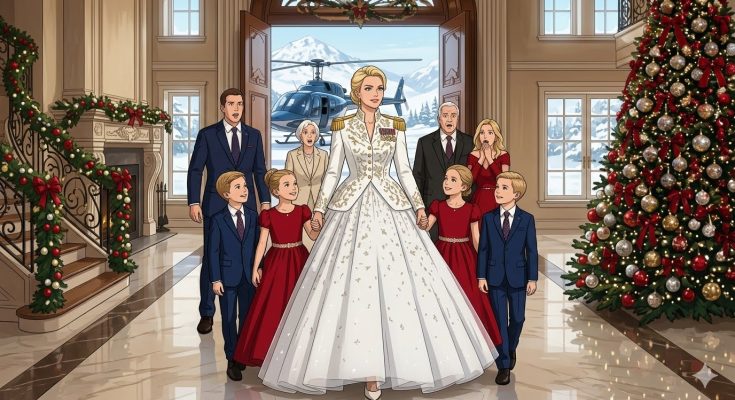
Snow was already drifting across the Colorado landscape when our SUV turned onto the private road leading toward the Montgomery estate on Christmas Eve.
The boys became unusually quiet as we approached.
Tall pine trees lined both sides of the road, their branches dusted white beneath the winter sky.
Small American flags had been positioned carefully along the drive, while warm Christmas lights wrapped around trees and illuminated the stone entrance ahead.
Everything looked exactly as I remembered it.
Grand.
Orderly.
Impressive.
And carefully designed to remind every visitor that the Montgomery family took its history seriously.
As our vehicle moved closer to the main house, the boys leaned toward the windows.
Through the enormous glass panels, we could already see the celebration underway.
Dozens of guests filled the rooms.
A magnificent Christmas tree, nearly twelve feet tall, stood in the center of the main hall, covered in warm lights and elegant ornaments.
People moved through the house carrying drinks and plates of food while holiday music played somewhere inside.
Mason pressed his face closer to the window.
His eyes widened as he studied the enormous stone house.
Then he gave a low whistle.
“This place looks like a museum.”
PART 2:
“Please do not touch anything that looks older than Grandma,” Reid whispered.
Owen giggled.
I tried not to.
My hands were shaking.
Not because I still loved Caleb.
That part of my life had ended years earlier.
I was shaking because four children were about to meet a family that should have known them from the beginning.
When the front doors opened, Caleb’s mother, Evelyn Montgomery, appeared first.
Her smile disappeared immediately.
She looked at me.
Then at Carter.
Then Mason.
Then Reid.
Then Owen.
All four boys had Caleb’s unmistakable gray eyes.
For several seconds, Evelyn said nothing.
Behind her, conversations gradually stopped.
Caleb appeared at the far end of the hall wearing his dress uniform.
His fiancée, Natalie, stood beside him in an elegant dark green dress.
Caleb smiled when he first saw me.
Then he noticed the children.
The smile vanished.
Carter looked at me once.
I nodded.
He stepped forward.
“Are you Caleb Montgomery?”
Caleb swallowed.
“Yes.”
Carter studied his face.
Then he asked calmly, “Are you the man who told everyone we weren’t real?”
The entire room went silent.
The silence inside the grand foyer of the Montgomery estate was absolute.
For a family that had built its entire identity around discipline, protocol, and an unyielding commitment to truth, the sudden collapse of Caleb’s grand narrative was a catastrophic event. Dozens of guests—decorated officers, extended family members, local civic leaders, and lifelong friends of the Montgomerys—stood frozen across the polished hardwood floors. Holiday cocktails remained halfway to frozen lips; laughter evaporated from the air. The faint, cheerful chime of a brass quartet playing from the adjacent ballroom felt absurdly out of place against the suffocating tension hanging over the main hall.
Natalie, standing beside Caleb in her emerald velvet gown, was the first to break the stillness. Her hand slowly dropped from Caleb’s arm, the bright, radiant smile she had worn all evening dissolving into utter confusion. She looked down at Carter, then across at Mason, Reid, and Owen, before turning her head sharply toward her fiancé.
“Caleb?” Natalie’s voice was barely a whisper, yet in the quiet hall, it cut with the precision of a blade. “What is this? Who are these children?”
Major Caleb Montgomery looked as though he had been hit by an artillery shell. The crisp, impeccable lines of his dress uniform offered him no protection against the four identical pairs of gray eyes staring back at him. His face had drained of all color, leaving his skin a sallow, chalky white. His lips parted, but no sound came out—only a shallow, desperate hitch of breath.
“Answer her, Caleb,” a voice commanded from the bottom of the grand staircase.
It was General Richard Montgomery, Caleb’s father. The patriarch of the family stepped slowly into the warm light of the foyer. His posture was rigid, his shoulders square, but the deep lines etched into his face had hardened into an expression of cold, formidable shock. He did not look at Caleb first; his gaze fell instantly upon the four eight-year-old boys standing side-by-side in front of the open oak doors.
Richard walked forward, his heavy dress shoes clicking rhythmically against the stone threshold. He stopped just two feet from where Carter stood. The old soldier’s eyes, weathered by decades of military service, scanned the four young faces before him.
The Montgomery genetics were undeniable. It was not merely the gray eyes—it was the sharp jawlines, the distinct double-crown in their dark brown hair, the quiet, observant set of their brows. They were not just Caleb’s sons; they were living, breathing mirrors of the historical photographs lining the wood-paneled walls behind them. They were Montgomerys, down to their very bones.
“My God,” Richard breathed out, his voice gravelly and trembling with an emotion he rarely permitted himself to feel.
Beside him, Evelyn Montgomery sank slowly down until one knee rested on the polished floor. The refined, untouchable matriarch of the estate seemed to forget about her pristine silk dress entirely. Her trembling fingers reached toward Carter, stopping just short of touching his coat, as if she feared the boys might vanish if she tried to hold them.
“Four of them,” Evelyn gasped, tears welling instantly in her eyes and spilling over her mascara. She looked up at me, her eyes wide with a horrific realization that had taken eight years to arrive. “Four… You didn’t have one baby. You had quadruplets.”
“I tried to tell him,” I said, my voice steady, calm, and completely devoid of anger. The shaking in my hands had stopped the moment Carter had spoken. Standing here now, surrounded by the weight of their grand estate, I felt no weakness—only an overwhelming, grounding clarity. “Eight years ago, when the doctor confirmed the ultrasound, I called Caleb. I told him we were having four children. I begged him to talk to me, to figure out how we were going to navigate something so life-changing together.”
A soft whisper ran through the crowd of guests like a cold draft.
“And what did you say to her, Caleb?” General Richard turned his head slowly toward his son. The quiet fury in the old man’s tone was far more terrifying than if he had shouted. “Tell me what you said.”
Caleb swallowed hard, his throat working against the tight collar of his uniform. He took a small step back, looking around the room as if searching for an exit, for a friendly face, for anything that might preserve the fragile illusion he had constructed. But no one stepped up to help him. His military peers stared at him with cold detachment; his friends looked away, embarrassed to be witnesses to his unspooling lie.
“I… I thought she was lying!” Caleb’s voice cracked, high and desperate, shattering the last remnants of his composed authority. “We were divorcing! Things were volatile! She called me saying she was pregnant with quadruplets—quadruplets! Do you have any idea how statistically impossible that sounded? I thought it was a trap, a hysterical ploy to stop the divorce papers from being signed! I told her to stop harassing me!”
“And when I stopped calling?” I asked softly, taking a single step forward, keeping my sons tucked safely at my side. “When I signed the papers without asking you for a single dime of child support, because I realized my children deserved a father who actually wanted them, rather than a man who saw them as a inconvenience to his career? What did you do then, Caleb?”
Caleb couldn’t answer.
“I’ll tell them what you did,” I continued, looking directly at Evelyn and Richard. “He built a story. He told you I was unstable. He told you I had fabricated a phantom pregnancy out of grief and desperation. He let you believe I was a bitter, broken woman living in isolation, clinging to a past that no longer existed. He brought you all here tonight to celebrate his bright new future, fully expecting me to walk through those doors alone, pathetic, and eager for a crumb of his family’s grace.”
Evelyn turned back toward her son, her face contorted in heartbreak and disgust. “You swore to us, Caleb. When the rumors floated around town eight years ago, your father and I asked you directly. We asked you if there was any chance—any chance at all—that she was carrying our grandchildren. You stood in our living room, in that very uniform, and gave us your word as an officer that it was all a lie!”
“Mother, please—” Caleb pleaded, his hands rising in a defensive gesture.
“Don’t you dare call me Mother right now!” Evelyn snapped, her voice ringing out across the grand foyer. The composure she was famous for had completely shattered. She looked back at the four boys, her hands hovering near Reid’s cheek. “Eight years… Eight years we missed. Their first steps. Their first words. Their first Christmases…”
“They didn’t miss anything, Evelyn,” I said gently, though firmly enough to draw her gaze back to mine. “They had love. They had security. They had a mother, a home, and a family that cherished them every single day of their lives. The only thing they missed out on was being raised by a man who valued his military reputation more than his own blood.”
Natalie, who had been standing in silence as the truth laid itself bare, took off her engagement ring. The diamond caught the light of the twelve-foot Christmas tree as she held it out in her palm.
“Natalie, wait—don’t do this here—” Caleb reached for her, his eyes wild with panic.
“Do not touch me, Caleb,” Natalie said, her voice dropping to a icy, lethal tone. She stepped toward a nearby marble console table and placed the ring heavily upon it. She looked at him with an expression of profound disappointment. “You didn’t just lie to your family. You built our entire relationship on a foundation of absolute cowardice. You let me believe you were a man of honor. But you’re just a coward in a nice uniform.”
Without waiting for a response, Natalie turned, grabbed her coat from the valet rack near the door, and walked out into the snow-dusted night, her heels clicking crisply down the stone steps.
Caleb stood frozen in the middle of the foyer, completely stripped of his dignity, his pride, his engagement, and the respect of every single person in the room. The silence returned, heavier now, suffocating and final.
Carter looked up at Caleb. There was no hatred in my eight-year-old’s eyes. There was no anger, no malice, no desire for vengeance. There was only a calm, observational clarity—the same eyes that had looked at my laptop screen just hours ago.
“You know,” Carter said, his voice easily carrying across the quiet room, “we made a fortress out of all the living room cushions today. It’s really strong. It took us three hours to build.”
Caleb stared down at his eldest son, completely paralyzed, unable to process the child’s words.
Carter held his head high. “We don’t need your house. Ours is better.”
Mason, Reid, and Owen all nodded in solemn agreement, standing shoulder-to-shoulder with their brother.
General Richard Montgomery lowered his head, a heavy, defeated breath escaping his chest. The proud old soldier looked up at me, his eyes filled with an unspoken, devastating apology. He knew there were no words that could undo eight years of deliberate absence. He knew that military medals, historic estates, and family pride meant nothing in the face of what his son had thrown away.
“If you ever… if you ever decide they should know their grandparents…” Richard’s voice was choked with emotion, a sight none of his military colleagues had ever witnessed before. “Our door is open. But we understand if you never come back.”
“They know who they are, General,” I replied calmly. “And that’s enough.”
I placed my hands gently on Carter and Mason’s shoulders, turning my boys back toward the snow-covered driveway where our SUV sat waiting, its headlights cutting brightly through the falling winter flakes.
“Come on, boys,” I said, my heart feeling lighter than it had in nearly a decade. “Let’s go home.”
We stepped out into the crisp, cold night air. Behind us, the heavy oak doors of the Montgomery estate remained wide open, exposing the ruined Christmas celebration inside to the icy Colorado wind. But as I strapped my four sons into their seats and climbed into the driver’s side, I didn’t look back once.
The engine hummed to life, heating the cabin, and as we pulled down the long, pine-lined driveway, past the tiny flags and bright holiday lights, the laughter in the backseat started up again. Mason began debating with Reid over who got to guard the main entrance of their cushion fortress, while Owen giggled at the memory of the gigantic Christmas tree.
I glanced in the rearview mirror, catching the bright, clear eyes of my four sons reflecting in the warm glow of the dashboard. The past was finally where it belonged—far behind us. Ahead was the only thing that mattered: our home, our family, and a Christmas built on unconditional love.
