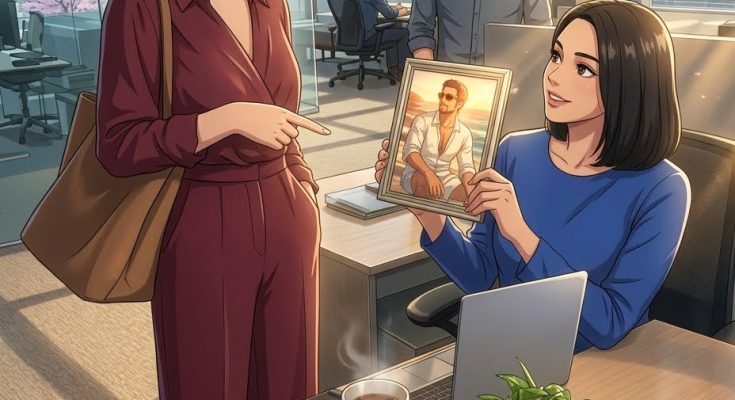
……….For a moment, I forgot where I was.
The office around me kept moving in its clean, expensive rhythm: keyboards clicking behind frosted glass, phones vibrating on walnut desks, the soft hiss of the espresso machine in the break area, someone laughing near the elevators about a client call that had gone too long. Outside the floor-to-ceiling windows, Midtown Manhattan looked washed in late-morning light, all steel, taxis, and ambition. It should have been the beginning of something good. A new title. A new team. A new office badge still warm from the printer and clipped to the lapel of my charcoal blazer.
Instead, I was standing beside a young woman’s desk, staring at a silver picture frame that had quietly opened the floor beneath my life.
The man in the photograph wore a navy polo shirt, one shoulder angled toward the camera, his smile caught halfway between confidence and tenderness. I knew the dimple on his left cheek. I knew the slight lift of his right eyebrow when he was trying not to laugh. I knew that shirt because I had bought it for him on our third wedding anniversary after he complained that most polos made him look like a country club dad. I knew the background too: blue water, palm trees, bright Maui sky. I had taken that photo myself.
Michael Davis.
My husband of seven years.
The same man who had stood behind me in our Upper West Side kitchen the night before, his arms around my waist, saying, “Tomorrow’s your big day, sweetheart. They’re lucky to have you.”
Now his face sat on another woman’s desk, polished under glass, placed beside a tiny potted succulent and a blush-colored planner.
I kept my smile on because it was all I had.
Maya Jenkins smiled back at me, warm and eager, completely unaware that she had just handed me a front-row seat to my own humiliation.
“That’s my boyfriend,” she said, touching the frame lightly with one finger. “Well, technically my fiancé now. His name is Michael. We’ve been together three years. He proposed last month.”
Three years.
The number did not hit like thunder. It entered quietly, clinically, and began rearranging everything I thought I knew. Three years meant Dallas. It meant late client dinners. It meant the weekends he had called “quick finance conferences.” It meant the birthday I spent alone because his flight had supposedly been delayed. It meant the quiet season when he grew less affectionate and I blamed stress, the market, his clients, our schedules, anything but the possibility that my husband had built another life so close to mine that I could walk into it on my first day at work.
“That’s wonderful,” I said.
My voice sounded normal. Almost too normal.
Maya lifted her left hand, and the diamond on her finger caught the office light. Radiant cut. Large, bright, confident. The kind of ring that announced itself before the woman wearing it entered a room.
My own wedding band was thin gold, plain by choice, or so I had believed. Michael used to say love did not need spectacle. “We’re not those people,” he told me when we got married at City Hall with a dinner afterward at a little Italian place in the West Village. I had loved him more for that. I had thought our simplicity was intimacy.
Looking at Maya’s ring, I understood something with the sharp clarity of injury.
He had never disliked spectacle.
He had simply reserved it for someone else.
Maya laughed softly, a little embarrassed by her own happiness. “He says he wants to give me the wedding I deserve. We’re looking at hotels in Midtown. I’m trying not to become one of those brides, but honestly, I already have three dress appointments.”
The office seemed to tilt.
I set my bag on my new chair slowly and sat down before my knees could reveal me. My desk was separated from hers by a frosted glass divider that blurred shapes without hiding sound. I opened my laptop, entered my password, and stared at the blank screen as if it held instructions for breathing.
Maya leaned slightly toward me.
“Sorry, I’m talking too much. First-day nerves, right? You must be overwhelmed.”
“You have no idea,” I said, still smiling.
She laughed because she thought it was a joke.
My name is Allison Davis. I was thirty-two then, senior marketing manager at TechSphere, a fast-growing tech firm on Madison Avenue with exposed brick walls, glass conference rooms, and a CEO who wore sneakers with Italian suits. I had spent a decade building a reputation for being calm under pressure. I could handle hostile clients, collapsing budgets, product delays, and executives who changed strategy twenty minutes before a presentation. I knew how to turn panic into a spreadsheet and chaos into a launch plan.
But nothing in my career had prepared me to sit three feet away from a woman who believed my husband was her future.
Maya was not cruel. That was the hardest part. She was twenty-six, maybe twenty-seven, with soft brown hair, careful makeup, and the kind of openness people either protect or exploit. She had welcomed me like a friend before she knew I had a reason to become anything else. Her desk was neat but personal: pastel sticky notes, a ceramic mug with lipstick on the rim, a framed quote about ambition, a bottle of perfume tucked near her monitor, and Michael’s photograph shining like evidence.
I wanted to hate her.
It would have been easier.
Instead, when she asked whether I wanted coffee from the break room, I heard myself say, “Black, if they have it.”
She came back with two cups and a story about how Michael preferred pour-over coffee but pretended to drink office coffee when he was “being humble.” I nodded at the right places. I asked questions because silence would have looked strange. I learned he had met her at a finance conference in Dallas. He had been a guest speaker. She had gone up afterward to ask for his contact information because she thought his panel comments were brilliant. He had been, according to her, “guarded but sweet.”
“He told me later he wasn’t looking for anything serious,” she said, smiling at the memory. “But I changed his mind.”
I felt my fingernails press into my palm beneath the desk.
Michael had been married four years when Maya met him.
Married to me.
He had worn his ring through that conference. I knew because I remembered helping him pack. He could never fold dress shirts correctly, so I did it while he stood in the doorway with his phone, answering emails. I put his charcoal suit in the garment bag. I placed his watch in the small leather case. I told him to bring a sweater because hotel conference rooms were always freezing. He kissed my forehead and said, “You take care of me too well.”
Apparently, I did.
By noon, I had learned enough to understand this was not confusion. Maya knew Michael as Michael Davis, investment consultant, bachelor, future husband. She had met some of his business contacts. She had traveled with him. She had been to Dallas, Miami, Napa, and Maui.
Maui.
I asked about the photo because I could not stop myself.
“That picture,” I said, keeping my voice light. “Where was it taken?”
Her whole face brightened.
“Maui. Last year. He surprised me with the trip after I helped him with a presentation. Isn’t it beautiful?”
I looked at the frame.
Last year, Michael told me he had a partners’ retreat in San Francisco. He came home tan and tired, carrying a box of chocolates from the airport for me. He said the hotel had a heated pool but he barely had time to use it. I teased him for getting sunburned during “strategy sessions.” He kissed my hand and told me I was suspicious by nature.
I had laughed.
The memory folded over itself, turning from sweet to humiliating in an instant.
“It is beautiful,” I said.
At lunch, the team took me to a small bistro two blocks away, the kind of place with exposed brick, hanging plants, and twelve-dollar iced tea. Everyone asked safe first-day questions. Where had I worked before? How did I like New York after Chicago? Was I ready for TechSphere’s pace? I answered smoothly. I even made Bob Sterling, my new department head, laugh when I compared onboarding decks to airport security lines: necessary, exhausting, and somehow always missing one important sign.
Across the table, Maya talked about her wedding.
Not constantly. Just enough.
A venue in Midtown. A white sheath dress she was considering. A possible fall date. Michael’s insistence that they find a place with skyline views because “a woman should remember the room where her life changes.”
I lifted my water glass and swallowed slowly.
My life was changing in a room with Edison bulbs and roasted garlic.
The team designer, Jordan, grinned at her. “Sounds like your guy is serious.”
“He is,” Maya said. “He’s been under so much pressure lately. He’s launching something big with investors, but he still makes me feel like I’m the center of his world.”
I nearly laughed.
Not because it was funny.
Because I had been the center too, apparently. Or one of them. A man like Michael did not divide love clumsily. He portioned it with precision, giving each woman the version she was most likely to believe.
That afternoon, in a conference room overlooking Park Avenue, I sat through a project briefing with my notebook open and my mind elsewhere. Bob walked me through campaign objectives, client expectations, media spend, and internal politics. I asked the right questions. I offered two immediate improvements to the launch schedule. Bob looked impressed.
“Good instincts,” he said when the meeting ended. “You’re going to be great here.”
I thanked him and returned to my desk.
Maya was typing with one hand and texting with the other. Her phone lit up, and though I did not try to read it, I saw enough to recognize the name.
Michael.
She smiled at the screen the way I used to.
The first rule of surviving a betrayal is simple: do not alert the person who thinks you are still blind.
I learned that rule in the elevator going down to the lobby that evening. My reflection stared back from polished steel. Tailored gray suit. Neat low bun. Burgundy lipstick. Calm face. No one would have known I had just spent eight hours sitting beside the woman my husband planned to marry.
My phone buzzed before I reached the sidewalk.
Michael.
How was the first day, beautiful?
I stared at the message until the letters blurred.
Yesterday, I would have sent him a paragraph. I would have told him about Maya, Bob, the office coffee, the campaign plan, the doorman who called me Ms. Davis instead of Mrs. Davis because my badge confused him. I would have complained about my heels. I would have asked if he wanted pasta or takeout.
Instead, I typed: Good. Busy.
His reply came quickly.
Proud of you. Dinner meeting tonight. Don’t wait up.
Dinner meeting.
I stood in front of the building while yellow cabs rolled by and pedestrians moved around me like water around stone.
Okay, I wrote. Good luck.
Then I turned off my notifications and took the subway home.
Our apartment looked exactly the way it had that morning and nothing like home. The gray velvet sofa. The oak dining table. The framed Sedona landscape we bought on our fifth anniversary. The expensive espresso machine Michael insisted was “a long-term investment.” The wedding photo in the hallway, both of us smiling outside City Hall, my hair windblown, his hand around mine.
I stood beneath that photo for a long time.
Then I walked into the bedroom and opened his closet.
I did not tear through it. I did not throw clothes to the floor. I moved carefully, methodically. Suits arranged by color. Polos folded in drawers. Travel bags on the top shelf. Shoe trees tucked into Italian loafers. Michael believed in order. That had always comforted me. Now I understood order could be another kind of disguise.
In the inner pocket of the charcoal suit he had worn to Dallas, I found a receipt.
Omakase dinner. Manhattan. Three weeks earlier. Five hundred fifty dollars.
That night he had told me he was taking potential investors out and might be home late.
I sat on the edge of the bed with the receipt in my hand.
A lesser pain might have made me cry.
This one made me precise.
I took a photo of the receipt and saved it to a new folder on my phone. Then I opened my laptop and created a spreadsheet. Date. Claim. Evidence. Amount. Related Person. Notes.
The first line was Dallas conference.
The second was Maui photo.
The third was dinner receipt.
By the time Michael came home at 10:43, I had ten entries and a face calm enough to fool him.
He walked in smelling faintly of expensive sushi and winter air. He loosened his tie and smiled when he saw me reading on the sofa.
“You’re still awake.”
“Couldn’t sleep.”
He bent to kiss my forehead. “Big day.”
“Yours too?”
“Brutal dinner,” he said, walking toward the kitchen. “Singapore investors. They like to talk in circles.”
I watched him pour water, roll his shoulders, check his phone discreetly near the island.
“Did it go well?”
“Productive,” he said.
That word.
I almost admired him. Truly. He lied with the ease of a man who had practiced in mirrors for years.
He sat beside me, draped an arm across the back of the sofa, and asked about TechSphere. I told him the team seemed sharp. I mentioned Bob Sterling, the campaign, the office layout, the bistro. I did not mention Maya.
Not yet.
When he touched my shoulder, I did not pull away. I let his hand rest there because evidence requires patience, and patience sometimes requires sitting beside the person who has already left you in every meaningful way.
The next morning, he left his phone face up on the kitchen island for twelve seconds while he rinsed his coffee mug.
That was all it took.
A message lit the screen.
Maya: Can’t wait for tonight.
I looked away before he turned back.
He slipped the phone into his pocket and kissed me goodbye.
“Late again?”
“Probably,” he said. “Back-to-back pitches.”
“Of course.”
At work, Maya arrived glowing.
She wore cream trousers, a silk blouse, and the engagement ring that flashed every time she moved her hand. Around ten, she leaned over the divider.
“Allison, you have to hear this.”
I looked up.
“Michael took me to the most amazing omakase place last night. He said we hadn’t had a proper date in weeks.”
My hand stilled over the keyboard.
“That’s sweet.”
“He works too hard, but he always finds a way to make me feel special.”
There it was.
The receipt, given a voice.
By noon, I had stopped wondering whether I was wrong. By five, I followed Maya from the lobby at a careful distance, standing behind the glass doors while she waited at the curb. A black Audi pulled up. Michael stepped out, sleeves rolled, face bright with the charm he used when he wanted the world to forgive him before knowing why.
Maya threw her arms around his neck.
He kissed her hair.
Then he opened the passenger door for her like a gentleman.
I stood less than fifty feet away.
The doorman beside me asked if I needed help getting a cab.
“No,” I said. “I found what I needed.”
That evening, I went to Washington Square and met Sarah Levin in our usual corner booth at a quiet coffee shop. Sarah had been my best friend since college and one of the most feared family law attorneys in Manhattan. She had the rare gift of listening without making sympathy feel like pity.
I told her everything.
When I finished, she put both hands flat on the table.
“Do not……………
PART 3: I LET HIM INTRODUCE HIS FIANCÉ
“I know.”
“Good. Because if you go home and throw that receipt at him, he’ll deny, minimize, move money, and make you look unstable.”
I took a sip of coffee though it had gone cold.
“What do I do?”
Sarah’s eyes sharpened.
“Money. Time. Cohabitation. Track where he was, what he claimed, what he spent, and whether he presented this relationship as permanent. If he used marital funds for her, that matters. If he created a business entity and gave her ownership using your shared resources, that matters even more.”
I stared at her.
“What makes you say business entity?”
“Men like Michael don’t build second lives without financial structure.”
By the next morning, I understood exactly what she meant.
I downloaded twelve months of statements from our joint account. Groceries. Mortgage. Utilities. Dry cleaning. Restaurants. Travel. Then wire transfers. One thousand here. Three thousand there. Repeated payments to M. Jenkins.
Maya Jenkins.
Forty-five thousand dollars in one year.
Then, from our high-yield savings account, a transfer that made my pulse slow instead of quicken.
Fifty thousand dollars to Hudson Luxury Developments.
The condo.
The “investment property” Michael had mentioned over dinner two weeks earlier. He had said buying early in Hudson Yards was smart. I had nodded, trusting the man who handled most of our aggressive investments. Now I saw the shape of it. He had used our money to place a foundation under his next life.
I sent the statements to Sarah through encrypted email.
She called immediately.
“Allison,” she said, “this changes everything.”
“I know.”
“No, I mean legally. If he’s diverting marital assets to another woman, buying real estate, and setting up for a separate future, we have leverage.”
I looked at the spreadsheet.
“I want all of it documented.”
“Good. Keep going.”
The next week became a performance in restraint.
At home, I kissed Michael’s cheek and asked about his “clients.” At work, I reviewed campaign decks beside Maya while she told me about cake tastings, condo views, and how Michael wanted her to choose between two wedding bands because “he said I deserve options.” I approved ad copy, led strategy meetings, and built a private case file during lunch breaks.
Then Maya handed me the final piece herself.
“Allison,” she said one Thursday, rolling her chair closer, “can you look at something? Professionally?”
“Sure.”
She emailed me a pitch deck.
M&M Capital Partners.
The logo was sleek. The language polished. The founder bio had Michael’s name, his credentials, his projected assets under management. I scrolled to the structure page.
Chief Executive Officer: Michael Davis.
Director of Operations: Maya Jenkins.
Equity Stake: 20%.
For a moment, the office noises disappeared again.
Michael had not merely given her dinners and diamonds.
He had given her ownership.
With money I had helped earn.
Maya watched my face anxiously. “Is it bad?”
I closed the deck and smiled.
“The branding is clean. Investors will understand the story quickly.”
She exhaled with relief. “Thank God. Michael’s so nervous. This launch party Friday could change everything for us.”
“Yes,” I said. “I imagine it could.”
That night, I stood outside a frosted glass door on the eighth floor of a boutique Midtown building and listened to my husband pitch his new firm to a potential backer. Maya’s voice joined his occasionally, bright and eager, practicing the role of partner. Not girlfriend. Not assistant. Partner.
When I returned home, Michael was already there, barefoot in the kitchen, pretending to be tired.
“You’re late,” he said.
“So are you most nights.”
He smiled, missing the edge. “Fair.”
“Big plans Friday?”
He glanced up. A small pause. “Networking thing. Boring finance crowd.”
“Important?”
“Could be.”
“I hope it goes well.”
His face softened. “You’re always supportive.”
I looked at him and thought of Maya’s ring, the condo wire, the M&M pitch deck, the Maui photograph on her desk.
“Always,” I said.
Friday arrived slowly.
Maya left the office early to get ready, carrying a garment bag and a joy so pure it made me ache for the girl she had been before Michael stepped into her life with borrowed promises. I almost told her then. I almost pulled her into a conference room and laid the truth on the table gently, privately, like a doctor delivering bad news.
But Michael’s investors would be there that night.
His new firm would be there.
The money would be there.
And after three years of quiet deception, I was done protecting him from public truth.
I left at four, went to a salon, and let a stylist smooth my hair into a low sleek knot. I wore a black Tom Ford dress that fit like armor. No bright colors. No drama. Just clean lines, red lipstick, and the diamond earrings I bought myself after closing the largest campaign of my career.
At 7:42, I walked through the brass doors of the Plaza Hotel.
The event suite glowed with warm light. Waiters moved between investors with champagne. A jazz trio played softly near the windows. At the front of the room, a screen displayed the M&M Capital Partners logo. Michael stood beneath it in a midnight-blue tuxedo, laughing with a cluster of men in expensive suits. Maya stood beside him in white, one hand on his arm, her ring flashing like a small, bright lie.
I paused at the registration table.
“Name?” the attendant asked.
I picked up a marker and wrote slowly.
Allison Davis.
Then I placed the name tag on my dress and walked in.
Michael saw me before Maya did.
It was beautiful, in a terrible way, watching him understand.
His smile vanished. His face lost color. His hand tightened around the champagne glass. The older investor beside him noticed and followed his gaze.
Maya turned.
“Allison?” she said, confused. “What are you doing here?”
I stopped three feet away.
“Aren’t you going to introduce us, Michael?”
He opened his mouth.
Nothing came out.
Maya looked between us. “You know each other?”
“Yes,” I said softly. “Very well.”
Michael finally moved. “Allison, let’s talk outside.”
“Why?” I asked. “This is your launch party, isn’t it? Your investors are here. Your partner is here. Your fiancée is here.”
Maya’s expression faltered.
Then I looked at her, and I let my voice carry just enough.
“But I think everyone should also meet your wife.”
The room changed.
Not loudly at first. Conversations thinned. A glass stopped halfway to someone’s mouth. The jazz trio kept playing for two more bars, then softened awkwardly into silence.
Maya’s hand dropped from Michael’s arm.
“Wife?” she whispered.
I turned to the investors.
“My name is Allison Davis. I have been married to Michael for seven years.”
An older man in a gray suit looked at Michael sharply. “Michael, is that true?”
Michael’s face was damp at the temples.
“This is a personal matter,” he said. “It has no relevance to—”
“It has financial relevance,” I said.
I opened my clutch and removed a folded packet of statements. Not everything. Just enough.
I laid them on the cocktail table.
“Wire transfers to Maya Jenkins from our joint accounts. A condo deposit from marital savings. Startup funds diverted into this new company. And a pitch deck listing Maya as an equity partner in a business capitalized, at least in part, by money that belongs to the marriage.”
No one spoke.
Maya stared at the papers as if they might rearrange themselves into mercy.
“You told me you were single,” she said to Michael.
He reached for her. “Maya—”
She stepped back.
“You told me you were going to marry me.”
“Allison is making this look worse than it is.”
That was the first thing he said that made me truly angry.
Not to me.
To her.
Even then, he was trying to bend the room.
I looked at Maya. “I found out my first day at TechSphere. The photo on your desk was from Maui. I took it. It used to sit in my bedroom.”
Her face crumpled.
The investor in the gray suit set his drink down with quiet finality.
“If marital funds are disputed and this entity is exposed to litigation,” he said, “we’re out.”
“Jim,” Michael said quickly. “This can be managed.”
Another investor shook his head. “Not by us.”
The exit began slowly, then all at once. Men collected coats. Women exchanged glances. A few people avoided my eyes. Others looked at me with something like respect. Within minutes, the room that had been designed to launch Michael’s new life had emptied into a corridor full of murmurs.
Maya stood near the screen, crying silently.
Michael looked smaller beneath the logo.
“Allison,” he said. “Please.”
I turned toward him.
“Do not ask me for privacy now. You spent three years using secrecy like a second home.”
He flinched.
Maya wiped her face and looked at me.
“You knew when I showed you the ring?”
“Yes.”
“And you sat next to me every day?”
“I was trying to understand what he had done,” I said. “I’m sorry you were part of it.”
Her pain shifted then. Not toward forgiveness. Toward comprehension.
“He said you were an ex who wouldn’t move on,” she whispered. “He said the marriage was over in everything but paperwork.”
I laughed once, softly. “He came home to me every night.”
She closed her eyes.
Then she took off the engagement ring and placed it on the cocktail table beside the bank statements.
“I don’t want anything he bought with your money,” she said.
For the first time since I saw that photograph, I felt something loosen in my chest.
Michael stepped toward her. “Maya, baby—”
“Don’t,” she said.
One word.
It stopped him.
She walked out without looking back.
Then it was only Michael and me, standing under the M&M logo while the city glittered beyond the windows.
His voice changed. The charm was gone. “Are you happy now?”
I looked at him, really looked, at the man I had loved, defended, trusted, and unknowingly financed into someone else’s future.
“No,” I said. “But I am done being useful to your lies.”
His eyes hardened. “You ruined me.”
“No, Michael. I documented you.”
He had no answer.
That night, he came back to the apartment just after midnight. I was standing on the balcony, the Hudson dark below, the city lights trembling on the water. He joined me without speaking. His tuxedo jacket was gone. His bow tie hung loose. He looked like a man who had walked out of a room where every mirror had finally told the truth.
“Did you have to do it in front of everyone?” he asked.
I did not look at him.
“Did you have to do it behind my back for three years?”
The wind moved between us.
“I’m sorry,” he said.
I waited to feel something.
I felt tired.
“That may be true,” I said. “But it is late.”
He gripped the railing.
“I never meant to hurt you like this.”
“No. You meant to have both lives until one became more convenient.”
He closed his eyes.
“My lawyer will contact you Monday,” I said. “We are separating. The apartment will be addressed legally. The funds you diverted will be accounted for. And you will not move another dollar without my attorney seeing it.”
He looked at me then, startled by the calm in my voice.
Maybe he expected screaming. Tears. Begging. The familiar proof that he still mattered enough to break me visibly.
I gave him none of it.
“Allison,” he said.
I finally turned.
“On my first day at TechSphere,” I said, “I asked Maya who was in the picture. She told me he was the man she was going to marry.”
His face tightened.
“I smiled,” I continued. “I sat beside her. I listened. I learned. I waited. And tonight, for the first time in three years, you did not control the story.”
The city below us roared softly, indifferent and alive.
Michael went inside first.
I stayed on the balcony until the cold made my fingers numb. I did not know exactly what my life would become after the lawyers, the apartment sale, the financial accounting, the quiet mornings without his coffee cup beside mine.
But I knew one thing.
The woman who walked into TechSphere that Monday morning had been a wife who trusted the wrong man.
The woman standing over the Hudson that night was something else.
Not broken.
Not bitter.
Awake……………
PART 4: SHE WASN’T THE FIRST WIFE
He did not vanish in the dramatic way people imagine. There was no abandoned car, no disconnected phone found in a park, no police tape. He simply stopped showing up to the life he had spent years constructing.
His office told clients he was taking an unexpected leave. His assistant claimed she had not heard from him since Friday night, and even the private gym he visited almost every morning confirmed his membership card had not been scanned once.
For a man obsessed with schedules and appearances, silence felt unnatural. It was almost as if someone had erased him carefully, leaving behind only questions.
Sarah arrived at my apartment on Monday carrying two coffees and a thick legal folder. She placed it on the kitchen island without speaking, then looked at me with an expression I had never seen before.
“He hired a divorce attorney,” she said quietly. “But the attorney withdrew before filing a single document.”
I frowned. “Why would anyone do that?”
Sarah slid a letter toward me. “No explanation. No forwarding address. Just a notice that representation had been terminated less than twelve hours after it began.”
She leaned closer. “Rich men who are guilty still hire lawyers. Men who disappear usually have something much bigger to hide.”
The conversation stayed with me all day at TechSphere. Everyone whispered about the disaster at the Plaza, but no one dared ask me what had really happened.
Bob treated me exactly as before, assigning me the company’s biggest account without hesitation. Maya barely spoke to anyone anymore, moving through the office like someone still trying to wake up from a nightmare.
Thursday morning, an envelope appeared on my desk.
There was no stamp, no company logo, no return address. Only my first name written in neat black handwriting that looked strangely familiar.
Inside was a photograph.
It showed me leaving my apartment building six months earlier, carrying grocery bags and glancing over my shoulder. The angle made one thing painfully clear: whoever took it had been watching me from across the street.
My pulse slowed instead of racing.
On the back of the photograph, someone had written four words.
YOU WERE NEVER FIRST.
I slipped the picture into my bag before anyone noticed my expression.
That afternoon, Maya walked to my desk and asked if we could talk somewhere private. Her engagement ring was gone, and the hopeful woman I had met on my first day seemed to have disappeared with it.
She opened her laptop inside an empty conference room and pulled up an insurance document she had accidentally discovered while deleting shared files.
“I don’t understand it,” she whispered. “But I think you need to see this.”
The beneficiary section listed a woman neither of us recognized.
Primary Beneficiary: Evelyn Cross. Relationship: Spouse.
I stared at the screen for several seconds before speaking.
“This has to be a mistake.”
Maya shook her head. “The document was filed eighteen months ago.”
My mind tried desperately to make sense of impossible math.
Michael had been married to me for seven years. He had been engaged to Maya for three. Now an official legal document identified another woman as his wife only eighteen months earlier.
Three women.
One man.
One timeline that should not have existed.
I called Sarah immediately.
The moment I read the name Evelyn Cross aloud, she fell silent.
When she finally spoke, her voice had changed.
“Allison… don’t leave that conference room.”
“Why?”
“I’ve seen that name before.”
My grip tightened around the phone.
Sarah took a slow breath.
“Five years ago I handled a probate dispute. The widow’s name was Evelyn Cross.”
“What does that have to do with Michael?”
“The deceased was her husband.”
I felt my heartbeat echo inside my ears.
Sarah continued softly.
“His name was Michael Davis.”
For a long moment, neither Maya nor I moved.
“There are thousands of men named Michael Davis,” I finally whispered.
“There are,” Sarah replied. “But not many born on August seventeenth, nineteen eighty-five.”
Every sound inside the conference room disappeared.
According to court records, Evelyn’s husband had died in a boating accident in Connecticut five years earlier.
Five years ago, I was living with Michael in Manhattan.
Five years ago, he kissed me goodbye every morning before work.
Five years ago, he was very much alive.
That night I returned to an apartment that no longer felt familiar.
Half his suits were gone. His watches had disappeared. The empty spaces in the closet looked deliberate, as though someone had planned this exit long before I discovered the truth.
Just before midnight, the building intercom buzzed.
The concierge sounded uncertain.
“Mrs. Davis… there’s a gentleman downstairs asking for you.”
“I don’t know any gentleman.”
“He says he’s Michael’s brother.”
I stood perfectly still.
Michael had always insisted he was an only child.
Before I could answer, the concierge added one final sentence.
“He told me to tell you that if you want to stay alive… you should leave before sunrise.”
At that exact moment, every light inside the apartment went dark.
The entire floor lost power.
Then my phone vibrated.
An unknown number.
One message.
DON’T TRUST THE MAN DOWNSTAIRS.
A second message appeared before I could breathe.
HE HELPED MICHAEL BURY THE FIRST WIFE……..
PART 5 – THE BROTHER WHO SHOULDN’T EXIST
The apartment was completely dark.
Not dim.
Not shadowed.
Dark.
The kind of darkness that makes familiar rooms feel unfamiliar.
For several seconds, I stood frozen beside the kitchen island, staring at my phone screen as if the glow itself could protect me.
The last message still sat there.
HE HELPED MICHAEL BURY THE FIRST WIFE.
My pulse pounded against my ribs.
Downstairs, a man claiming to be Michael’s brother was waiting for me.
A brother Michael had sworn did not exist.
And somewhere else, an unknown person knew enough to warn me about him.
The silence inside the apartment felt wrong.
The city never truly went quiet.
There should have been elevators moving.
Voices in the hallway.
The distant hum of electricity.
Instead, there was nothing.
Then came a soft knock.
Three slow taps.
Not at the apartment door.
At the balcony glass.
I spun around.
My heart nearly stopped.
Nothing.
Only my reflection staring back at me through the darkness.
A frightened woman holding a phone.
The knock did not come again.
I realized it had probably been a loose branch scraping against the building.
Or at least I hoped it was.
The intercom buzzed again.
I jumped.
The concierge sounded even more nervous than before.
“Mrs. Davis?”
“Yes.”
“The gentleman downstairs says time is important.”
I swallowed.
“What does that mean?”
A pause.
Then the concierge answered.
“He said Michael isn’t missing.”
Every muscle in my body tightened.
“What?”
“He said Michael is running.”
The line went dead.
I stared at the receiver.
Running.
Not missing.
Running.
The difference between those two words felt enormous.
My phone vibrated again.
Unknown Number.
IF YOU GO DOWNSTAIRS ALONE, YOU’LL REGRET IT.
Another message arrived instantly.
HE IS NOT WHO HE SAYS HE IS.
I closed my eyes.
Two warnings.
Two opposite directions.
Two strangers telling me not to trust the other.
Someone was lying.
The question was who.
A minute later, Sarah answered on the first ring.
“Allison?”
I explained everything.
The blackout.
The messages.
The man downstairs.
The supposed brother.
Sarah listened without interrupting.
When I finished, she was quiet for several seconds.
Then she said something unexpected.
“Meet him.”
“What?”
“Meet him.”
“Sarah—”
“But don’t meet him alone.”
I looked around the dark apartment.
“How exactly do you suggest I do that?”
“I’m coming over.”
“You live forty minutes away.”
“Then keep the door locked for forty minutes.”
The call ended.
I checked every lock twice.
Then three times.
The next thirty-eight minutes felt longer than the previous three days combined.
Every sound made me flinch.
Every vibration of my phone felt like another warning.
At 12:47 a.m., Sarah arrived.
The moment she stepped into the apartment, everything felt slightly more manageable.
She carried a leather briefcase in one hand and pepper spray in the other.
“You brought pepper spray?”
She looked at me.
“You married a man with three possible wives.”
“Fair point.”
Ten minutes later, we entered the elevator together.
The emergency lights had come on, bathing everything in a pale yellow glow.
Neither of us spoke during the descent.
The lobby was nearly empty.
Only the night concierge remained behind the desk.
And a man sitting alone near the windows.
He stood when he saw us.
For a second, I couldn’t breathe.
Because he looked exactly like Michael.
Not identical.
But close enough to make my stomach drop.
Same height.
Same dark hair.
Same eyes.
The resemblance was unmistakable.
The man noticed my reaction.
“They always react like that.”
His voice was rougher than Michael’s.
Older somehow.
He extended his hand.
“My name is Daniel.”
I didn’t take it.
“You claim you’re Michael’s brother.”
“I am.”
“Michael said he was an only child.”
Daniel laughed.
A short humorless sound.
“Michael says a lot of things.”
Sarah stepped forward.
“Why are you here?”
Daniel looked directly at me.
“Because you’re in danger.”
There it was.
The sentence every person in every bad movie says before things become worse.
I folded my arms.
“Then start explaining.”
He reached inside his coat.
Sarah immediately stiffened.
Daniel slowly removed a worn photograph.
Nothing else.
Just a photograph.
He handed it to me.
The moment I looked at it, the air seemed to leave the room.
Three people stood together on a dock beside a lake.
A younger Michael.
Daniel.
And a woman.
Blonde hair.
Blue eyes.
Wide smile.
The woman from the insurance document.
Evelyn Cross.
The date printed in the corner made my pulse stop.
The photograph had been taken six years ago.
One year after Evelyn supposedly buried her husband.
One year after Michael supposedly died.
I looked up slowly.
“What is this?”
Daniel’s face darkened.
“The beginning.”
“The beginning of what?”
“The truth.”
Sarah took the photograph from my hand.
Her expression changed instantly.
“What aren’t you telling us?”
Daniel glanced toward the lobby entrance.
For the first time, he looked genuinely nervous.
“We don’t have much time.”
“Why?” I asked.
He lowered his voice.
“Because if Michael knows I found you first…”
The front doors suddenly slid open.
All three of us turned.
A woman entered the building.
Dark coat.
Baseball cap.
Head lowered.
She stopped the moment she saw Daniel.
Daniel’s face lost all color.
“No.”
The word escaped him like a prayer.
The woman slowly removed her cap.
My heart nearly stopped.
I recognized her immediately.
So did Sarah.
So did Daniel.
Because standing inside the lobby…
very much alive…
was Evelyn Cross.
And she looked terrified.
“Run,” she whispered.
Then the glass doors behind her exploded inward.
PART 6– EVELYN CROSS
The sound of shattering glass echoed through the lobby.
For one frozen second, nobody moved.
Evelyn stood in the doorway, breathing hard, tiny pieces of glass glittering around her shoes.
“Run!” she shouted again.
Daniel grabbed my arm.
“Move!”
Sarah didn’t hesitate.
She shoved me toward the elevator corridor.
“What the hell is happening?” I yelled.
“No time!” Daniel barked.
Behind us, several dark figures stepped through the broken entrance doors.
Not police.
Not security.
Three men in black jackets.
Purposeful.
Silent.
The kind of men who looked like they already knew exactly where they were going.
And exactly who they were looking for.
Evelyn turned and sprinted toward us.
One of the men shouted.
“Stop her!”
The entire lobby exploded into motion.
The concierge dove behind his desk.
An alarm began screaming somewhere above us.
Daniel pushed the emergency stairwell door open.
“Inside!”
We stumbled into the stairwell.
The heavy metal door slammed shut behind us.
For a moment, all I could hear was our breathing.
Then footsteps.
Fast.
Coming from the lobby side.
“They’re following us,” Evelyn whispered.
Sarah stared at her.
“Who are they?”
Evelyn’s face was pale.
“Michael’s cleanup team.”
Nobody spoke.
Even Daniel looked disturbed.
“You told them?” he asked.
“I didn’t have a choice.”
Daniel cursed under his breath.
We started climbing.
Not down.
Up.
Thirty floors above Manhattan.
The stairwell lights flickered.
Every step echoed.
Every sound felt too loud.
My lungs burned.
Questions crashed through my head.
Michael’s cleanup team.
The first wife.
The fake death.
The mysterious brother.
Nothing made sense anymore.
Finally, we reached an empty maintenance level.
Daniel forced open the door.
The room beyond was dark and filled with HVAC equipment.
Nobody would come here voluntarily.
Which made it perfect.
Sarah immediately locked the door behind us.
Then she turned toward Evelyn.
“Start talking.”
Evelyn looked exhausted.
Like someone who had spent years running.
Maybe she had.
Her eyes landed on me.
“You must be Allison.”
I nodded.
For several seconds she simply stared.
Then she looked away.
“I’m sorry.”
The words confused me.
“For what?”
Her expression broke.
“For being too late.”
Silence filled the room.
“What does that mean?” I asked.
Evelyn took a shaky breath.
“Because if I had found you sooner, you never would have married him.”
The room went completely still.
Sarah crossed her arms.
“Let’s begin with something simple.”
She pointed directly at Evelyn.
“Who are you?”
Evelyn closed her eyes.
Then she answered.
“My real name is Evelyn Cross.”
I expected relief.
Instead, the tension grew worse.
Because she continued.
“And I was married to Michael Davis.”
Nobody spoke.
Not even Daniel.
“I married him nine years ago.”
My stomach dropped.
Nine years ago.
That meant before me.
Before Maya.
Before everything.
Evelyn looked directly at me.
“When I saw your wedding photo online three years later, I thought I was losing my mind.”
The room spun.
“What?”
She nodded slowly.
“I thought Michael was dead.”
The words landed like a bomb.
Daniel sat down heavily.
Sarah stared at Evelyn.
“Explain.”
Evelyn’s hands trembled.
“Five years ago Michael disappeared during a boating trip in Connecticut.”
The same story Sarah had mentioned.
The same story from the court records.
“The police found debris.”
She swallowed.
“They found blood.”
I felt cold.
“But they never found a body.”
Nobody interrupted.
“I spent almost a year grieving.”
Tears appeared in her eyes.
“I buried an empty coffin.”
My pulse pounded.
Then Evelyn said the sentence that changed everything.
“Eight months after the funeral, I received a photograph.”
My heart stopped.
“A photograph of Michael.”
She looked directly at me.
“Alive.”
The room became silent.
The exact same thing had happened to me.
A photograph.
A warning.
Proof.
Evelyn reached into her coat.
Slowly.
Carefully.
Then she removed an old envelope.
The paper was worn from being handled countless times.
Inside were photographs.
She handed them to me.
The first showed Michael entering a hotel.
Alive.
The second showed him leaving a restaurant.
Alive.
The third showed him holding hands with another woman.
Not me.
Not Maya.
Someone else.
A completely different woman.
The photo was dated six months after his funeral.
I felt sick.
“Who is she?”
Evelyn’s eyes filled with sadness.
“I never found out.”
Daniel leaned forward.
“How many?”
Evelyn looked at him.
“What?”
“How many women?”
Her answer came quietly.
“I stopped counting.”
Nobody spoke.
Because suddenly every lie felt much larger.
This wasn’t a husband having an affair.
This wasn’t even a double life.
It was a pattern.
A system.
A business.
A profession.
Michael wasn’t building relationships.
He was collecting them.
Using them.
Replacing them.
Sarah finally broke the silence.
“What exactly was Michael after?”
Evelyn’s expression darkened.
“Money.”
I almost laughed.
Not because it was funny.
Because it was too simple.
Money.
All of this for money.
The marriages.
The fake deaths.
The disappearances.
The new identities.
The women.
The companies.
The condos.
Everything.
Money.
Evelyn nodded.
“He targeted successful women.”
I felt my stomach twist.
“Professionals.”
She pointed at me.
“Marketing executive.”
Then toward Maya, who wasn’t even there but somehow still felt part of the story.
“Young rising professional.”
Then herself.
“I owned a chain of wellness clinics.”
Sarah understood before I did.
“Oh my God.”
Evelyn nodded.
“He wasn’t looking for love.”
The room felt colder.
“He was looking for assets.”
Nobody moved.
Nobody spoke.
Then Daniel said something that made every previous revelation seem small.
“Tell her the rest.”
Evelyn stared at the floor.
“No.”
“You have to.”
Her face tightened.
“No.”
“She deserves to know.”
I stepped forward.
“Know what?”
Evelyn looked at me.
And for the first time since entering the building, she looked terrified.
Not frightened.
Terrified.
When she finally spoke, her voice barely existed.
“Michael isn’t running.”
The room froze.
My pulse hammered.
“What do you mean?”
Evelyn swallowed.
Then she whispered:
“Because Michael Davis isn’t his real name.”
The maintenance room fell silent.
Nobody breathed.
Nobody moved.
Then Evelyn slowly pulled a folded FBI document from her coat.
Across the top, in bold black letters, were two words.
MULTIPLE IDENTITIES.
Beneath them sat six different photographs.
Every photograph was the same man.
My husband.
Maya’s fiancé.
Evelyn’s husband.
But under each photo…
there was a different name.
And at the bottom of the page, highlighted in yellow, was a sentence that made my blood run cold:
SUBJECT IS BELIEVED TO HAVE MARRIED AT LEAST SEVEN WOMEN UNDER FALSE IDENTITIES.
Seven.
I stared at the page.
Then at Evelyn.
Then at Daniel.
And finally at the photograph of Michael.
The man I thought I knew.
The man none of us had ever truly known.
At that exact moment, someone began pounding on the maintenance room door.
Three heavy blows.
The metal shook.
Then came a voice.
A voice I would have recognized anywhere.
A voice that should not have been there.
A voice that made every hair on my body stand up.
“Allison.”
Michael.
“Open the door.”
PART 7 – THE MAN BEHIND THE NAMES
Nobody moved.
Nobody breathed.
The pounding on the maintenance room door stopped.
For a moment, the silence felt worse.
Because now we were waiting.
Waiting for the next sound.
The next lie.
The next truth.
Then Michael’s voice came again.
Calm.
Controlled.
Exactly the way it always sounded when he wanted people to trust him.
“Allison.”
My heart hammered.
“You need to leave with me.”
Sarah immediately stepped in front of me.
“No.”
Michael laughed softly from the other side of the door.
“You were always protective, Sarah.”
The sound froze all of us.
He knew her name.
Sarah’s face hardened.
“How long has he been watching us?”
Evelyn answered quietly.
“Years.”
The room seemed to shrink.
Daniel moved toward the door.
“Don’t.”
Evelyn grabbed his arm.
“He wants us to open it.”
The metal handle suddenly turned.
Once.
Twice.
Then stopped.
Locked.
For now.
Michael sighed.
“Listen carefully.”
His voice remained calm.
“Everything Evelyn told you is a lie.”
Evelyn’s face filled with anger.
“Of course he would say that.”
“She’s manipulating you, Allison.”
I found my voice.
“Manipulating me?”
“Yes.”
I laughed.
It sounded strange even to me.
“You married multiple women.”
“You don’t know that.”
“I saw the documents.”
“Evelyn showed you documents.”
The distinction hit harder than I expected.
Because technically he was right.
I hadn’t found them.
Evelyn had.
And for the first time all night, a small seed of doubt appeared.
Michael heard the silence.
He immediately pushed harder.
“Ask yourself one question.”
Nobody spoke.
Then he continued.
“If I’m such a criminal, why would I come here?”
The room fell quiet.
Because it was a fair question.
Dangerous people usually ran.
They didn’t walk directly into traps.
Evelyn stepped forward.
“Because you’re desperate.”
“No.”
His answer came instantly.
“Because she’s finally getting close.”
My stomach tightened.
“What does that mean?”
No response.
Then:
“Ask Evelyn what happened to Rachel.”
The room froze.
Evelyn went pale.
Completely pale.
The reaction was immediate.
Visible.
Terrifying.
Daniel stared at her.
“Evelyn?”
She didn’t answer.
Michael’s voice returned.
“Ask her.”
Nobody moved.
Nobody spoke.
Finally I looked directly at Evelyn.
“Who is Rachel?”
Her lips parted.
Then closed.
For several seconds she couldn’t answer.
That frightened me more than anything Michael had said.
Because for the first time all night, Evelyn looked guilty.
Sarah noticed too.
“Answer the question.”
Evelyn sat down heavily.
Her hands trembled.
“Oh God.”
The words barely escaped her.
Michael’s voice came through the door.
“Tell them.”
Evelyn looked at the floor.
Then finally spoke.
“Rachel was the woman before me.”
The room became silent.
Before me.
Not after.
Before.
Daniel stared.
“You never told me that.”
“I know.”
“Why?”
Evelyn closed her eyes.
“Because Rachel disappeared.”
Every muscle in my body tightened.
“What do you mean disappeared?”
“No body.”
No answer.
No explanation.
Just gone.
The same way Michael supposedly vanished years later.
The same way Michael himself had disappeared now.
A pattern.
Another pattern.
Michael laughed softly through the door.
“Keep going, Evelyn.”
She looked sick.
“When I married him, I didn’t know Rachel existed.”
My chest tightened.
The sentence sounded familiar.
Too familiar.
Because Maya could have said it.
Because I could have said it.
Because apparently every woman connected to Michael eventually discovered another woman before her.
Evelyn continued.
“Rachel started contacting me anonymously.”
I felt cold.
Anonymous messages.
Photographs.
Warnings.
Exactly what had happened to me.
Exactly.
“At first I thought she was crazy.”
Evelyn swallowed.
“Then I started finding things.”
The room seemed frozen in place.
“Bank accounts.”
“Photographs.”
“Different names.”
“Different addresses.”
She looked directly at me.
“The same things you’re finding now.”
I understood suddenly.
This had happened before.
Not once.
Not twice.
Over and over.
Like a script.
Like a cycle.
Michael’s voice interrupted.
“And what happened to Rachel, Evelyn?”
Tears appeared in her eyes.
“I don’t know.”
“That’s not true.”
“Stop.”
“Tell them.”
“Stop!”
The scream echoed through the room.
Silence followed.
Heavy silence.
Then Michael spoke one final sentence.
One sentence that changed everything.
“Rachel didn’t disappear.”
Nobody breathed.
Michael continued.
“She was murdered.”
The room exploded.
“No!” Evelyn shouted.
“Tell them who found the body.”
“No!”
“Tell them!”
The door shook violently.
A loud crash echoed through the hallway.
Someone else had arrived.
Not Michael.
Someone bigger.
Someone stronger.
The pounding started again.
This time harder.
Metal bent.
Sarah grabbed my arm.
“We need to leave.”
Daniel nodded.
“Now.”
Michael’s voice rose.
Desperate for the first time.
“Allison!”
I froze.
“Don’t trust either of them!”
Another crash hit the door.
The hinges groaned.
Whatever was outside was getting through.
Fast.
Then Michael shouted something that made everyone stop moving.
Especially Evelyn.
“Rachel was your sister.”
The world stopped.
Evelyn’s face lost all color.
The room spun.
“What?”
Michael’s voice came through the damaged door.
Cold.
Sharp.
Certain.
“Tell Allison who Rachel really was.”
Nobody moved.
Nobody breathed.
Tears rolled down Evelyn’s face.
And finally she whispered:
“Rachel Cross.”
My pulse stopped.
“My older sister.”
Another crash shook the door.
The top hinge snapped.
Metal screamed.
The door was seconds away from breaking.
But nobody was looking at it anymore.
Because every person in the room was staring at Evelyn.
And for the first time since this nightmare began…
she looked like she had been hiding something far worse than Michael ever imagined……
PART 8 – RACHEL CROSS
The top hinge tore free.
The maintenance room door bent inward with a violent screech.
Sarah grabbed my wrist.
“We have to go. Right now.”
Nobody moved.
Not yet.
Because Evelyn was crying.
And because the name Rachel Cross had changed everything.
Another crash hit the door.
Metal folded.
Daniel finally reacted.
He rushed toward the far side of the maintenance room and yanked open a narrow utility door hidden behind a row of HVAC units.
“There!”
A dark service corridor stretched beyond it.
Sarah pulled me forward.
But before we crossed the threshold, I looked back at Evelyn.
“Tell me the truth.”
She stared at me through tears.
“The whole truth.”
Another crash.
The maintenance door buckled again.
Evelyn wiped her eyes.
Then she said the words she should have said years ago.
“Rachel was my sister.”
The room fell silent.
“She was six years older than me.”
Evelyn’s voice trembled.
“When she met Michael, she thought she had found the love of her life.”
A bitter laugh escaped her.
“Just like I did.”
Another crash.
The door was beginning to split.
Daniel shouted.
“Evelyn!”
She ignored him.
“Rachel married him under a different name.”
My stomach twisted.
Another name.
Another identity.
Another life.
“Back then he called himself Ryan Mercer.”
The name meant nothing to me.
But Sarah immediately reacted.
Her eyes widened.
“What?”
Evelyn looked at her.
“You know it?”
Sarah nodded slowly.
“I’ve seen that name before.”
The room seemed to stop.
“Where?” I asked.
Sarah looked shaken.
“In a fraud investigation.”
Nobody spoke.
Even Daniel looked surprised.
Sarah swallowed.
“The case disappeared before charges were filed.”
My pulse quickened.
Another fake identity.
Another investigation.
Another escape.
Evelyn continued.
“Rachel married him.”
“Three years later she discovered another woman.”
I closed my eyes.
The pattern.
Again.
Always the same pattern.
“When she confronted him, he disappeared.”
A cold feeling spread through my chest.
Disappeared.
Not divorced.
Not separated.
Gone.
Just gone.
“When she started investigating him, she found evidence of multiple identities.”
Evelyn’s breathing became uneven.
“Then she vanished.”
The maintenance door exploded inward.
Metal flew across the room.
Someone was coming through.
Daniel grabbed Evelyn.
“NOW!”
The four of us rushed into the service corridor.
The utility door slammed behind us.
For several seconds all we heard were footsteps.
Running.
Ours.
And someone else’s.
Behind us.
The corridor twisted through the building like a maze.
Pipes ran along the ceiling.
Emergency lights flickered overhead.
Nobody spoke.
Nobody stopped.
Finally we reached a service elevator.
Daniel slammed the call button repeatedly.
“Come on.”
The elevator was taking forever.
The footsteps behind us were getting louder.
Closer.
Closer.
Then the elevator doors opened.
We rushed inside.
Daniel hit the basement button.
The doors began closing.
Just before they sealed shut, a figure appeared at the end of the corridor.
Michael.
For one brief second, our eyes met.
He looked exhausted.
His suit was gone.
His beard was longer.
His face thinner.
But it was him.
Definitely him.
Then the elevator doors closed.
The descent felt endless.
Nobody spoke.
Nobody breathed normally.
Finally the doors opened again.
Basement level.
Parking access.
Storage areas.
Loading docks.
Daniel led us through a series of concrete hallways until we reached an old storage room.
Inside was a folding table.
Several chairs.
A laptop.
Boxes.
Files.
Photographs.
Maps.
The room looked less like a hiding place and more like an investigation headquarters.
I stared at Daniel.
“What is this?”
He looked tired.
“Five years.”
“What?”
“I’ve spent five years tracking him.”
Silence.
Sarah walked toward one of the tables.
Her expression changed immediately.
“Oh my God.”
The wall was covered in photographs.
Dozens.
Maybe hundreds.
Different names.
Different cities.
Different women.
Different identities.
But always the same man.
Michael.
Ryan.
David.
Eric.
Jonathan.
Six names.
Six lives.
And according to the FBI document…
possibly more.
I moved closer.
The photographs stretched across the entire wall.
Some showed weddings.
Some showed vacations.
Some showed business meetings.
Each represented another life.
Another victim.
Another lie.
Then I noticed something.
One photograph wasn’t attached to the others.
It sat alone.
Centered.
Important.
Rachel Cross.
The woman smiled at the camera.
Dark hair.
Confident eyes.
A bright future.
A future she never got to live.
I stared at her.
“This is Rachel?”
Evelyn nodded.
“That’s the last photograph taken before she disappeared.”
A chill ran through me.
“Do the police know?”
Daniel laughed bitterly.
“The police know exactly what they can prove.”
The answer wasn’t comforting.
Sarah opened one of the boxes.
Inside were police reports.
Financial records.
Marriage licenses.
Insurance claims.
Property deeds.
Years of evidence.
Years.
I looked at Daniel.
“Why haven’t you taken this to the FBI?”
His expression darkened.
“We did.”
We.
Not I.
We.
That caught my attention.
“We?”
Daniel exchanged a glance with Evelyn.
Then he looked away.
A feeling of dread crept through me.
“Who else is involved?”
Neither answered.
Sarah looked up from the files.
“What aren’t you telling us?”
The room became silent.
Finally Daniel sighed.
“Because we’re not the only ones looking for Michael.”
My pulse quickened.
“What does that mean?”
Evelyn sat down heavily.
“It means there are others.”
“Others?”
“Women.”
The word hung in the air.
Women.
Plural.
Not Rachel.
Not Evelyn.
Not Maya.
Not me.
More.
Daniel walked to a locked cabinet.
Slowly he opened it.
Inside were folders.
Rows and rows of folders.
Each labeled with a woman’s name.
I felt sick.
There were dozens.
Not seven.
Dozens.
The room spun.
Sarah whispered:
“Dear God.”
Daniel pulled one folder from the cabinet.
Then another.
Then another.
He placed them on the table.
Each contained photographs.
Marriage licenses.
Bank records.
Investigation notes.
Evidence.
Lives.
Destroyed lives.
I stared at the folders.
Then at Daniel.
“How many?”
His answer came quietly.
“We stopped counting at twenty-three.”
Nobody spoke.
Twenty-three.
Twenty-three women.
Twenty-three identities.
Twenty-three lives touched by the same man.
Then a sound echoed through the room.
A phone ringing.
Everyone froze.
The ringing wasn’t coming from us.
It was coming from the laptop.
Daniel’s face went white.
“No.”
The phone kept ringing.
One call.
Then another.
Then another.
The screen suddenly lit up by itself.
Incoming Video Call.
Unknown Source.
Nobody touched it.
The laptop answered automatically.
Static filled the screen.
For several seconds, nothing appeared.
Then the image cleared.
A woman sat in a dimly lit room.
She looked directly into the camera.
Directly at us.
My breath caught.
Because I recognized her immediately.
Not from a photograph.
Not from a file.
From Michael’s apartment.
From a picture hidden inside one of his old storage boxes.
The woman smiled sadly.
“Hello, Allison.”
Every hair on my body stood up.
She knew my name.
The woman took a slow breath.
Then she said the impossible.
“My name is Rachel Cross.”
The room froze.
Evelyn dropped the glass she was holding.
It shattered across the concrete floor.
Because Rachel Cross…
the woman everyone believed had been murdered…
was alive.
PART 9– THE WOMAN WHO SHOULDN’T BE ALIVE
Nobody moved.
Nobody breathed.
The shattered glass on the floor seemed impossibly loud in the silence.
Evelyn stared at the laptop screen.
Her face had gone completely white.
“No.”
The word barely escaped her lips.
“No.”
Tears filled her eyes instantly.
“Rachel?”
The woman on the screen smiled sadly.
A smile that looked exhausted.
A smile worn down by years of surviving.
“Hi, Evie.”
Evelyn collapsed into a chair.
The room spun around me.
Rachel Cross was alive.
The woman everyone believed had been murdered.
The woman whose disappearance had started this nightmare.
The woman Michael had used to manipulate us moments earlier.
Alive.
Actually alive.
Evelyn covered her mouth with both hands.
For several seconds she couldn’t speak.
Then the dam broke.
“Oh my God.”
Rachel’s eyes filled with tears too.
“I know.”
“No.”
Evelyn shook her head repeatedly.
“No, no, no.”
She stood.
Then sat.
Then stood again.
Unable to process what she was seeing.
“I buried you.”
Rachel looked down.
“I know.”
“I mourned you.”
“I know.”
“I spent five years believing you were dead.”
Rachel closed her eyes.
“I know.”
The room felt too small.
Too hot.
Too full of impossible truths.
Finally Sarah stepped forward.
“How?”
Rachel looked directly into the camera.
“Because Michael wanted me dead.”
Nobody spoke.
The sentence landed like a stone.
Not because it was shocking anymore.
Because it felt inevitable.
Rachel continued.
“When I discovered who he really was, I became a problem.”
My pulse quickened.
The same story.
Again.
The same cycle.
The same pattern.
Rachel leaned back.
The room behind her was dimly lit.
A cabin maybe.
Or a safe house.
There were no windows visible.
Nothing that revealed her location.
“I started investigating him fourteen years ago.”
Fourteen years.
The number stunned me.
Fourteen years.
Long before me.
Long before Maya.
Long before Evelyn.
Long before almost everything.
“I found evidence of multiple identities.”
Rachel looked tired.
“At first I thought he was a fraud.”
A bitter laugh escaped her.
“I was aiming far too low.”
Nobody interrupted.
Nobody wanted to.
Because for the first time we were hearing from someone who had survived.
Someone who had seen the beginning.
Rachel continued.
“I hired a private investigator.”
Daniel lowered his head.
I noticed immediately.
Rachel saw it too.
“Hi Daniel.”
Daniel managed a weak smile.
“Hi Rachel.”
My eyes widened.
“You know each other?”
Rachel nodded.
“He’s the investigator.”
The room fell silent.
Everything suddenly made sense.
The photographs.
The files.
The evidence.
The years of tracking.
Daniel had never been a random brother appearing out of nowhere.
He had been part of this from the beginning.
Rachel continued.
“Daniel found things that shouldn’t have existed.”
“What things?” I asked.
Rachel looked directly at me.
“Other wives.”
The word echoed through the room.
Not girlfriends.
Not affairs.
Wives.
Plural.
Legal wives.
Multiple marriages.
Multiple identities.
Multiple lives.
Rachel reached beside her.
Then she lifted a thick folder.
“This is what started everything.”
She opened it.
The first page appeared on screen.
Marriage Certificate.
Name of Groom:
JONATHAN PRICE.
The photograph attached to the document made my stomach twist.
Michael.
Another name.
Same face.
Rachel turned the page.
Another marriage certificate.
Another identity.
Another wife.
Then another.
And another.
And another.
The stack seemed endless.
Sarah whispered:
“Jesus.”
Rachel nodded.
“Exactly.”
The room remained silent.
Finally I asked the question everyone was thinking.
“Who is he?”
Rachel looked away.
For the first time all evening, uncertainty appeared on her face.
“We still don’t know.”
That answer hit harder than I expected.
Because after everything…
We still didn’t know.
Not really.
Rachel continued.
“We know his identities.”
“We know his marriages.”
“We know his financial schemes.”
“We know dozens of victims.”
Her eyes darkened.
“But we still don’t know his real name.”
A chill ran through me.
Even now.
After all these years.
Nobody knew who Michael actually was.
The realization felt terrifying.
Sarah crossed her arms.
“Then how is he doing this?”
Rachel looked directly into the camera.
“Because he doesn’t work alone.”
The room froze.
I felt my stomach drop.
Another twist.
Another layer.
Another secret.
“What?”
Rachel nodded slowly.
“He has help.”
Daniel swore quietly.
Rachel continued.
“For years we believed Michael was operating by himself.”
She shook her head.
“We were wrong.”
The screen flickered slightly.
Rachel glanced over her shoulder.
For the first time she looked nervous.
Genuinely nervous.
“We discovered another name six months ago.”
Nobody moved.
Nobody blinked.
Rachel took a breath.
Then spoke carefully.
“A woman.”
The room became silent.
A woman.
Not a partner.
Not an assistant.
A woman.
Rachel continued.
“We think she’s been helping him for years.”
Evelyn stared.
“Who?”
Rachel swallowed.
“We don’t know.”
The answer frustrated everyone.
Rachel held up a photograph.
The image was grainy.
Blurry.
Taken from a distance.
A woman leaving a building.
Face partially hidden.
Nothing identifiable.
Except one detail.
My heart stopped.
The woman was carrying a white designer handbag.
The exact handbag Maya carried to work almost every day.
I leaned closer.
No.
That couldn’t be right.
Rachel noticed my expression immediately.
“So you see it too.”
Nobody spoke.
Evelyn looked at me.
Then at the photograph.
Then back at me.
“Oh my God.”
Sarah grabbed the picture.
Her face darkened.
“No.”
I couldn’t breathe.
Because suddenly a terrible possibility appeared.
Maya.
Sweet.
Kind.
Broken-hearted Maya.
The woman who cried when she learned the truth.
The woman who removed her engagement ring.
The woman who looked just as betrayed as I was.
Could she have been lying too?
Rachel looked directly into the camera.
“We don’t know if it’s her.”
The clarification barely helped.
Because now the idea existed.
And once an idea like that exists…
it never fully leaves.
Then Rachel’s expression changed.
Suddenly.
Sharply.
Fear.
Real fear.
She looked past the camera.
Someone had entered her room.
My pulse exploded.
“Rachel?”
She stood quickly.
“Listen carefully.”
The urgency in her voice was immediate.
“He’s found me.”
The room froze.
“What?”
Rachel grabbed something off-screen.
A bag.
A jacket.
Keys.
“He found me.”
The video shook violently.
We could hear footsteps.
Not hers.
Someone else’s.
Approaching.
Fast.
Rachel looked into the camera one last time.
“If anything happens to me—”
A loud crash interrupted her.
The screen jolted.
Rachel spun around.
The camera fell sideways.
We couldn’t see her anymore.
Only part of the room.
A table.
A wall.
A doorway.
Then a shadow appeared.
A man entered.
The image was blurry.
Unclear.
But there was enough.
Enough for all of us to recognize him.
The same height.
The same build.
The same walk.
Michael.
Or whatever his real name was.
The room erupted.
“Rachel!” Evelyn screamed.
The video feed flickered.
For one brief second, the man turned toward the camera.
And I saw his face.
Clearly.
Perfectly.
Completely.
The blood drained from my body.
Because it wasn’t Michael.
Not even close.
The stranger looked directly into the camera.
And smiled.
Then the feed went black.
The room fell silent.
Nobody spoke.
Nobody moved.
Finally Daniel whispered the words that changed everything.
“That’s impossible.”
My voice barely worked.
“Who is he?”
Daniel looked terrified.
More terrified than I had ever seen him.
Because apparently he recognized the man.
And whatever he knew…
was worse than Michael.
Much worse.
PART 10 – THE NAME IN THE FILE
Nobody spoke.
The laptop screen remained black.
Rachel was gone.
Again.
The difference this time was that we had actually seen her.
Heard her.
Spoken to her.
And now she had vanished right in front of us.
Evelyn stared at the screen as if refusing to accept reality.
“No.”
Her voice cracked.
“No.”
Sarah immediately moved to the laptop.
Her fingers flew across the keyboard.
“Can you trace it?” I asked.
“I’m trying.”
The room was silent except for the sound of typing.
Daniel looked worse than anyone.
His face had lost all color.
His hands trembled.
I noticed something then.
Daniel wasn’t shocked because Rachel disappeared.
He was shocked because he recognized the man.
I turned toward him.
“You know who that was.”
It wasn’t a question.
Daniel didn’t answer.
“Daniel.”
Nothing.
Sarah looked up.
“You know him.”
Finally Daniel sat down.
Slowly.
Like a man carrying something too heavy for too long.
Then he nodded.
Once.
The room froze.
“Who is he?” Evelyn asked.
Daniel looked at the floor.
For several seconds he couldn’t speak.
When he finally did, his voice sounded hollow.
“The real target.”
Nobody understood.
I certainly didn’t.
“What does that mean?”
Daniel looked directly at me.
“It means Michael was never the mastermind.”
The room fell silent.
My pulse stopped.
“No.”
Daniel nodded.
“Yes.”
Everything Rachel had told us replayed in my mind.
The fake identities.
The marriages.
The fraud.
The disappearances.
The years of deception.
Michael had orchestrated all of it.
Hadn’t he?
Daniel seemed to read my thoughts.
“Michael is guilty.”
He spoke carefully.
“Very guilty.”
“Then what are you saying?”
Daniel took a deep breath.
“I’m saying somebody taught him.”
Nobody moved.
Nobody blinked.
The implication settled over us like a storm cloud.
Someone bigger.
Someone older.
Someone more dangerous.
Evelyn looked horrified.
“No.”
Daniel nodded.
“That’s why we never found the beginning.”
I remembered Rachel’s words.
Fourteen years.
Twenty-three women.
Multiple identities.
It had always felt too large for one person.
Now I understood why.
Because maybe it wasn’t.
Daniel stood and walked toward a locked cabinet in the corner.
He entered a code.
The door clicked open.
Inside sat a single file.
Unlike the others, this one was black.
No label.
No name.
No photograph.
Daniel stared at it.
Then handed it to me.
“What is this?”
“The file we never wanted to open.”
A chill ran down my spine.
I opened it.
The first page contained a photograph.
An old photograph.
Nearly twenty years old.
Two young men stood together.
One of them was Michael.
Much younger.
Early twenties.
But unmistakably Michael.
The second man was taller.
Older.
Sharper.
His arm rested casually across Michael’s shoulder.
They looked comfortable together.
Close.
Too close to be strangers.
I looked up.
“Who is this?”
Daniel’s answer came quietly.
“We don’t know.”
The room became silent.
“What?”
“We never found his real name.”
I stared at him.
“You’re telling me you’ve investigated this for years and don’t know who he is?”
Daniel nodded.
“We only know what Michael called him.”
The air felt heavy.
“What did he call him?”
Nobody spoke.
Finally Daniel answered.
“The Architect.”
A cold feeling spread through my chest.
The Architect.
The name sounded ridiculous.
Until I looked at the evidence.
Twenty-three women.
Multiple identities.
Fake deaths.
Missing people.
Fraud.
Entire lives manufactured from nothing.
Maybe the title fit.
Sarah flipped through the file.
Her expression darkened with every page.
“What is it?” I asked.
She handed me another photograph.
This one showed Michael entering a courthouse.
Beside him stood the same older man.
Different city.
Different year.
Same face.
Another page.
A wedding reception.
Michael in a tuxedo.
The older man standing nearby.
Watching.
Always watching.
Another page.
An airport.
A business conference.
A marina.
A hotel.
The same pattern.
The same man.
Everywhere.
Like a ghost.
Like a handler.
Like a teacher.
I suddenly understood why Daniel looked terrified.
Michael wasn’t the beginning.
Michael was the student.
Then Sarah stopped turning pages.
Her face went pale.
“What?”
She handed me a document.
I read it once.
Then again.
Then a third time.
Because my brain refused to process it.
Employee Record.
TechSphere Solutions.
Position: Strategic Operations Consultant.
Start Date: Eight Years Ago.
The name listed beneath it made my blood run cold.
The Architect.
He worked at TechSphere.
My company.
The room spun.
“No.”
Sarah pointed lower.
Additional Notes.
Executive Advisor to Multiple Departments.
Access Level: Senior Leadership.
My hands trembled.
Because suddenly dozens of small memories connected themselves.
The occasional older consultant people respected.
The mysterious advisor who never attended large meetings.
The man Bob once mentioned during onboarding.
The name nobody ever discussed.
The person with access to nearly everything.
Including personnel records.
Including employee information.
Including me.
Evelyn saw my expression.
“What?”
I looked up slowly.
“He may have known exactly where I worked.”
Nobody spoke.
Because the truth was obvious.
If he worked at TechSphere…
then my first day wasn’t a coincidence.
Meeting Maya wasn’t a coincidence.
None of it was.
The realization made me sick.
For years I believed I accidentally discovered Michael’s secret.
What if I hadn’t?
What if someone wanted me to?
Then another thought appeared.
Worse than the first.
Much worse.
I looked toward Daniel.
Then Sarah.
Then Evelyn.
Finally I whispered:
“What if Maya wasn’t the target?”
The room became silent.
Nobody understood.
Until I finished.
“What if I was?”
Nobody had an answer.
Because suddenly everything looked different.
The photograph on Maya’s desk.
The timing.
The job.
The discovery.
The exposure.
The launch party.
The disappearance.
It all happened too perfectly.
Too neatly.
Too intentionally.
Sarah slowly closed the file.
“Allison…”
Before she could continue, every light in the room went out.
Complete darkness.
Again.
Someone cursed.
A chair overturned.
The emergency lights failed to activate.
The blackness felt absolute.
Then a voice echoed through the room.
Calm.
Controlled.
Close.
Far too close.
“Good.”
My blood froze.
I knew that voice.
Not Michael.
Someone else.
Someone older.
Someone I’d heard before.
But where?
The voice continued.
“It took you longer than expected.”
Nobody moved.
Nobody breathed.
Then a flashlight clicked on.
One narrow beam cut through the darkness.
It illuminated a single man standing across the room.
Gray suit.
Silver hair.
Perfect posture.
A face I recognized instantly.
Not from a file.
Not from a photograph.
From work.
From TechSphere.
The executive advisor.
The consultant nobody questioned.
The man who had welcomed me during my first week.
The man who shook my hand and told me:
“You’re going to do very well here, Allison.”
He smiled.
And for the first time in this entire nightmare…
I finally understood who had been watching from the beginning.
The Architect had been standing beside me all along…………
PART 11 – THE ARCHITECT
The flashlight beam remained fixed on his face.
Nobody moved.
Nobody spoke.
The room felt frozen in time.
The Architect smiled calmly, as if we had arrived exactly when he expected.
As if this meeting had been scheduled months ago.
Years ago.
Maybe longer.
Evelyn stepped backward.
Daniel looked like he had seen a ghost.
Sarah instinctively moved closer to me.
The Architect noticed.
His smile widened.
“Still protecting people, Sarah.”
The fact that he knew her name made my stomach tighten.
He knew all of our names.
Of course he did.
He always had.
The emergency lights flickered once.
Twice.
Then finally glowed weakly overhead.
The room became visible again.
The Architect stood alone.
No bodyguards.
No weapons.
No fear.
That frightened me more than anything.
Because only dangerous people walk into a room full of enemies without protection.
He adjusted his cufflinks.
“Allison.”
My name sounded strange coming from him.
Personal.
Familiar.
Like he had practiced saying it.
I stared.
“Who are you?”
He chuckled softly.
“That is always the first question.”
“Answer it.”
Instead of answering, he looked around the room.
Evelyn.
Daniel.
Sarah.
Then finally me.
“My name doesn’t matter.”
“I think it does.”
“No.”
His smile faded slightly.
“The truth matters.”
Silence filled the room.
Then Daniel stepped forward.
“You destroyed people’s lives.”
The Architect looked almost disappointed.
“No.”
He shook his head.
“I revealed them.”
Nobody understood.
Not yet.
Sarah crossed her arms.
“Twenty-three women.”
The Architect nodded.
“Twenty-three opportunities.”
Evelyn’s face twisted with anger.
“My sister died because of you.”
For the first time, something changed in his eyes.
Regret.
Real regret.
“I never wanted Rachel harmed.”
The room fell silent.
That answer wasn’t what anyone expected.
Evelyn stared.
“What?”
The Architect lowered his gaze.
“Rachel was smarter than the others.”
Nobody moved.
Nobody spoke.
He continued quietly.
“She discovered things she wasn’t supposed to discover.”
A cold feeling spread through me.
“What things?”
The Architect looked directly at me.
“The money.”
The room became silent.
The money.
Not the marriages.
Not the affairs.
Not the identities.
The money.
Sarah immediately understood.
Her expression darkened.
“Financial fraud.”
The Architect nodded.
“Much larger than financial fraud.”
Nobody spoke.
Then he walked toward the table.
Calmly.
Slowly.
As though none of us could stop him.
Maybe we couldn’t.
He picked up one of the folders.
Opened it.
Spread several documents across the table.
Bank records.
Investment accounts.
Transfer logs.
Numbers.
Thousands.
Millions.
Then billions.
I stared.
The figures seemed impossible.
The Architect tapped one page.
“Michael thought he was stealing from wealthy women.”
He looked at me.
Then Evelyn.
Then Maya’s empty folder.
“He wasn’t.”
Nobody understood.
The Architect sighed.
For the first time, he seemed tired.
Old.
Almost human.
“He was stealing from people much worse.”
The room froze.
“What?”
The Architect pointed at the accounts.
Shell companies.
Foreign transfers.
Offshore entities.
Names I didn’t recognize.
The amounts made my pulse quicken.
Because nobody builds that kind of network for ordinary fraud.
Nobody.
Sarah whispered:
“Oh my God.”
The Architect nodded.
“Exactly.”
Daniel stared.
“You used him.”
The Architect didn’t deny it.
“No.”
Then after a pause:
“I trained him.”
The answer hit harder.
Much harder.
Because it felt true.
Michael had learned somewhere.
Learned from someone.
And that someone was standing in front of us.
The Architect folded his hands.
“Michael was talented.”
The compliment sounded bizarre.
“He could become whoever people needed.”
The room remained silent.
“He learned quickly.”
The Architect smiled sadly.
“Too quickly.”
Something changed then.
Something important.
For the first time, I saw genuine disappointment in him.
Not anger.
Not fear.
Disappointment.
“He became greedy.”
Nobody moved.
The Architect continued.
“He stopped following rules.”
I almost laughed.
Rules.
The word sounded absurd.
The man had spent years creating fake identities.
Fake marriages.
Fake lives.
Yet apparently even criminals had rules.
Then a voice echoed from the doorway.
“That’s rich.”
Every head turned.
Michael stood there.
Alive.
Exhausted.
Dirty.
But alive.
Nobody spoke.
Nobody breathed.
The Architect looked at him.
No surprise.
No shock.
Only recognition.
Like a teacher seeing a former student.
Michael looked directly at him.
“You always did love speeches.”
The Architect smiled.
“And you always interrupted them.”
The tension between them felt ancient.
Old.
Complicated.
Dangerous.
Michael entered the room slowly.
His eyes found mine.
For a brief second, the room disappeared.
Just me and him.
Seven years.
Gone.
Reduced to a stranger standing across concrete floors.
Then he looked away.
Toward the Architect.
“You should have left.”
The Architect sighed.
“So should you.”
Nobody understood.
Not yet.
Michael laughed bitterly.
“You really thought I’d let you take the blame?”
The room froze.
Take the blame?
The Architect’s expression hardened.
For the first time.
“I protected you.”
“No.”
Michael shook his head.
“You used me.”
Silence.
Heavy silence.
Then Michael looked at us.
All of us.
“I lied.”
Nobody reacted.
The statement barely mattered anymore.
“I lied about my name.”
No reaction.
“I lied about my past.”
Still nothing.
“I lied about almost everything.”
His eyes finally met mine.
“But not about one thing.”
The room became still.
Painfully still.
Michael swallowed.
Then looked at me.
“I loved you.”
The words hung there.
Broken.
Useless.
Too late.
I stared at him.
And realized something surprising.
I wasn’t angry anymore.
Not really.
Anger had burned itself out.
What remained was clarity.
“I don’t care.”
His face tightened.
Not dramatically.
Just enough.
Enough to know the truth hurt.
Then alarms suddenly began blaring throughout the building.
Red lights flashed.
Sarah’s phone vibrated.
She looked at the screen.
Then at Daniel.
Then at me.
“They found us.”
Nobody needed clarification.
The FBI.
Law enforcement.
Whoever had been searching for years.
They had finally arrived.
The Architect closed his eyes.
Almost peacefully.
Michael laughed softly.
“Looks like we’re out of time.”
The Architect nodded.
“Yes.”
Then something unexpected happened.
The Architect stepped forward.
And held out his hands.
Surrendering.
Nobody moved.
Because nobody expected it.
Not after all this.
Not after years of secrets.
Years of lies.
Years of destruction.
Yet there he stood.
Ready.
Finished.
Tired.
The sirens grew louder.
Closer.
Closer.
Closer.
Michael looked at him.
“Why?”
The Architect smiled faintly.
“Because eventually every story reaches its ending.”
The words settled over the room.
And suddenly I understood something.
Not about Michael.
Not about fraud.
Not about identities.
About myself.
For months, maybe years, my life had revolved around someone else’s deception.
Someone else’s choices.
Someone else’s lies.
Not anymore.
The sirens echoed outside.
The doors burst open.
Agents flooded the room.
Voices shouted.
Orders were given.
Handcuffs clicked.
Chaos exploded around us.
But for the first time since I saw Michael’s photograph on Maya’s desk…
I felt calm.
Truly calm.
Because the story no longer belonged to him.
Or The Architect.
Or the lies.
It belonged to me.
Six months later, I stood on a rooftop overlooking Manhattan.
The city glittered beneath a clear autumn sky.
My divorce was finalized.
The investigations were ongoing.
The headlines had faded.
The world had moved on.
Beside me stood Maya.
Friendship had arrived slowly.
Painfully.
But honestly.
We looked out over the city together.
“So,” Maya said.
“What now?”
I smiled.
A real smile.
The first in a very long time.
“Now?”
The wind moved gently across the rooftop.
I looked toward the skyline.
Toward the future.
Toward everything waiting beyond the damage.
And finally answered.
“Now we live.”
PART 12 – THE LAST FILE
Six months later.
The headlines had faded.
The court hearings were mostly over.
The investigations continued behind closed doors.
And for the first time in years, my life belonged to me again.
The strange thing about surviving a disaster is how ordinary everything feels afterward.
People expect dramatic healing.
They expect some magical moment where the pain disappears.
Real life doesn’t work that way.
Healing is usually smaller.
Quieter.
A morning coffee that tastes good again.
A song that no longer hurts.
A day when you realize you haven’t thought about the person who broke you.
Then another day.
Then another.
Until eventually you look up and notice you’ve started living again.
That Tuesday began like any other.
I arrived at TechSphere shortly before eight.
The elevator carried me to the thirty-first floor.
The city stretched beyond the windows.
Bright.
Alive.
Normal.
Maya was already at her desk.
“Morning.”
“Morning.”
She held up a coffee cup.
“Bribe.”
I smiled.
“What did you break?”
She laughed.
The sound no longer carried sadness.
“Nothing.”
“Suspicious.”
“Fair.”
We had become friends in the strange way survivors sometimes do.
Not because we wanted to.
Because we understood things other people couldn’t.
Because we had both loved the same lie.
And somehow managed to survive it.
By noon I was halfway through a campaign review when reception called.
“Allison?”
“Yes?”
“There’s a package here for you.”
My stomach tightened instantly.
Old instincts.
Old fears.
Some wounds heal slowly.
“Who sent it?”
“No return address.”
The feeling got worse.
Much worse.
Thirty minutes later the box sat on my desk.
Brown cardboard.
Completely ordinary.
Completely anonymous.
Maya noticed my expression.
“What is it?”
“I don’t know.”
Neither of us touched it immediately.
That should have been my first warning.
Because people only hesitate when something feels wrong.
Eventually I opened it.
Inside was a single file.
Black.
Unmarked.
My pulse quickened.
Because I had seen a file like this before.
In Daniel’s investigation room.
The Architect’s file.
My hands suddenly felt cold.
Maya looked at me.
“Allison?”
Slowly, carefully, I opened the folder.
The first page contained a photograph.
And my entire world stopped.
The woman smiling in the picture looked familiar.
Very familiar.
Dark hair.
Professional clothes.
Confident smile.
A face I saw almost every day.
Maya.
Beside her stood a man.
Tall.
Handsome.
Smiling.
A stranger.
At least I thought he was.
Then I looked closer.
The blood drained from my face.
“No.”
Maya leaned forward.
“What?”
I couldn’t answer.
Because the stranger wasn’t a stranger.
It was Michael.
Or one of his identities.
The photograph had been taken four years ago.
One full year before Maya claimed she met him in Dallas.
The room spun.
“No.”
Maya grabbed the photograph.
Then froze.
Her face lost all color.
“What is this?”
Neither of us knew.
The next page was worse.
Far worse.
It contained airline records.
Hotel receipts.
Travel bookings.
Dates.
Locations.
Evidence.
And according to those records…
Maya had known Michael far longer than she claimed.
The silence between us became unbearable.
Finally Maya whispered:
“Allison…”
I looked at her.
For the first time in six months, uncertainty returned.
Because I didn’t know what to believe.
Not anymore.
Maya looked horrified.
“I swear I’ve never seen this.”
I wanted to believe her.
Part of me did.
Another part remembered every lie Michael ever told.
Every lie that sounded sincere.
The file continued.
More photographs.
More records.
More dates.
Then we reached the final page.
The page that changed everything.
Attached to it was a handwritten note.
Three words.
Nothing more.
Just three words.
ASK DANIEL ABOUT MAYA.
The room became silent.
Dead silent.
Maya stared at the note.
I stared at the note.
Neither of us spoke.
Because the implication was obvious.
Someone wanted us to suspect Maya.
Someone wanted to reopen old wounds.
Someone wanted to destroy trust.
Again.
My phone rang.
Unknown number.
The same feeling returned immediately.
The feeling I had standing in the dark apartment months earlier.
The feeling that nothing was truly over.
Slowly, I answered.
“Hello?”
For several seconds there was only silence.
Then a familiar voice spoke.
A voice I hadn’t heard since the arrests.
A voice that should not have been calling me.
A voice that made my heart stop.
“Allison.”
I stood frozen.
Impossible.
Completely impossible.
Because the voice belonged to The Architect.
And according to every official report…
The Architect had died in federal custody three months earlier.
The voice laughed softly.
The exact same laugh.
Calm.
Patient.
Dangerous.
Then he said:
“I think it’s time we discussed Victim Number Twenty-Four.”
The line went dead.
And for the first time since the investigation ended…
I realized the story wasn’t over.
Not even close.
PART 13 – VICTIM NUMBER TWENTY-FOUR
The line went dead.
I stared at my phone.
Nobody spoke.
Nobody moved.
The office around us continued normally.
Keyboards clicked.
Phones rang.
People walked past our desks carrying coffee and presentation folders.
Yet it felt like the world had stopped.
Maya sat across from me, pale and silent.
The black file remained open between us.
Photographs.
Travel records.
Dates that didn’t make sense.
Evidence that suggested she had known Michael long before Dallas.
Long before the story she told me.
Long before the engagement ring.
I looked at her.
She looked terrified.
Not defensive.
Not angry.
Terrified.
That was what made it difficult.
Because guilty people and innocent people often look exactly the same when someone places evidence in front of them.
“What did he say?” Maya asked quietly.
I swallowed.
“The Architect.”
Her face lost what little color remained.
“That’s impossible.”
“I know.”
“No.”
She shook her head.
“He’s dead.”
I remembered the voice.
Calm.
Patient.
The exact same voice from the basement.
The exact same voice from the night everything ended.
Dead people weren’t supposed to make phone calls.
Yet someone had.
Someone who knew about Victim Number Twenty-Four.
I looked down at the file again.
Then at the note.
ASK DANIEL ABOUT MAYA.
Whoever sent this wanted us suspicious.
The question was why.
Before either of us could speak again, my phone vibrated.
A text message.
Unknown Number.
One photograph.
Nothing else.
No words.
No explanation.
Just a photograph.
My stomach tightened.
The image showed a woman standing outside a courthouse.
Dark hair.
Business suit.
Briefcase.
At first I didn’t recognize her.
Then I realized why.
The photograph was old.
Several years old.
The woman was me.
I stared at the screen.
The timestamp in the corner read:
EIGHT YEARS AGO.
My pulse stopped.
Eight years ago.
I had never met Michael eight years ago.
I didn’t even live in New York yet.
I was still working in Chicago.
Still building my career.
Still living an entirely different life.
Yet someone had been photographing me.
Years before I met my husband.
Years before my marriage.
Years before Maya.
Years before everything.
A second message arrived.
This one contained words.
Only four.
YOU WERE CHOSEN FIRST.
The air seemed to disappear from the room.
Maya read the message over my shoulder.
Neither of us spoke.
Because suddenly the story looked different.
Much different.
What if Michael hadn’t randomly entered my life?
What if none of it had been random?
What if someone had selected me years earlier?
My phone vibrated again.
Another text.
An address.
No explanation.
No signature.
Just an address in Brooklyn.
And a time.
7:00 P.M.
Tonight.
Maya looked at me.
“You’re not going.”
I looked at the address.
Then at the old photograph of myself.
Then at the black file.
Then at the note about Daniel.
A feeling settled into my chest.
The feeling that someone wanted me to follow a trail.
The same feeling I had on my first day at TechSphere when I saw Michael’s picture on Maya’s desk.
The feeling that I wasn’t discovering a secret.
I was being led to one.
Slowly.
Carefully.
Intentionally.
I stood up.
“Maya.”
“What?”
“Call Daniel.”
Her expression tightened.
“Why?”
I handed her the note.
ASK DANIEL ABOUT MAYA.
For several seconds she stared at it.
Then she whispered:
“I think there’s something I never told you.”
My heart stopped.
Because she didn’t sound guilty.
She sounded afraid.
And sometimes fear is far more dangerous than guilt……..
PART 14 – DANIEL’S SECRET
For several seconds, neither of us spoke.
The office noise faded into the background.
All I could hear was Maya’s last sentence.
“I think there’s something I never told you.”
My stomach tightened.
The words could mean anything.
Everything.
The black file sat between us like a loaded weapon.
“What didn’t you tell me?” I asked quietly.
Maya looked around the office.
People were working.
Talking.
Living normal lives.
Completely unaware that another nightmare was opening beneath our feet.
“Not here.”
I nodded.
Thirty minutes later, we sat in a private conference room overlooking Manhattan.
The skyline glowed orange in the late afternoon sun.
Maya stared at the table.
Her hands trembled.
That frightened me.
Because Maya was not someone who frightened easily.
Finally she spoke.
“Before Dallas …”
She stopped.
Took a breath.
Started again.
“Before I met Michael in Dallas, I met someone else.”
A cold feeling spread through me.
“Who?”
She looked up.
And answered with a name I did not expect.
“Daniel.”
The room froze.
My pulse stopped.
“What?”
Maya nodded slowly.
“I met Daniel first.”
Nothing made sense.
Not immediately.
Daniel was the investigator.
The brother.
The man who spent years hunting Michael.
At least that was what we believed.
Maya continued.
“It was four years ago.”
The exact timeline from the photographs.
The exact timeline from the black file.
“He approached me after a business seminar.”
My heart hammered.
The similarities were impossible to ignore.
A seminar.
A professional event.
An introduction.
Exactly how Michael had supposedly entered her life.
Exactly.
“What happened?”
Maya swallowed.
“He warned me.”
The room became silent.
“He told me a dangerous man might contact me.”
I stared.
“What dangerous man?”
Her answer came instantly.
“Michael.”
The pieces began moving.
Slowly.
Uneasily.
Toward something larger.
Maya looked miserable.
“I thought Daniel was crazy.”
The sentence sounded familiar.
Because Evelyn once said the same thing about Rachel.
Rachel once said the same thing about anonymous warnings.
And I had nearly said the same thing myself.
Maya continued.
“Then six months later, I met Michael.”
The room felt colder.
“At Dallas.”
She nodded.
“He was charming.”
A bitter smile appeared.
“He knew exactly what to say.”
I knew that smile.
I had once worn it.
The smile people wear when remembering the beginning of a disaster.
“What did Daniel do?”
Maya looked away.
“He disappeared.”
Silence.
Then:
“Until after the Plaza.”
My pulse quickened.
The timeline fit.
Perfectly.
Too perfectly.
I leaned forward.
“Why didn’t you tell me this?”
Maya looked ashamed.
“Because after everything happened…”
She stopped.
Then finally admitted:
“I thought Daniel was using me.”
The room froze.
Using her.
Not helping her.
Using her.
The possibility hit me hard.
Because suddenly another explanation appeared.
Another version of events.
What if Daniel wasn’t a hero?
What if he wasn’t a victim?
What if he wasn’t Michael’s brother?
What if Daniel had been manipulating everyone from the beginning?
My phone vibrated.
The sound made both of us jump.
Daniel.
Calling.
The timing felt impossible.
I answered immediately.
“Hello?”
Silence.
Then Daniel’s voice.
“Don’t tell Maya where you’re going tonight.”
The room froze.
I looked directly at Maya.
She stared back.
Confused.
Concerned.
Listening.
My pulse accelerated.
“Why?” I asked.
Daniel didn’t answer immediately.
When he finally spoke, his voice sounded different.
Not calm.
Not confident.
Scared.
Because Daniel was scared.
Truly scared.
And that frightened me more than anything he could have said.
“Because if she’s involved,” he whispered, “you’re already too late.”
The call ended.
Dead.
Just like that.
Maya’s face had gone pale.
“What did he say?”
I stared at the phone.
Then at her.
Then back at the phone.
And for the first time since this began…
I didn’t know who to trust.
Not Michael.
Not Daniel.
Not The Architect.
Not even Maya.
My phone vibrated again.
Another unknown message.
Another photograph.
This one had been taken recently.
Very recently.
The image showed a small café in Brooklyn.
The same address from the text.
The same place I was supposed to visit at seven o’clock.
But that wasn’t what caught my attention.
The woman sitting at the café did.
Because she looked exactly like me.
For one terrifying second I thought it actually was me.
Then I noticed the differences.
Slightly different hair.
Different eyes.
Different posture.
But close enough.
Close enough to make my blood run cold.
A second message arrived.
Three words.
SHE WAS TWENTY-FOUR.
My heart stopped.
Victim Number Twenty-Four.
The woman in the photograph.
The woman who looked almost exactly like me.
Then a final message appeared.
The one that changed everything.
COME ALONE.
IF YOU WANT TO KNOW WHY HE CHOSE YOU.
The room became silent.
Completely silent.
Because suddenly I wasn’t wondering who Victim Twenty-Four was.
I was wondering something much worse.
Why she looked like me.
And why someone believed I needed to know.
PART 15 – MAYA’S MISSING YEAR
I went.
Against every rational thought.
Against Sarah’s advice.
Against Daniel’s warning.
Against the small voice inside my head that had kept me alive through everything else.
At 6:53 p.m., I stood across the street from the Brooklyn café.
Rain drifted through the evening air.
The windows glowed amber against the dark sidewalk.
People sat inside drinking coffee.
Talking.
Laughing.
Looking normal.
I checked my phone.
No new messages.
No instructions.
No clues.
Just the address.
Just the photograph.
Just the mystery.
Victim Number Twenty-Four.
The woman who looked like me.
I crossed the street.
The bell above the café door rang softly.
Nobody looked up.
Nobody seemed interested in me.
For several moments, I simply stood there.
Then I noticed an envelope resting on a corner table.
My name was written across the front.
ALLISON.
Nothing else.
No stamp.
No sender.
My pulse quickened.
I sat down slowly and opened it.
Inside was a key.
A hotel key card.
And a handwritten note.
Room 814.
The Monarch Hotel.
Check-in date: four years ago.
The exact date made my stomach twist.
Because it matched one of the photographs from the black file.
The same period when Maya supposedly met Michael.
The same period Daniel had warned her.
The same missing section of the timeline.
A second piece of paper slipped from the envelope.
A hotel guest record.
Registered Guest:
Maya Jenkins.
Room 814.
Four years ago.
I stared at the paper.
Confused.
Then another page appeared.
Security camera stills.
Hotel lobby.
Elevator.
Hallway.
Room 814.
The images showed Maya entering the hotel.
Alone.
Then exiting three hours later.
Not alone.
With Michael.
The room seemed to tilt.
I looked closer.
The timestamp was real.
The records appeared authentic.
This wasn’t Dallas.
This wasn’t their first meeting.
This was months earlier.
Much earlier.
The café suddenly felt too warm.
Too crowded.
My phone rang.
Maya.
I answered immediately.
“Where are you?”
Her voice sounded panicked.
“What happened?”
“You left.”
“Maya—”
“Don’t.”
She interrupted me.
“Just tell me where you are.”
Something in her voice felt wrong.
Not dangerous.
Desperate.
I hesitated.
Then gave her the address.
The silence that followed lasted three seconds.
Four.
Five.
Then she whispered:
“Oh no.”
My pulse quickened.
“What?”
“You shouldn’t be there.”
The call ended.
Before I could react, the chair across from me moved.
Someone sat down.
I looked up.
Rachel Cross.
Alive.
Again.
For a moment, I couldn’t speak.
Neither could she.
Because Rachel looked exhausted.
Thinner.
Older.
More frightened than before.
“You came.”
I nodded.
“You’re really alive.”
A sad smile appeared.
“Most days.”
The answer didn’t comfort me.
Rachel noticed the hotel records.
Her expression darkened.
“So you found the missing year.”
“The missing year?”
Rachel nodded.
Then looked toward the rain-covered window.
As though checking whether anyone had followed her.
Finally she leaned closer.
“Maya has been telling the truth.”
The statement hit me hard.
“What?”
Rachel repeated it.
“Maya has been telling the truth.”
I stared.
Then pointed at the records.
“The photographs.”
“The hotel.”
“The dates.”
Rachel nodded.
“I know.”
“Then explain.”
For several seconds she didn’t answer.
Finally she took a slow breath.
And said something I never expected.
“Because Maya doesn’t remember any of it.”
The café noise disappeared.
“What?”
Rachel’s expression remained serious.
“She doesn’t remember.”
I stared.
Nobody loses an entire year.
That wasn’t possible.
Rachel seemed to know exactly what I was thinking.
“Neither did I.”
The room froze.
My pulse accelerated.
“What are you talking about?”
Rachel reached into her bag.
Then removed a thick medical file.
She slid it across the table.
I opened it.
The first page contained her name.
Rachel Cross.
The second page made my blood run cold.
Neurological Evaluation.
Memory Gaps.
Extended Missing Time.
Documented Dissociative Episodes.
I looked up slowly.
Rachel nodded.
“I lost eight months.”
The café suddenly felt unreal.
“Eight months?”
“I have no memory of them.”
The realization settled heavily between us.
Rachel continued.
“Evelyn thought I disappeared.”
“I thought I disappeared.”
The words sounded impossible.
Yet the file was real.
The reports were real.
The medical evaluations were real.
Then Rachel delivered the sentence that changed everything.
“I wasn’t the only one.”
The room became silent.
I already knew.
Or thought I did.
“Maya.”
Rachel nodded.
“Maya lost eleven months.”
I felt cold.
Very cold.
The photographs.
The missing year.
The hotel.
The contradictions.
The confusion.
Suddenly it all looked different.
Rachel continued.
“Victim Number Twenty-Four lost fourteen months.”
The air left my lungs.
Victim Twenty-Four.
The woman who looked like me.
The woman in the photograph.
The woman I still didn’t know.
Rachel looked directly into my eyes.
“You need to understand something.”
“What?”
Her voice dropped lower.
More serious.
More afraid.
“The marriages were never the main project.”
My pulse stopped.
“What?”
Rachel glanced around the café again.
Then leaned closer.
“The relationships were recruitment.”
Nothing made sense.
Not yet.
But the fear in Rachel’s eyes was real.
Terrifyingly real.
“The Architect wasn’t collecting wives.”
Every hair on my body stood up.
Rachel swallowed.
Then whispered:
“He was collecting subjects.”
The room froze.
Completely froze.
Before I could respond, the café door opened.
The bell rang.
Rachel’s face immediately lost all color.
“No.”
I turned.
A woman had entered.
Dark coat.
Dark umbrella.
Calm expression.
Nothing unusual.
Nothing threatening.
Except for one thing.
Rachel was terrified.
Truly terrified.
The woman slowly removed her gloves.
Then looked directly at me.
Not Rachel.
Not anyone else.
Me.
And smiled.
My blood turned to ice.
Because I recognized her instantly.
She was Victim Number Twenty-Four.
The woman from the photograph.
The woman who looked almost exactly like me.
And as she walked toward our table, I realized something even worse.
She wasn’t surprised to see me.
It looked like she’d been expecting me all along.
PART 16 – THE ARCHITECT’S GAME
The woman stopped beside our table.
For several seconds, nobody spoke.
Rain tapped softly against the café windows.
The coffee grinder hummed in the background.
Somewhere near the counter, someone laughed.
Normal sounds.
Normal life.
Completely disconnected from the nightmare unfolding around us.
Rachel looked terrified.
The woman looked calm.
Too calm.
She slowly removed her coat and sat down.
Directly across from me.
Like this was a meeting she had attended a hundred times before.
“Hello, Allison.”
My pulse hammered.
“You know my name.”
A faint smile appeared.
“Of course I do.”
The answer sent a chill through me.
Rachel stood abruptly.
“We need to leave.”
The woman shook her head.
“No.”
Rachel froze.
The woman never raised her voice.
Never showed anger.
Yet somehow she controlled the room immediately.
She looked at me.
“My name is Sophie.”
Victim Number Twenty-Four.
Finally a name.
Finally something real.
Or at least I hoped it was real.
Nothing felt reliable anymore.
Not names.
Not memories.
Not histories.
Not even photographs.
Sophie folded her hands.
“The Architect is dead.”
Rachel laughed bitterly.
“We’ve heard that before.”
Sophie nodded.
“I know.”
The answer surprised everyone.
Because she wasn’t arguing.
She wasn’t defending him.
She wasn’t pretending.
She simply looked tired.
Very tired.
Then she said something none of us expected.
“But his game isn’t.”
The room became silent.
The game.
Not the crimes.
Not the fraud.
The game.
The wording mattered.
I could feel it.
Rachel stared.
“What game?”
Sophie looked directly at me.
“You.”
My stomach tightened.
“What?”
“You were always the final piece.”
The café seemed to disappear around me.
Rachel immediately stood.
“No.”
Sophie’s eyes shifted toward her.
“Tell her.”
Rachel looked away.
That reaction terrified me.
Because Rachel knew something.
Something important.
Something she had been hiding.
Again.
I stared at her.
“Rachel.”
She didn’t answer.
“Rachel.”
Finally she closed her eyes.
And whispered:
“She’s right.”
The world stopped.
For several seconds I couldn’t process the words.
Then Sophie reached into her bag.
Slowly.
Carefully.
And placed a folder on the table.
Not black.
Not labeled.
Simple.
Plain.
Old.
She pushed it toward me.
“Open it.”
My hands felt numb.
But I opened it anyway.
The first photograph nearly made me drop the folder.
It showed me.
Not recently.
Not with Michael.
Not even in New York.
Chicago.
Eight years ago.
Exactly like the photograph from the text message.
Except this one showed more.
A lot more.
The image had been taken through a restaurant window.
I sat alone.
Reading.
Working.
Completely unaware anyone was watching.
I turned the page.
Another photograph.
Me entering my office building.
Another.
Me leaving a grocery store.
Another.
Me walking my dog.
Another.
Me at an airport.
Hundreds.
Hundreds of photographs.
Years before Michael.
Years before Maya.
Years before everything.
My stomach twisted.
“Why?”
Sophie answered quietly.
“Because he selected you.”
I couldn’t breathe.
Selected.
The same word from the text message.
You Were Chosen First.
Rachel looked miserable.
Like she already knew where this was going.
I turned another page.
Personnel records.
Employment records.
University records.
Financial records.
Medical records.
Everything.
Every detail of my life.
Every address.
Every job.
Every apartment.
Every promotion.
Every relationship.
Someone had been documenting me for years.
Then I reached the final page.
And everything changed.
There was no photograph.
No report.
No financial record.
Just a handwritten note.
One sentence.
PROJECT ALPHA – PRIMARY CANDIDATE.
I stared.
“What is this?”
Nobody answered immediately.
Finally Sophie spoke.
“The reason all of this happened.”
The room became silent.
Rachel looked sick.
Physically sick.
Like she wanted to leave.
Like she wanted to run.
But couldn’t.
I looked back at Sophie.
“What happened?”
Her eyes met mine.
“The Architect believed he could identify certain types of people.”
The explanation sounded absurd.
Until I remembered who we were talking about.
Nothing about this had ever been normal.
“What kind of people?”
Sophie took a slow breath.
“The survivors.”
A chill ran through me.
“The people who keep going.”
The room fell silent.
“The people who recover from betrayal.”
“The people who rebuild.”
“The people who adapt.”
“The people who don’t break.”
My pulse quickened.
This sounded insane.
Completely insane.
Yet Sophie continued calmly.
“He thought those people were valuable.”
Rachel looked away.
Ashamed.
As if she had once believed it too.
I noticed immediately.
“Rachel.”
She didn’t answer.
Then I understood.
A terrible possibility.
“You worked for him.”
The words escaped before I could stop them.
The café became silent.
Rachel closed her eyes.
And nodded.
The world tilted.
“No.”
Tears appeared immediately.
“I didn’t know what it really was.”
Sophie looked down.
Neither of them denied it.
Because it was true.
Rachel had been part of it.
At least in the beginning.
The realization hurt more than I expected.
Rachel.
The survivor.
The victim.
The woman I’d trusted.
She had helped him.
At least once.
At least long enough.
Then Sophie spoke again.
And somehow things became even worse.
“The Architect wasn’t looking for victims.”
Nobody moved.
Nobody breathed.
“He was looking for one person.”
My pulse stopped.
One person.
Not twenty-four.
Not twenty-three.
One.
Sophie looked directly into my eyes.
“Everything else was preparation.”
The café disappeared.
The room seemed to narrow.
Until only Sophie existed.
Only her words.
Only the truth.
Then she said the sentence that changed everything.
The sentence that explained why my photograph existed years before Michael.
Why I got the TechSphere job.
Why I found the picture on Maya’s desk.
Why every road somehow led back to me.
Why I was always at the center.
Sophie swallowed.
Then whispered:
“You weren’t Project Alpha.”
The blood drained from my face.
“What?”
Sophie looked heartbroken.
Because she already knew what came next.
“You were Project Beta.”
The room froze.
Completely.
Absolutely.
Frozen.
Because if I wasn’t the real target…
then somewhere out there…
there was another woman.
The real target.
The woman The Architect had spent years searching for.
And according to the fear in Sophie’s eyes…
he had finally found her…….
PART 17 – THE REAL TARGET
For a long moment, nobody spoke.
The rain continued tapping against the café windows.
The coffee machines hissed.
People chatted around us.
The ordinary world carried on.
Meanwhile, mine had just shattered again.
Project Beta.
Not Alpha.
Not the original target.
Not the center.
A backup.
A contingency.
A second choice.
I stared at Sophie.
My voice barely worked.
“If I wasn’t the real target …”
Sophie nodded.
“… then who was?”
The question hung in the air.
Rachel looked down.
Sophie closed her eyes.
Neither wanted to answer.
That terrified me more than any answer could.
Finally I slammed my hand on the table.
The sound startled several nearby customers.
“I am done.”
Both women looked at me.
“Done with half-truths.”
I pointed at the folder.
“Done with secrets.”
Then at Rachel.
“Done with people deciding what I can handle.”
My pulse hammered.
“Who was Project Alpha?”
The café fell silent around our table.
Sophie slowly reached into her bag.
Then removed a single photograph.
She placed it face down.
Nobody touched it.
Nobody breathed.
Then she turned it over.
I looked.
And immediately felt the world stop.
Because I recognized her.
Not personally.
Not from my life.
From work.
From TechSphere.
A woman in her late thirties.
Dark hair.
Sharp eyes.
Confident smile.
The photograph had been taken years earlier.
But I knew exactly who she was.
My stomach dropped.
“No.”
Rachel looked away.
Sophie nodded sadly.
“Yes.”
The woman in the photograph was Bob Sterling’s former business partner.
The co-founder of TechSphere.
The woman who disappeared eight years ago.
The woman nobody talked about anymore.
Emma Carlisle.
The name echoed through my memory.
During my first month at TechSphere, I’d seen her portrait hanging near the executive offices.
Then one day it disappeared.
Nobody ever explained why.
Nobody ever mentioned her again.
Until now.
I stared at the photograph.
“Emma Carlisle was Project Alpha?”
Sophie nodded.
“The original one.”
The room became silent.
My mind raced.
Nothing made sense.
Then Sophie explained.
Years ago, The Architect became obsessed with a theory.
A dangerous theory.
He believed some people possessed an unusual ability.
Not intelligence.
Not talent.
Not education.
Resilience.
The ability to survive disaster and emerge stronger.
He spent years studying successful entrepreneurs, executives, leaders, founders.
And one person fascinated him more than anyone else.
Emma Carlisle.
The woman who built TechSphere from nothing.
The woman who survived bankruptcy.
Survived betrayal.
Survived lawsuits.
Survived loss.
Again and again.
She kept rebuilding.
The Architect became obsessed.
At first he merely watched.
Then he studied.
Then he crossed a line.
Then another.
Then another.
Until eventually his fascination became something darker.
An experiment.
He wanted to know whether resilience could be created.
Manufactured.
Engineered.
The café felt colder.
Much colder.
Sophie continued.
Michael.
Rachel.
Evelyn.
Maya.
The other women.
The identities.
The betrayals.
The marriages.
The losses.
The manipulation.
The Architect wasn’t collecting victims.
He was collecting data.
Watching how people responded to pain.
Watching who broke.
Watching who adapted.
Watching who survived.
The realization made me feel sick.
Years.
Years of lives destroyed.
Not for money.
Not for revenge.
Not even for power.
For a theory.
For an obsession.
For a question.
Then Sophie delivered the final truth.
Emma Carlisle discovered everything.
The surveillance.
The files.
The experiments.
The tracking.
She discovered all of it.
And she vanished.
Not because she was murdered.
Not because she lost.
Because she escaped.
Nobody knew where.
Not Michael.
Not Rachel.
Not Daniel.
Not even The Architect.
For eight years he searched.
Eight years.
Then one day he found me.
A woman with a similar profile.
Similar history.
Similar resilience.
Similar psychological markers.
Project Beta.
The replacement.
The backup.
The second attempt.
Silence filled the café.
The weight of it felt unbearable.
Finally I asked the question that mattered most.
“Where is Emma now?”
Sophie’s eyes softened.
For the first time all evening, she smiled.
A real smile.
The smile of someone carrying good news.
“Safe.”
I blinked.
“What?”
“She’s safe.”
Rachel nodded.
The tension in her shoulders disappeared.
As if she had been waiting years to say it.
“She’s been safe for a long time.”
My pulse quickened.
“How do you know?”
Sophie laughed quietly.
Then looked toward the café entrance.
Toward the rain-covered street beyond the glass.
And suddenly I realized she wasn’t looking at the street.
She was looking at someone.
Someone standing outside.
Watching.
Waiting.
My breath caught.
A woman stood beneath a black umbrella.
Mid-forties.
Dark coat.
Calm expression.
She looked ordinary.
Completely ordinary.
Until she smiled.
Then I understood.
Emma Carlisle.
The real target.
Project Alpha.
The woman who escaped.
The woman who won.
Our eyes met through the glass.
She raised one hand.
A simple greeting.
Nothing dramatic.
Nothing theatrical.
Just a wave.
Then she turned.
And walked away into the rain.
Free.
Gone.
Untouchable.
The Architect had spent eight years searching for her.
And in the end…
she had been the one watching him.
Not the other way around.
Tears filled Rachel’s eyes.
Relief.
Real relief.
The kind that arrives after carrying fear for far too long.
Sophie stood.
“So that’s it?”
I asked.
She smiled.
“That’s it.”
“No more files?”
“No.”
“No more identities?”
“No.”
“No more secrets?”
Sophie considered the question.
Then laughed softly.
“There will always be secrets.”
Fair enough.
We walked out of the café together.
The rain had stopped.
The city lights reflected off the wet sidewalks.
For the first time in years, I felt something strange.
Not victory.
Not revenge.
Not closure.
Freedom.
The freedom that comes when someone else’s obsession finally releases its grip on your life.
Months later, TechSphere promoted me to Vice President.
Maya became one of my closest friends.
Sarah remained impossible, stubborn, brilliant Sarah.
Daniel finally stopped chasing ghosts.
Rachel started over.
Evelyn opened a new business.
And me?
I stopped looking backward.
One morning, while cleaning out an old storage box, I found a photograph.
The Maui photograph.
The one that started everything.
Michael smiling beside the ocean.
The photograph that once shattered my world.
I looked at it for a long time.
Then I dropped it into the trash.
Not because I hated him.
Not because I forgave him.
Because he no longer mattered.
Some stories end with revenge.
Some end with justice.
Mine ended with something better.
A future.
And for the first time since my first day at TechSphere…
I walked toward it without looking back.
PART 18 – THE LETTER
One year later.
The first anniversary of freedom arrived quietly.
No headlines.
No court hearings.
No anonymous messages.
No hidden files.
Just an ordinary Tuesday morning in Manhattan.
I was halfway through my second cup of coffee when my assistant knocked on my office door.
“You have a delivery.”
I looked up.
“A delivery?”
She nodded.
“No return address.”
For a split second, an old fear returned.
The fear that had followed me through years of lies and secrets.
Then I reminded myself.
That chapter was over.
The Architect was gone.
The investigations were finished.
The story had ended.
Or so I thought.
The package was small.
A plain brown envelope.
Nothing unusual.
Nothing threatening.
Yet the moment I saw the handwriting, my stomach tightened.
I recognized it immediately.
Michael.
I hadn’t seen his handwriting in over a year.
Not since the divorce.
Not since the trials.
Not since I had finally stopped waking up angry.
For several minutes, I simply stared at it.
Then I opened it.
Inside was a single letter.
Three pages.
Folded carefully.
And a photograph.
I ignored the photograph.
The letter came first.
My hands trembled slightly as I unfolded the pages.
The first line hit harder than I expected.
Allison,
If you’re reading this, it means I finally stopped lying.
I sat back in my chair.
For a long moment, I couldn’t continue.
Then I forced myself to keep reading.
Michael wrote about prison.
Not dramatically.
Not as a victim.
Not asking for sympathy.
Just honestly.
For the first time in his life, he wrote without trying to manipulate anyone.
He admitted things.
Terrible things.
Selfish things.
He admitted how many opportunities he had to stop.
How many chances he had to tell the truth.
How many times he chose the easier lie.
He wrote about fear.
Fear of losing people.
Fear of becoming ordinary.
Fear of being abandoned.
The same fears that eventually made him destroy everything he loved.
Then I reached a paragraph that made me stop reading.
There is one thing I never told you.
I stared at the sentence.
Then continued.
I tried to leave.
My pulse slowed.
Three years before you discovered Maya, I tried to leave the operation.
The operation.
The Architect.
The lies.
Everything.
Michael claimed he wanted out.
He claimed he tried.
And according to the letter, that decision changed everything.
Because someone threatened him.
Not with prison.
Not with money.
With a child.
I reread the sentence three times.
Then four.
Then five.
A child.
Michael continued.
I never told anyone because I thought I could protect her.
Her.
Not him.
Her.
My heart began pounding.
The next paragraph explained why.
And nothing could have prepared me for it.
I have a daughter.
The room became silent.
Completely silent.
I read the sentence again.
Then again.
A daughter.
Michael had a daughter.
The man with a dozen identities.
The man who lied about everything.
The man who never mentioned children.
Had a daughter.
My hands trembled.
I continued reading.
The girl’s name was Lily.
She was eleven years old.
And according to Michael…
she had no idea who her father really was.
The letter ended with a request.
Not a demand.
Not an excuse.
A request.
The final lines read:
I don’t deserve forgiveness.
I don’t deserve understanding.
But she deserves the truth.
Please don’t let my mistakes become her inheritance.
I sat motionless for a very long time.
Then I finally looked at the photograph.
An eleven-year-old girl smiled into the camera.
Brown eyes.
Dark hair.
A shy smile.
Completely innocent.
Completely unaware of the storm she had inherited.
And somehow…
despite everything…
I couldn’t stop staring.
Because for the first time since this story began…
I wasn’t looking at a victim.
I was looking at a child.
A child who had done nothing wrong.
And as I turned the photograph over, I found one final handwritten sentence.
Just six words.
She asked about me yesterday.
I stared at those words.
Then at the smiling girl.
And for the first time in a very long while…
I realized the story wasn’t asking for justice anymore.
It was asking for compassion.
PART 19 – THE DAUGHTER
For three days, I carried Lily’s photograph everywhere.
Not intentionally.
I would slip it into my briefcase.
Then find myself staring at it during lunch.
I would put it away.
Then take it out again.
The little girl in the picture had become impossible to ignore.
Not because she was Michael’s daughter.
Because she looked like a child.
Just a child.
Eleven years old.
A shy smile.
A school picture.
A future she hadn’t chosen.
And somehow that made everything harder.
If Michael had asked me to help him, the answer would have been easy.
No.
If Michael had asked me to visit him, the answer would have been easy.
No.
If Michael had asked me for forgiveness, the answer would have been easy.
No.
But he hadn’t.
He asked me to think about a girl who didn’t know the truth.
A girl who had never lied to me.
A girl who had never betrayed me.
A girl who had never done anything except exist.
That was different.
Very different.
By Friday evening, I found myself sitting across from Sarah in our favorite coffee shop.
The same booth.
The same corner.
The same place where years earlier I first told her about Maya.
Life had a strange sense of humor.
Sarah listened while I explained the letter.
Then she held out her hand.
“Let me see the picture.”
I handed it over.
Sarah studied Lily’s face carefully.
For a long moment she said nothing.
Then:
“She looks scared.”
I blinked.
“What?”
Sarah slid the photograph back.
“Look at her eyes.”
I did.
Again.
And suddenly I saw it.
The uncertainty.
The hesitation.
The careful smile.
The expression of a child trying very hard to be brave.
My chest tightened.
Sarah stirred her coffee.
“You’ve already decided.”
“No, I haven’t.”
“Yes, you have.”
I hated when she did that.
Mostly because she was usually right.
Sarah smiled slightly.
“If you didn’t care, we wouldn’t be having this conversation.”
The truth landed quietly.
Because she was right.
I cared.
Despite myself.
I cared.
Three days later, I stood outside a small community center in Brooklyn.
The address from Michael’s letter.
The place where Lily attended an after-school art program.
My stomach felt strangely nervous.
More nervous than court.
More nervous than the Plaza.
More nervous than confronting Michael.
Because this wasn’t about winning.
There was nothing to win.
Only a child.
A child who deserved better adults than the ones she’d been given.
I checked the time.
4:12 p.m.
Children began leaving the building.
Laughing.
Talking.
Running toward waiting parents.
Then I saw her.
Lily.
The photograph hadn’t captured how small she looked.
Or how carefully she watched the world.
She carried an oversized backpack and a sketchbook tucked beneath one arm.
She stopped near the front steps.
Waiting.
Alone.
No parent arrived.
No guardian appeared.
For several minutes she simply stood there.
Patient.
Used to waiting.
That hurt more than I expected.
Then she noticed me.
Our eyes met.
I immediately looked away.
But not before seeing something strange.
Recognition.
Not certainty.
Not familiarity.
Recognition.
As if she had seen my face before.
Then she walked toward me.
My pulse quickened.
Step.
Step.
Step.
Finally she stopped a few feet away.
For several seconds neither of us spoke.
Then she surprised me completely.
“You’re Allison.”
Not a question.
A statement.
I stared.
“What?”
She shifted her backpack slightly.
“My dad showed me your picture.”
The world seemed to tilt.
My dad.
Present tense.
Not showed.
Shows.
Not used to.
Still.
Alive.
Still part of her life.
At least somehow.
My voice felt strange.
“You know who I am?”
Lily nodded.
A little embarrassed.
“A little.”
The answer somehow felt honest.
Children were often more honest than adults.
“Did your father tell you about me?”
She looked down.
Then nodded again.
“Some.”
I waited.
Eventually she whispered:
“He said he hurt you.”
The simplicity of it nearly broke my heart.
Not because it excused anything.
Because it didn’t.
But because children often reduced complicated truths into simple ones.
He hurt you.
Yes.
That was true.
Lily looked nervous.
Like she was waiting for me to be angry.
Waiting for me to blame her.
Waiting for something.
Instead I asked:
“Do you like art?”
Her eyes immediately brightened.
The transformation was instant.
She held up the sketchbook.
A shield becoming a treasure.
“I love it.”
I smiled despite myself.
“Can I see?”
The hesitation lasted only a second.
Then she handed it over.
Inside were sketches.
Pages and pages of sketches.
Buildings.
Trees.
Animals.
People.
Dreams.
The kind of drawings made by someone who noticed details.
Someone who watched quietly.
Someone who felt deeply.
Then I reached a drawing that stopped me.
A family.
Three people standing together.
A little girl.
A woman.
A man.
The woman wasn’t labeled.
The man wasn’t labeled.
But beneath the little girl, written in careful handwriting, was a name.
Lily.
I looked up.
“Who’s this?”
Lily’s smile faded.
“Oh.”
A pause.
Then:
“I don’t know.”
The answer hurt.
A lot.
Because she wasn’t talking about the drawing.
She was talking about the woman.
The mother.
The missing piece.
I sat beside her on the steps.
For several minutes neither of us spoke.
The city moved around us.
Cars.
People.
Life.
Then Lily asked the question she had probably wanted to ask from the beginning.
“Are you mad at him?”
I stared toward the street.
Toward the fading sunlight.
Toward years of memories.
Good ones.
Terrible ones.
Complicated ones.
Then I answered honestly.
“I used to be.”
Lily nodded slowly.
As if she understood more than an eleven-year-old should.
Then she asked another question.
One that completely blindsided me.
“Do you think people can become better?”
My breath caught.
Because suddenly I wasn’t talking to Michael’s daughter.
I was talking to a child trying to understand her father.
Trying to understand herself.
Trying to understand whether mistakes define a person forever.
I looked at her.
Really looked at her.
And saw none of Michael’s lies.
None of his manipulation.
None of his damage.
Only possibility.
Only potential.
Only a future still unwritten.
So I answered carefully.
“Yes.”
Lily looked relieved.
Not happy.
Relieved.
As though she had needed someone to say it.
Then she smiled.
A real smile.
The first real smile I’d seen from her.
And for the first time since opening Michael’s letter…
I understood why he had written it.
Not because he wanted redemption.
Because he wanted hope for her.
A few minutes later, a woman approached from across the street.
Mid-thirties.
Kind eyes.
Warm smile.
Lily stood immediately.
“That’s my aunt.”
The woman waved.
Then stopped when she saw me.
Confusion crossed her face.
Lily grinned.
“This is Allison.”
The woman froze.
Completely froze.
Because she knew exactly who I was.
And judging by her expression…
she knew much more than Michael ever put in that letter.
Much more.
The feeling hit me instantly.
Another secret.
Another piece of the story.
Another truth waiting to be uncovered.
The woman walked closer.
Slowly.
Carefully.
Then looked directly into my eyes.
And said the last thing I expected to hear.
“You deserve to know what really happened the night Lily was born.”
The world stopped.
Because suddenly…
Michael’s final secret wasn’t finished yet…….
PART 20 – THE NIGHT LILY WAS BORN
The world seemed to stop.
Lily’s aunt stood on the sidewalk holding a set of car keys.
Traffic moved behind her.
People passed by.
A bus hissed to a stop half a block away.
Yet all I could hear were her words.
“You deserve to know what really happened the night Lily was born.”
Lily looked between us.
Confused.
Completely unaware of the weight behind the conversation.
“Aunt Claire?”
The woman immediately softened.
“Not now, sweetheart.”
Lily nodded.
Used to adults hiding difficult conversations.
That realization hurt more than it should have.
Claire smiled gently.
“Why don’t you wait in the car for a minute?”
Lily hesitated.
Then hugged her sketchbook against her chest and walked toward a blue SUV parked nearby.
The moment she was gone, Claire’s expression changed.
The warmth remained.
But something else appeared too.
Sadness.
Old sadness.
The kind people carry for years.
Maybe decades.
“You knew Michael?” I asked.
Claire laughed softly.
A humorless laugh.
“Unfortunately.”
The answer told me everything.
She glanced toward Lily.
Then back at me.
“Can we walk?”
Ten minutes later we sat on a bench overlooking the East River.
The evening air felt cool.
The skyline shimmered across the water.
For several moments neither of us spoke.
Finally Claire took a deep breath.
“Michael wasn’t Lily’s biological father.”
The words hit me like a physical blow.
“What?”
Claire nodded slowly.
“He raised her.”
My pulse accelerated.
“But he wasn’t her father.”
Nothing made sense.
Again.
Just when I thought the story had finally settled.
Another secret appeared.
Another layer.
Another truth.
Claire looked exhausted.
Like someone who had been carrying this alone for far too long.
“My sister Emily met Michael twelve years ago.”
Emily.
Not Lily’s mother.
A real name.
A real person.
Not another mystery.
Not another file.
A woman.
Claire continued.
“Emily was brilliant.”
A smile appeared briefly.
“Too smart for her own good.”
The affection in her voice felt genuine.
Deep.
Real.
Then the smile vanished.
“She was also dying.”
The river seemed to disappear.
“What?”
Claire looked down.
“Cancer.”
The word hung heavily between us.
“Stage four.”
Silence.
I didn’t know what to say.
What could anyone say?
Claire stared toward the water.
“She knew she wasn’t going to survive.”
A knot formed in my chest.
“Then she met Michael.”
The sadness returned.
Stronger this time.
“Back then he wasn’t pretending to be a hero.”
Claire swallowed.
“He actually tried.”
I stared.
“What do you mean?”
For the first time in years, someone spoke about Michael without describing a monster.
Not excusing him.
Not defending him.
Simply telling the truth.
“He helped her.”
The answer surprised me.
Claire nodded.
“He drove her to appointments.”
“He sat through treatments.”
“He paid bills.”
“He stayed.”
My mind struggled to reconcile the image.
Michael.
The liar.
The manipulator.
The man with a dozen identities.
Sitting beside a hospital bed.
Holding someone’s hand.
Remaining when things became difficult.
It felt impossible.
Yet Claire wasn’t lying.
I could see it.
The memory still lived in her eyes.
“Emily loved him.”
A pause.
“Very much.”
The wind moved softly across the river.
Claire continued.
“Six months before Lily was born, Emily asked him something.”
My pulse quickened.
“What?”
Claire looked directly at me.
“To stay.”
The answer seemed too simple.
Too human.
Too tragic.
“She knew she wouldn’t survive.”
My chest tightened.
“She knew Lily would grow up without a mother.”
The pieces began falling into place.
Slowly.
Painfully.
Claire nodded.
“She wanted someone to love her daughter.”
I closed my eyes.
Suddenly Michael’s letter felt different.
Not better.
Not forgiven.
Different.
Claire wiped her eyes.
“Michael promised.”
The river blurred slightly.
For the first time since this entire story began, I felt something unexpected.
Grief.
Not for Michael.
For the version of him that might have existed once.
The version that made a promise.
The version that meant it.
Claire continued.
“Emily died three days after Lily was born.”
Silence.
Heavy silence.
Then:
“Michael stayed.”
The answer landed quietly.
Powerfully.
“He kept his promise.”
I looked toward the city lights.
Trying to understand.
Trying to reconcile.
Trying to fit this man into the monster I’d spent years learning about.
Claire seemed to understand the conflict.
“He became someone else later.”
A sad smile.
“I know that.”
Neither of us spoke.
Because we both did.
People aren’t usually one thing.
Not heroes.
Not villains.
Not victims.
Not survivors.
Most people are simply complicated.
Painfully complicated.
Then Claire reached into her purse.
Slowly.
Carefully.
And removed a photograph.
The image was old.
Worn.
Folded from years of handling.
She handed it to me.
I stared.
A hospital room.
A newborn baby.
A pale young woman smiling weakly from a bed.
And beside her stood Michael.
Much younger.
Holding Lily.
Looking terrified.
And happy.
Truly happy.
Not performing.
Not pretending.
Happy.
For several moments I couldn’t look away.
Because the expression on his face wasn’t the face of a con man.
It was the face of a man who had just been trusted with something precious.
Then I noticed something else.
Written on the back of the photograph.
A message.
In Emily’s handwriting.
I read it slowly.
“No matter what happens, please let Lily know she was loved from the very beginning.”
The words hit harder than anything else.
Harder than the conspiracies.
Harder than the betrayals.
Harder than the lies.
Because they were real.
Simple.
Human.
And impossible to manipulate.
Claire stood.
“It’s getting late.”
I nodded.
Still holding the photograph.
Still staring at the message.
Then she said something that made my heart stop.
“There’s one more thing.”
Of course there was.
There always was.
Claire looked toward the SUV where Lily waited.
Then back at me.
“Emily left something behind.”
My pulse quickened.
“What?”
Claire smiled softly.
“A letter.”
The river seemed to disappear.
“A letter?”
Claire nodded.
“For Lily.”
A pause.
Then:
“And she asked that it only be opened when the right person was ready to read it with her.”
The air left my lungs.
Because somehow…
I already knew who Claire believed that person was.
PART 21 – FULL CIRCLE
For the next week, I couldn’t stop thinking about the letter.
Emily’s letter.
A mother’s final words waiting for a daughter who had never known her.
The responsibility felt enormous.
Too enormous.
I wasn’t family.
I wasn’t Lily’s guardian.
I wasn’t even sure what role I played in her life anymore.
Former wife of the man who raised her.
That wasn’t exactly a category Hallmark made cards for.
Yet every time I tried to walk away from it, I found myself looking at the photograph Claire had given me.
Emily.
Michael.
Baby Lily.
A promise.
A future nobody expected.
A future that somehow led to me.
Life was strange that way.
The following Saturday, Claire invited me to lunch.
When I arrived, Lily was already there.
She sat at a picnic table in a small Brooklyn park, sketchbook open, completely focused on a drawing.
The moment she saw me, she smiled.
A real smile.
The kind that appears automatically.
The kind that can’t be faked.
And for reasons I couldn’t explain, that smile mattered.
A lot.
“You’re late.”
I laughed.
“By three minutes.”
She grinned.
“I noticed.”
Claire rolled her eyes.
“She’s inherited your obsession with schedules.”
I pointed at myself.
“What exactly have I done?”
“Twice you’ve arrived early.”
Lily nodded seriously.
“That’s enough evidence.”
I laughed despite myself.
For a little while, we simply ate lunch.
Nothing dramatic.
Nothing emotional.
Just sandwiches, lemonade, and ordinary conversation.
And somehow it felt more meaningful than all the dramatic confrontations that came before.
Because ordinary moments are what people fight so hard to protect.
Eventually Claire became quiet.
Then she reached into her bag.
The wooden box appeared.
Small.
Simple.
Old.
My pulse quickened immediately.
The letter.
Claire placed the box on the table.
Nobody spoke.
Even Lily seemed to understand this moment mattered.
The world around us continued.
Children played nearby.
Dogs chased tennis balls.
The city moved forward.
Yet our table felt suspended in time.
Claire looked at Lily.
“Your mother wrote this.”
The words hung in the air.
Lily froze.
Completely.
The box suddenly seemed much heavier than wood should allow.
Claire continued gently.
“She wrote it before you were born.”
Tears immediately appeared in Lily’s eyes.
Not dramatic tears.
Not crying.
Just emotion arriving too quickly.
I understood.
Some absences never stop hurting.
Even when you’ve never met the person.
Claire slid the box closer.
“It’s yours.”
For several seconds, Lily simply stared.
Then she looked at me.
Not Claire.
Me.
The trust in her eyes nearly broke my heart.
“Will you stay?”
The question was so small.
So quiet.
So vulnerable.
And somehow it became the most important question in the world.
I smiled.
“Of course.”
Lily nodded.
Then opened the box.
Inside sat a sealed envelope.
Yellowed slightly with age.
Protected carefully for eleven years.
Her name appeared on the front.
Lily.
Nothing more.
Just Lily.
The little girl took a deep breath.
Then opened the envelope.
Her hands trembled slightly.
Mine probably would have too.
For a few moments, she simply stared at the paper.
Unable to begin.
Then she started reading.
Silently at first.
The park disappeared.
The city disappeared.
Everything disappeared.
Only Lily and her mother’s words remained.
I watched emotions move across her face.
Curiosity.
Confusion.
Sadness.
Laughter.
Love.
Then tears.
Real tears.
She continued reading anyway.
When she finally reached the last page, she sat completely still.
The letter rested in her lap.
The world remained quiet.
Then she whispered:
“She knew.”
Claire wiped her eyes.
“What?”
Lily looked down.
“She knew she wouldn’t get to meet me.”
Nobody spoke.
Because there was nothing to say.
Some truths speak for themselves.
After a long silence, Lily handed me the letter.
“Can you read this part?”
I hesitated.
Then nodded.
The paragraph she pointed to sat near the end.
I read it carefully.
Slowly.
“Sweetheart, if you’re reading this, it means there were people who loved you enough to protect this letter until you were ready.”
My throat tightened.
I continued.
“Please remember something important.”
The words blurred slightly.
I blinked.
Then read on.
“Family is not always the people you’re born to.”
Silence.
“Sometimes family is the people who choose to stay.”
Nobody moved.
Nobody breathed.
I finished the final line.
“When you find those people, hold them close.”
The park seemed unusually quiet.
Even the wind felt softer somehow.
Then Lily looked around the table.
At Claire.
At me.
At the letter.
At the life still waiting in front of her.
And finally asked the question that changed everything.
“Do you think my mom would like us?”
Claire laughed through tears.
A real laugh.
The kind that comes from healing.
“Absolutely.”
Lily looked at me.
I smiled.
“Without question.”
That seemed to satisfy her.
Because she nodded.
Then carefully folded the letter.
And placed it back inside the box.
Not hidden.
Not forgotten.
Protected.
Exactly as it should be.
As the afternoon faded into evening, more people arrived.
Sarah came first.
Complaining about traffic.
As usual.
Then Daniel.
Looking healthier than I’d ever seen him.
Then Rachel.
Then Evelyn.
One by one.
Without planning it.
Without coordinating it.
The people who had survived.
The people who remained.
The people who chose to stay.
By sunset, we were all sitting together.
Talking.
Laughing.
Living.
No investigations.
No files.
No hidden identities.
No conspiracies.
Just people.
Broken people.
Healing people.
Good people.
And for the first time, I understood what this story had really been about.
Not Michael.
Not The Architect.
Not betrayal.
Not revenge.
Survival.
The quiet kind.
The ordinary kind.
The kind that allows people to build something beautiful after everything falls apart.
As the sun disappeared behind the skyline, Lily opened her sketchbook.
Then handed it to me.
A new drawing.
Freshly finished.
I stared at it.
Unable to speak.
Because she had drawn all of us.
Claire.
Sarah.
Rachel.
Evelyn.
Daniel.
Me.
And herself.
One group.
One picture.
One family.
Not by blood.
By choice.
At the top of the page, she had written two words.
FULL CIRCLE
And for the first time in a very long time…
everything finally felt complete.
PART 22 – THE LAST PHOTOGRAPH
Five years later.
The photograph found me on a rainy Thursday afternoon.
Not because I was looking for it.
Because life has a strange habit of returning old things when you’re finally ready to see them differently.
I was cleaning out a storage unit.
Nothing dramatic.
Nothing symbolic.
Just a task I had postponed for too long.
Boxes.
Old files.
Forgotten furniture.
Pieces of a life that no longer fit the person I had become.
The storage manager handed me one final cardboard box.
“Last one.”
I smiled.
“About time.”
He laughed and walked away.
The box looked ordinary.
Dusty.
Worn.
Unimportant.
I almost left it unopened.
Almost.
Instead, I sat on the concrete floor and lifted the lid.
Inside were pieces of another lifetime.
Wedding invitations.
Old tax documents.
Travel brochures.
Photographs.
Dozens of photographs.
Most of them I recognized immediately.
Sedona.
Chicago.
Our first apartment.
Places that belonged to a version of me that felt increasingly distant.
Not forgotten.
Just distant.
Then I found it.
The photograph.
The photograph that started everything.
Maui.
Blue water.
Palm trees.
Bright sunlight.
Michael smiling at the camera.
The photograph that sat on Maya’s desk.
The photograph that shattered my world.
For a long moment, I simply stared.
Five years earlier, that picture had felt like a weapon.
Proof.
Evidence.
Pain.
Now it was just paper.
Ink.
A frozen moment from a life that no longer controlled me.
I turned it over.
There was writing on the back.
I frowned.
I had never noticed that before.
The handwriting belonged to Michael.
A note.
Short.
Simple.
Probably forgotten.
It read:
“The future feels bright today.”
I stared at the words.
Then laughed.
Not because they were funny.
Because life had turned out so differently than any of us imagined.
His future.
My future.
Everyone’s future.
None of it unfolded the way we expected.
The storage unit suddenly felt very quiet.
I looked around.
At the boxes.
At the years.
At the distance between who I had been and who I had become.
Then my phone buzzed.
A text message.
Lily.
Twenty years old now.
A college student.
Still carrying a sketchbook everywhere she went.
Some habits never change.
The message contained a photograph.
I opened it.
And smiled immediately.
Because Lily stood in front of an art gallery.
Her art gallery.
The first exhibition of her work.
The sign above the entrance displayed her name.
Large.
Confident.
Deserved.
A second message arrived.
You better be coming.
I laughed.
Then typed back.
Wouldn’t miss it.
Three dots appeared.
Then another message.
Good. Family should be there.
Family.
The word made me pause.
Not because it hurt.
Because it didn’t.
That was the miracle.
For years I thought family was something I had lost.
Something Michael had destroyed.
Something betrayal had stolen.
I was wrong.
Family had simply changed shape.
Claire.
Sarah.
Rachel.
Evelyn.
Daniel.
Maya.
Lily.
People who arrived through chaos.
People who stayed through healing.
People who chose one another.
The kind of family Emily had written about in her letter.
The kind built intentionally.
The kind built to last.
I slipped the old Maui photograph back into the box.
Not because I wanted to keep it.
Because I wanted to finish with it properly.
There was a recycling bin near the storage office.
I walked over.
Opened the lid.
Looked at the photograph one final time.
Then let it go.
The picture disappeared among paper and cardboard.
No ceremony.
No speech.
No tears.
Just release.
When I walked away, I didn’t look back.
That surprised me.
Five years earlier, I would have looked back.
Three years earlier, I would have looked back.
One year earlier, maybe.
But not now.
Some chapters don’t need to be revisited.
They only need to be finished.
That evening, I arrived at Lily’s gallery.
The space glowed with warm light.
People moved between paintings.
Conversations filled the room.
Life filled the room.
The walls displayed dozens of pieces.
Landscapes.
Portraits.
City scenes.
Moments.
Stories.
And near the center of the gallery hung one final painting.
The largest in the room.
The painting that stopped everyone.
I stood before it for a very long time.
Because I recognized every person.
Sarah.
Claire.
Rachel.
Evelyn.
Daniel.
Maya.
Lily.
Me.
All standing together beneath a bright New York sky.
Not posed.
Not perfect.
Simply present.
At the bottom corner of the painting sat a small plaque.
Title:
The People Who Stayed
My throat tightened immediately.
Not from sadness.
From gratitude.
Lily appeared beside me.
“When I was little, I thought every story needed a villain.”
I smiled.
“That’s a common mistake.”
She nodded.
Then looked at the painting.
“You know what I think now?”
“What?”
Her eyes remained on the artwork.
“I think stories are really about the people who stay after the villain leaves.”
The room seemed to grow quieter.
Because she was right.
Michael mattered.
The Architect mattered.
The betrayals mattered.
The lies mattered.
But only because they led us here.
To the people who stayed.
To the people who healed.
To the people who chose one another.
Lily slipped her arm through mine.
“Mom would have liked you.”
The words caught me completely off guard.
I looked at her.
She smiled.
Not sad.
Not uncertain.
Certain.
Confident.
The way people become when they’ve finally found where they belong.
I laughed softly.
“I would have liked her too.”
We stood there together.
Looking at the painting.
Looking at the future.
Looking at everything that survived.
And for the first time since my first day at TechSphere…
I realized there were no more questions.
No more mysteries.
No more unfinished chapters.
Only life.
Beautiful.
Messy.
Unexpected life.
The kind worth fighting for.
The kind worth choosing.
The kind worth staying for.
And as the gallery lights reflected across the painting, I thought about a photograph on a desk.
A moment that once felt like the end of everything.
It wasn’t the end.
It was the beginning.
THE ABSOLUTE FINAL ENDING…………
PART 23 – THE STRANGER AT MY ART GALLERY
At my first art gallery show, a stranger pointed at my painting and whispered, “Your father used a different name when he knew me.”
The gallery was supposed to be the happiest night of my life.
Twenty years old.
First solo exhibition.
Three years of art school.
Hundreds of sketches.
Thousands of hours.
And somehow, all of it had led to this.
People moved through the gallery with wine glasses and polite smiles.
My paintings covered the walls.
City skylines.
Portraits.
Moments.
Memories.
A collection of everything I loved about seeing the world.
Near the center hung my favorite piece.
The People Who Stayed.
The painting showed the family I chose.
Claire.
Allison.
Sarah.
Rachel.
Evelyn.
Daniel.
And me.
Not connected by blood.
Connected by survival.
Connected by love.
Connected by the decision to remain.
The painting had become unexpectedly popular.
People stopped in front of it longer than any other piece.
Some cried.
Some smiled.
Some simply stared.
Around nine o’clock, I noticed an older man standing in front of it.
He had been there for nearly twenty minutes.
Motionless.
Studying every detail.
Something about him felt strange.
Not dangerous.
Familiar.
Though I was certain we’d never met.
Gray hair.
Dark coat.
Weathered face.
The kind of face that had lived through things.
Eventually I walked over.
“Do you like it?”
The man looked up.
His eyes seemed sad.
Very sad.
“It’s beautiful.”
“Thank you.”
For a moment, neither of us spoke.
Then he pointed toward the figure representing me.
“That’s you?”
I smiled.
“It is.”
He nodded slowly.
Then his gaze shifted toward the small brass plaque beside the painting.
Artist:
Lily Monroe.
The name my mother gave me.
The name I kept.
The name I chose.
The stranger stared at it for a long time.
Then he asked a question.
“Do people know who your father was?”
My stomach tightened slightly.
It happened sometimes.
Not often anymore.
But sometimes.
People recognized the story.
The headlines.
The investigations.
The scandals from years ago.
I answered carefully.
“Some do.”
The man nodded.
Then looked back at the painting.
And whispered:
“Michael wasn’t his real name.”
The air seemed to leave the room.
Slowly.
Painfully.
I stared.
“What?”
The stranger closed his eyes briefly.
As if regretting something.
As if debating whether to continue.
Then he opened them again.
And said the sentence that changed everything.
“Your father used a different name when he knew me.”
The gallery disappeared.
The noise faded.
The room narrowed.
Until only the stranger existed.
Only his words.
Only the impossible possibility they created.
Because my father’s secrets were supposed to be over.
Finished.
Buried.
Gone.
I swallowed.
“Who are you?”
The man’s expression darkened.
Not with anger.
With memory.
The kind people carry when they’ve spent years trying to forget something.
“My name is Thomas.”
A pause.
Then:
“And forty years ago, I knew a boy who called himself Michael.”
My pulse quickened.
Forty years ago.
Long before Allison.
Long before Rachel.
Long before everyone.
Long before the first identity we knew about.
Thomas looked directly into my eyes.
And for the first time, I noticed something truly unsettling.
He wasn’t looking at me.
He was looking at someone else.
Someone from long ago.
Someone he thought he recognized.
Then he whispered:
“The problem is…”
My heart hammered.
“The boy I knew died in 1986.”
The gallery vanished.
The world tilted.
And suddenly, for the first time in years…
another mystery had begun.
PART 24 – THE BOY WHO DIED IN 1986
For several seconds, I couldn’t speak.
The gallery continued around us.
People admired paintings.
Wine glasses clinked.
Someone laughed near the entrance.
Normal sounds.
Normal life.
Yet everything felt distant.
Because one sentence kept echoing inside my head.
The boy I knew died in 1986.
I stared at Thomas.
“What?”
His eyes remained fixed on me.
Not because of who I was.
Because of who my father might have been.
Or wasn’t.
Thomas seemed to realize how strange he sounded.
“I know.”
“No, you don’t.”
The words escaped more sharply than I intended.
He nodded.
“Fair enough.”
I folded my arms.
“My father died three years ago.”
Thomas looked away.
“I’m aware.”
“And before that, half the country knew his story.”
Another nod.
“Yes.”
“Then explain what you mean.”
For a moment, I thought he might leave.
Walk away.
Disappear back into whatever past he had carried into my gallery.
Instead, he reached into his coat pocket.
Slowly.
Carefully.
Then removed a photograph.
Old.
Very old.
The edges were worn white.
The image slightly faded.
He handed it to me.
My hands felt cold as I took it.
The photograph showed three boys standing beside a lake.
Summer.
Sunlight.
Fishing poles.
Laughter frozen in time.
Two of the boys looked ordinary.
The third made my breath catch.
Because he looked exactly like my father.
Not similar.
Not close.
Exactly.
Same eyes.
Same smile.
Same face.
Just younger.
Much younger.
Maybe twelve years old.
The photograph trembled in my hands.
“Who is this?”
Thomas pointed.
“That’s him.”
The boy who looked like Michael.
My pulse hammered.
“No.”
Thomas nodded.
“That’s what I said when I first saw his picture in the news.”
I looked again.
The resemblance was impossible to deny.
The same face.
The same expression.
The same person.
Except…
The date printed in the corner read:
July 1985.
A full year before the boy supposedly died.
I looked up.
“Who was he?”
Thomas’s answer came quietly.
“His name was Benjamin Hart.”
The name meant nothing to me.
Nothing at all.
And somehow that made it worse.
Because I knew every identity connected to my father.
Or at least I thought I did.
Michael.
Ryan.
Jonathan.
David.
The names from the investigation.
Benjamin Hart wasn’t one of them.
Thomas continued.
“We grew up together.”
The sadness returned to his eyes.
“We were best friends.”
The gallery suddenly felt too warm.
Too crowded.
Too small.
I glanced toward the entrance.
Toward the people.
Toward normal life.
Then back at the photograph.
“How did he die?”
Thomas looked away.
The answer clearly hurt.
“Drowning.”
The word landed heavily.
A lake.
A child.
A tragedy.
Simple.
Final.
Except apparently it wasn’t.
I swallowed.
“What happened?”
Thomas stared at the painting behind me.
The People Who Stayed.
The irony wasn’t lost on either of us.
Then he answered.
“Benjamin disappeared during a camping trip.”
A chill ran down my spine.
Disappeared.
Not unlike Michael.
Not unlike Rachel.
Not unlike half the people in the stories I grew up hearing.
Thomas continued.
“The police searched for three days.”
His voice had become distant.
Like someone replaying an old nightmare.
“They found his jacket.”
A pause.
“Then they found a body.”
My pulse quickened.
“A body?”
Thomas nodded.
“The body was badly damaged.”
The room seemed quieter.
“The family identified him.”
Another pause.
“The funeral happened six days later.”
I stared.
Everything sounded normal.
Tragic.
But normal.
Then why was he here?
Why was he standing in my gallery?
Why was he looking at me like a ghost?
Thomas seemed to read the question in my face.
Because he reached into his pocket again.
And removed a second photograph.
This one wasn’t old.
This one wasn’t faded.
This one made my blood run cold.
Because it showed my father.
Twenty years ago.
Standing outside a hotel.
Looking directly at the camera.
The photograph had been taken secretly.
I recognized that style immediately.
The same kind Rachel once showed Allison.
The same kind investigators collected.
The same kind used to track people.
On the back, someone had written a date.
Thomas pointed.
“Look.”
I did.
The year printed there made my stomach drop.
I looked up.
Confused.
Thomas nodded slowly.
“That’s twelve years after Benjamin Hart died.”
The gallery disappeared.
My pulse thundered in my ears.
No.
Impossible.
Thomas leaned closer.
His voice dropped.
“Someone sent me that photograph anonymously.”
I stared.
“When?”
“Twenty years ago.”
Silence.
Then:
“I’ve been looking for answers ever since.”
The weight of that sentence settled between us.
Twenty years.
Twenty years of searching.
Twenty years of questions.
Twenty years of believing a dead friend somehow came back.
I looked down at the photograph again.
Then at the old picture from 1985.
Then back at Thomas.
And suddenly a thought appeared.
A terrible thought.
“What if it wasn’t him?”
Thomas didn’t answer immediately.
Because he had clearly considered that possibility.
Over and over.
For decades.
Finally he spoke.
“The DNA records were destroyed.”
The room froze.
“What?”
His face darkened.
“The evidence storage facility burned down in 1994.”
My stomach tightened.
Of course it did.
In stories like this, certainty never arrived easily.
Thomas continued.
“The original reports disappeared.”
“The samples disappeared.”
“The files disappeared.”
Silence.
Then:
“Everything disappeared.”
I looked toward my painting.
Toward the family that had survived years of secrets.
Then back at Thomas.
“What do you want from me?”
For the first time all evening, he looked uncomfortable.
Almost guilty.
The answer clearly mattered.
Finally he took a folded piece of paper from his pocket.
And handed it to me.
An address.
Nothing else.
No explanation.
No note.
Just an address.
I stared.
“What’s this?”
Thomas swallowed.
Then whispered:
“Benjamin Hart’s childhood home.”
My pulse quickened.
The address was in upstate New York.
A small town I’d never heard of.
Thomas looked directly into my eyes.
And said the last thing I expected.
“The house was abandoned for thirty years.”
A pause.
Then:
“Until someone moved in last month.”
The gallery vanished.
Because suddenly I understood.
This wasn’t about the past anymore.
Someone was there now.
Someone connected to Benjamin Hart.
Someone connected to Michael.
Someone who had chosen that house.
That address.
That history.
And according to the fear in Thomas’s eyes…
they had done it for a reason.
PART 25 – THE HOUSE ON WILLOW ROAD
I should have ignored the address.
That’s what Allison would have told me.
That’s what Sarah definitely would have told me.
That’s what every reasonable person would have told me.
My father was dead.
The investigations were over.
The secrets were buried.
The smart thing to do was walk away.
Instead, two days later, I was driving north through the Hudson Valley with Thomas sitting beside me.
Rain tapped softly against the windshield.
The farther we drove, the quieter the world became.
The city disappeared.
Then the suburbs.
Then everything.
Eventually only trees remained.
And questions.
Lots of questions.
Thomas stared out the passenger window.
Silent.
Thoughtful.
Nervous.
The closer we got to Willow Road, the more uncomfortable he seemed.
Finally I broke the silence.
“When was the last time you came here?”
Thomas laughed softly.
“1986.”
The answer wasn’t reassuring.
“Forty years?”
“Almost.”
I tightened my grip on the steering wheel.
“You never came back?”
His expression darkened.
“No.”
I didn’t ask why.
Some answers reveal themselves without words.
The town appeared shortly afterward.
Small.
Quiet.
The kind of place where everyone probably knew everyone.
A diner.
A gas station.
A church.
A post office.
Nothing unusual.
Nothing dramatic.
Yet the moment we drove through town, people noticed.
I could feel it.
Heads turning.
Eyes following.
The sensation was immediate.
Uncomfortable.
Thomas noticed too.
“They still remember.”
My pulse quickened.
“Remember what?”
He looked toward the road ahead.
“The summer Benjamin disappeared.”
The answer hung heavily between us.
A tragedy that old shouldn’t still feel alive.
Yet somehow it did.
Willow Road appeared five minutes later.
A narrow country road lined with aging trees.
At the very end stood a white house.
Or what used to be a white house.
Time had been unkind.
Paint peeled from the walls.
The porch sagged.
Several windows were boarded shut.
The place looked forgotten.
Abandoned.
Lonely.
Except for one thing.
A black SUV sat in the driveway.
Recently washed.
Recently driven.
Recently used.
Someone lived here.
My pulse accelerated.
I parked across the road.
Neither of us moved.
Neither of us spoke.
The house seemed to stare back at us.
Then Thomas whispered:
“That’s Benjamin’s room.”
He pointed toward a second-floor window.
The curtains were closed.
The glass reflected gray clouds.
Nothing else.
Yet something about the sight unsettled him.
Deeply.
I noticed immediately.
“What’s wrong?”
Thomas looked pale.
“I don’t know.”
Not the answer I wanted.
Then a sound echoed across the property.
A screen door opening.
Both of us turned.
Someone had stepped onto the porch.
A woman.
Mid-thirties.
Dark hair.
Jeans.
Sweater.
Coffee mug in one hand.
She looked completely ordinary.
Until she saw us.
The moment her eyes landed on Thomas, everything changed.
The mug slipped from her hand.
It shattered against the porch.
Neither of us moved.
The woman stared.
Thomas stared.
For several seconds, they simply looked at each other.
Then the woman whispered something.
I couldn’t hear it.
But Thomas could.
Because every drop of color vanished from his face.
“No.”
The word escaped him immediately.
“No.”
I looked between them.
Confused.
Lost.
Trying to understand.
The woman stepped forward slowly.
Like someone approaching a ghost.
Then she spoke louder.
Loud enough for both of us to hear.
“Thomas?”
My pulse quickened.
She knew him.
Thomas looked terrified.
Actually terrified.
Not surprised.
Terrified.
The difference mattered.
A lot.
The woman descended the porch steps.
Never taking her eyes off him.
Then she said something that made the entire world stop.
“You haven’t changed.”
Thomas stared.
His lips parted slightly.
No sound emerged.
Finally he managed one sentence.
A sentence that made absolutely no sense.
A sentence that made the air leave my lungs.
“That’s impossible.”
The woman smiled sadly.
Not because she was amused.
Because she already knew what came next.
Then she answered.
The three words that changed everything.
“Hello, Dad.”
The world tilted.
Completely.
I looked at Thomas.
Then the woman.
Then back at Thomas.
Because the woman looked about thirty-five years old.
Maybe thirty-six.
And Thomas looked sixty.
Old enough to be her father.
Yet according to every story he’d told me…
he’d never had children.
Never married.
Never came back here.
Never stayed.
The woman seemed to understand my confusion.
Because she looked directly at me.
Then smiled gently.
And said:
“My name is Rebecca Hart.”
Hart.
My pulse exploded.
Benjamin Hart.
The boy who drowned.
The boy who died.
The boy who might have become Michael.
The boy whose childhood home stood behind her.
Rebecca took a slow breath.
Then delivered the sentence that shattered everything we thought we knew.
“My father wasn’t Benjamin.”
Silence.
Complete silence.
Then:
“My father was the boy buried in Benjamin’s grave.”
The world stopped.
Because suddenly…
Benjamin Hart might not have been the one who died in 1986……..
PART 26 – REBECCA HART
Nobody moved.
The wind rustled through the trees.
Somewhere in the distance, a dog barked.
Yet the world felt completely silent.
Because Rebecca Hart had just destroyed forty years of certainty.
“My father wasn’t Benjamin.”
Thomas looked like he might collapse.
His face had gone completely pale.
Rebecca took another step forward.
Slowly.
Carefully.
As though approaching a wounded animal.
Or a frightened child.
Maybe both.
“Thomas …”
His name sounded strange coming from her.
Familiar.
Personal.
Like she’d said it many times before.
Thomas shook his head.
“No.”
The word escaped automatically.
“No.”
Rebecca’s eyes filled with sadness.
“I know.”
“No.”
He repeated it.
Louder this time.
“My God.”
I had never seen someone look so lost.
Not even during the stories Allison told about Michael.
This was different.
This was not fear.
This was grief.
Old grief.
The kind buried so deeply it becomes part of a person.
Rebecca stopped a few feet away.
Then quietly asked:
“Do you want to come inside?”
Thomas stared at her.
Unable to answer.
I stepped forward.
“Rebecca.”
She looked at me.
“Please explain.”
For a moment, she seemed relieved.
Like someone finally asking the correct question.
Then she nodded.
And led us into the house.
The interior surprised me.
Outside, the place looked abandoned.
Inside, it felt preserved.
Carefully preserved.
Photographs covered the walls.
Books lined the shelves.
A grandfather clock ticked softly near the staircase.
Nothing felt random.
Everything felt intentional.
Like a museum.
Or a memorial.
Rebecca guided us into the living room.
Then disappeared briefly.
When she returned, she carried a wooden box.
Old.
Worn.
Important.
She placed it on the coffee table.
Nobody touched it.
Nobody spoke.
Finally Rebecca sat down.
Across from Thomas.
And for the first time, I noticed something strange.
They had the same eyes.
Not exactly.
But close enough.
Close enough to make me believe her.
Close enough to explain why Thomas looked so shaken.
Rebecca folded her hands.
“My mother was sixteen.”
The room became silent.
Thomas closed his eyes.
As though he already knew where this story was going.
“My father was seventeen.”
A pause.
Then:
“They spent one summer together.”
Nobody spoke.
The grandfather clock ticked quietly.
Rebecca continued.
“By September, he was gone.”
Thomas looked away.
Tears appeared in Rebecca’s eyes.
“My mother never saw him again.”
The room felt smaller.
Much smaller.
I suddenly understood.
Rebecca wasn’t here to expose anyone.
She wasn’t angry.
She wasn’t seeking revenge.
She was carrying a question.
A question she’d lived with her entire life.
She looked directly at Thomas.
“You never knew about me.”
It wasn’t an accusation.
Just truth.
Thomas swallowed hard.
“No.”
His voice barely worked.
“I didn’t.”
Rebecca nodded.
Then opened the wooden box.
Inside sat dozens of letters.
Photographs.
Documents.
Memories.
A lifetime compressed into paper.
She carefully removed one photograph.
And handed it to Thomas.
The moment he saw it, he broke.
Not dramatically.
Not loudly.
Just completely.
His shoulders shook.
His breathing stopped.
Tears filled his eyes.
Because the photograph showed a teenage girl.
Laughing.
Standing beside a lake.
Beautiful.
Alive.
Loved.
“My God.”
The words barely escaped him.
Rebecca smiled sadly.
“That’s my mother.”
Thomas stared at the picture.
Then whispered her name.
“Claire.”
The way he said it told me everything.
The years disappeared.
The distance disappeared.
The grief remained.
Rebecca looked away politely.
Giving him a moment.
Giving him dignity.
Eventually Thomas regained enough composure to speak.
“What happened?”
Rebecca understood immediately.
He wasn’t asking about her.
He was asking about Claire.
The girl in the photograph.
The girl he once loved.
The girl who never saw him again.
Rebecca lowered her eyes.
“She died six years ago.”
The answer hit him hard.
I could see it.
The realization that someone he loved had lived an entire life without him.
An entire life.
Then Rebecca removed another item from the box.
A newspaper clipping.
Yellowed with age.
The headline read:
LOCAL BOY DROWNS IN TRAGIC LAKE ACCIDENT
My pulse quickened immediately.
The drowning.
The funeral.
Benjamin Hart.
Rebecca slid the article toward us.
Then quietly said:
“Everything started here.”
The room became silent.
Because finally…
we were approaching the truth.
Rebecca pointed to the article.
“My grandfather never believed it.”
Thomas looked up.
“What?”
She nodded.
“The body.”
A pause.
“He said something was wrong.”
The air seemed to thicken.
Rebecca continued.
“He wasn’t allowed to see it.”
My pulse accelerated.
“What do you mean?”
“The sheriff wouldn’t allow it.”
The room froze.
Nobody spoke.
Rebecca opened another folder.
Inside sat copies of police reports.
Witness statements.
Old records.
Pieces of a mystery buried for forty years.
Then she revealed the detail that changed everything.
“The identification wasn’t made by family.”
I stared.
“What?”
Rebecca pointed at the report.
“The identification was made by Sheriff Walter Grayson.”
Silence.
Then:
“The same sheriff who closed the investigation in forty-eight hours.”
My stomach tightened.
Forty-eight hours.
Too fast.
Far too fast.
Rebecca nodded slowly.
“That’s why my grandfather spent the rest of his life believing the wrong child was buried.”
The room froze.
Because suddenly the impossible possibility became real.
Maybe Benjamin Hart never died.
Maybe someone else did.
And if that was true…
then someone had lied.
Someone powerful.
Someone local.
Someone connected to everything.
Rebecca looked at Thomas.
Then at me.
Then finally opened the last folder.
Inside sat a faded photograph.
One nobody had seen before.
One nobody had ever mentioned.
Three boys stood beside the lake.
Not two.
Not one.
Three.
Thomas immediately grabbed the photograph.
His hands trembled.
“My God.”
The blood drained from his face.
I looked closer.
Then my heart stopped.
Because one of the boys was Benjamin Hart.
One was Thomas.
And the third boy…
was Sheriff Walter Grayson’s son.
The same sheriff who identified the body.
The same sheriff who closed the case.
The same sheriff who buried the truth.
And according to the date on the photograph…
it had been taken two days before the drowning.
PART 27 – THE JOURNAL
Nobody spoke for a very long time.
The photograph sat on the coffee table between us.
Three boys.
One lake.
One death.
And forty years of unanswered questions.
Thomas stared at the image as if it might suddenly explain itself.
It didn’t.
Photographs rarely do.
They capture moments.
Not motives.
Not secrets.
Not guilt.
Rebecca carefully took the picture back and returned it to the folder.
“My grandfather found that photograph three months before he died.”
The room remained silent.
“He hid it.”
I looked up.
“Why?”
Rebecca sighed.
“Because he was afraid.”
The answer settled heavily between us.
Afraid.
Not uncertain.
Not confused.
Afraid.
That difference mattered.
A lot.
Thomas finally found his voice.
“What happened to Sheriff Grayson?”
Rebecca gave a humorless laugh.
“He became mayor.”
Nobody seemed surprised.
Then:
“He stayed mayor for twenty-two years.”
The room grew quieter.
Some mysteries survive because nobody investigates.
Others survive because powerful people make sure they do.
Rebecca walked toward a bookshelf.
For a moment I thought she was finished.
Instead, she reached behind a row of books.
Then carefully removed something wrapped in cloth.
My pulse quickened immediately.
The object looked important.
Protected.
Treasured.
Feared.
Maybe all three.
She placed it gently on the coffee table.
A notebook.
Small.
Black.
Worn from age.
The edges had faded.
The cover was cracked.
The kind of thing carried every day for years.
Thomas stared at it.
“What is that?”
Rebecca’s answer came quietly.
“The reason I asked you here.”
The room froze.
She slowly opened the notebook.
The first page contained a name.
Written in childish handwriting.
Benjamin Hart.
Nobody moved.
Nobody breathed.
The notebook wasn’t a diary.
It wasn’t a collection of random notes.
It was Benjamin’s journal.
His actual journal.
Forty years old.
The room suddenly felt sacred.
Like we had entered a church.
Or a grave.
Rebecca carefully turned another page.
Then another.
The writing was messy.
Young.
Honest.
The handwriting of a boy who never expected strangers to read his thoughts decades later.
Thomas leaned closer.
His eyes filled immediately.
Because suddenly Benjamin wasn’t a mystery.
He was a child again.
Alive again.
For the first time in years.
Rebecca looked at me.
“My grandfather found it hidden beneath a loose floorboard.”
I nodded.
Unable to speak.
Then she began reading aloud.
June 11, 1986
Thomas says we’re going fishing tomorrow.
I hope we catch something this time.
He always catches more than me.
It’s annoying.
Thomas laughed unexpectedly.
A real laugh.
Small.
Painful.
But real.
“I always did.”
Rebecca smiled softly.
Then continued.
June 17, 1986
Dad and Sheriff Grayson had another fight.
Mom says I shouldn’t listen.
But I heard everything.
Dad says Grayson is a liar.
The room became still.
Very still.
Rebecca looked up.
Nobody said anything.
Then she turned another page.
June 25, 1986
Mr. Grayson came by again.
Dad got really angry after he left.
I think something bad is happening.
My pulse quickened.
The journal was changing.
Shifting.
Moving away from childhood.
Toward something darker.
Rebecca continued reading.
July 2, 1986
I saw Sheriff Grayson and his son at the lake.
They were arguing.
Really arguing.
I don’t think they saw me.
Thomas sat up straighter.
The room seemed to narrow.
Rebecca turned another page.
Then stopped.
The expression on her face changed.
Immediately.
Sharply.
Fear.
Real fear.
My stomach tightened.
“What?”
She didn’t answer.
Instead, she handed me the journal.
I looked down.
The page had been partially torn.
Most of the entry was missing.
But one sentence remained.
One sentence written in shaky handwriting.
If something happens to me, it wasn’t an accident.
The room froze.
Completely froze.
Nobody moved.
Nobody breathed.
The grandfather clock continued ticking.
The sound suddenly felt deafening.
Thomas stared at the page.
His face had gone pale.
“No.”
The word escaped automatically.
Rebecca slowly nodded.
“That’s why my grandfather hid the journal.”
I looked down again.
At the words.
At the fear.
At the warning left by a teenage boy forty years earlier.
Then I noticed something.
A folded piece of paper tucked into the back cover.
My pulse quickened.
“Rebecca.”
She looked up.
I carefully removed the paper.
Old.
Fragile.
Yellow with age.
The moment I unfolded it, everyone leaned closer.
It wasn’t a letter.
It wasn’t a note.
It was a map.
A hand-drawn map.
The lake.
The woods.
The old fishing dock.
And one location circled repeatedly in red pencil.
Beside it, Benjamin had written two words.
THE BOAT.
Silence.
Then Thomas whispered:
“Oh my God.”
I looked up.
“What?”
His eyes remained fixed on the map.
Because suddenly he remembered something.
Something he’d forgotten for forty years.
Something terrible.
Something important.
Finally he looked at us.
And his voice barely worked.
“The boat never sank.”
The room froze.
“What?”
Thomas swallowed hard.
Then repeated it.
“The boat they said Benjamin drowned in…”
A pause.
Then:
“…was found untouched the next morning.”
Nobody moved.
Nobody breathed.
Because if the boat never sank…
then the entire story about Benjamin’s drowning might have been a lie.
And someone had spent forty years making sure nobody asked why.
PART 28 – THE LAKE
Nobody slept much that night.
Not me.
Not Thomas.
Not Rebecca.
The journal remained on the kitchen table long after midnight.
Benjamin’s words sat there like a challenge.
Like a voice reaching across four decades.
If something happens to me, it wasn’t an accident.
Every time I closed my eyes, I saw the sentence again.
And again.
And again.
By sunrise, Thomas had made a decision.
“We’re going to the lake.”
Rebecca looked up from her coffee.
“The old dock?”
Thomas nodded.
“The map.”
“The boat.”
“The sheriff.”
His eyes moved to Benjamin’s journal.
“Forty years is long enough.”
Nobody argued.
Because we were all thinking the same thing.
If Benjamin had left a clue, it would be there.
The place where everything ended.
Or began.
An hour later, we followed a narrow trail through dense woods.
The lake appeared gradually between the trees.
Gray water.
Still water.
Silent water.
The kind of place that could hide secrets.
The kind of place that often did.
The air felt cooler near the shoreline.
The forest seemed quieter.
Even the birds sounded distant.
Thomas stopped walking.
For a long moment he simply stared.
“This is it.”
His voice sounded different.
Older.
Smaller somehow.
Like part of him had become seventeen again.
Rebecca stepped beside him.
Neither spoke.
Neither needed to.
The lake carried enough memories for both of them.
I unfolded Benjamin’s map.
The paper trembled slightly in the wind.
According to the drawing, the location marked THE BOAT sat near the northern edge of the shoreline.
Not near the old dock.
Not near the place where the official reports claimed Benjamin drowned.
Farther away.
Hidden.
Almost forgotten.
We followed the shoreline for twenty minutes.
Then I saw it.
A small clearing.
Almost completely swallowed by nature.
Trees had grown thick around it.
Branches hung low.
The area looked abandoned.
Untouched.
Frozen in time.
And there, half buried beneath decades of leaves and mud…
sat a boat.
My pulse quickened.
“Oh my God.”
Thomas stopped.
Rebecca stopped.
Nobody moved.
The boat was real.
Not a memory.
Not a story.
Real.
Weathered by forty years of rain and snow.
Its paint had almost disappeared.
The wood had rotted in places.
Yet it remained.
Waiting.
The same boat.
The boat that supposedly sank.
The boat that supposedly killed Benjamin Hart.
The boat that clearly never sank at all.
Silence settled over the clearing.
Then Thomas laughed.
Not because anything was funny.
Because reality had finally become impossible to deny.
“Forty years.”
His voice cracked.
“Forty years.”
Rebecca wiped her eyes.
The grief wasn’t fresh.
It was old.
Ancient.
The kind that never completely leaves.
I carefully approached the boat.
The closer I got, the stranger it felt.
The official story had always been simple.
A boy.
A lake.
An accident.
Except the boat wasn’t underwater.
It wasn’t damaged.
It wasn’t broken.
It had simply been abandoned.
That wasn’t an accident.
That was a lie.
I knelt beside it.
The wood creaked softly.
Then I noticed something.
Scratches.
Not random scratches.
Letters.
My pulse accelerated.
“Thomas.”
He stepped closer.
“What?”
I pointed.
The markings were faded.
Almost invisible.
But they were there.
Someone had carved words into the side of the boat.
Thomas crouched beside me.
For several moments he stared.
Then his face changed.
Shock.
Pure shock.
Because he recognized the handwriting.
Benjamin’s.
The message was short.
Only four words.
Four words that survived forty years.
Four words carved by a frightened teenager.
HE SAW EVERYTHING.
The woods seemed to go silent.
Completely silent.
Thomas touched the carving carefully.
As if afraid it might disappear.
Rebecca looked pale.
“He saw what?”
Nobody knew.
Not yet.
But Benjamin clearly did.
Then I noticed another marking.
Smaller.
Lower.
Almost hidden beneath mud and moss.
I brushed it clean.
My heart stopped.
A second message.
This one unfinished.
As though Benjamin never got the chance to complete it.
The carving read:
DON’T TRUST—
And then nothing.
The rest was missing.
The knife marks ended abruptly.
Like someone interrupted him.
Like someone arrived.
Like someone stopped him.
The feeling sent a chill down my spine.
Rebecca looked around nervously.
The woods suddenly felt different.
Less empty.
Less safe.
Then Thomas climbed into the boat.
The old wood groaned beneath his weight.
“What are you doing?”
He didn’t answer.
Instead he examined the interior carefully.
Running his hands across the boards.
Checking every corner.
Every compartment.
Every inch.
Then he froze.
My pulse quickened immediately.
“What?”
Slowly, Thomas reached beneath one of the seats.
His fingers disappeared into a narrow gap.
Then he pulled something free.
A metal box.
Small.
Rust-covered.
Locked.
The world stopped.
Nobody spoke.
Nobody breathed.
Because somehow…
after forty years…
Benjamin Hart had left something behind.
Something hidden.
Something important enough to conceal.
Thomas climbed out of the boat.
His hands shook visibly.
Rebecca stared at the box.
“Oh my God.”
The lock had rusted almost completely through.
Carefully, Thomas pulled.
The metal snapped.
The lid opened.
Inside sat a stack of folded papers.
Protected from water.
Protected from time.
Protected for forty years.
Waiting.
The top page contained a date.
July 18, 1986.
The day before Benjamin disappeared.
My pulse thundered.
Then I saw the title.
Typed neatly across the top.
Not a diary entry.
Not a letter.
Not a confession.
A witness statement.
The name at the bottom made my blood run cold.
Because the statement wasn’t written by Benjamin.
It was written by Sheriff Walter Grayson’s son.
The same boy in the photograph.
The same boy at the lake.
The same boy connected to everything.
And before we could read a single word…
a gun clicked somewhere behind us.
The sound echoed through the trees.
Cold.
Sharp.
Terrifying.
Nobody moved.
Nobody breathed.
Then an elderly voice spoke.
A voice filled with anger.
And fear.
The kind of fear people carry when they’ve spent decades protecting a secret.
“You should’ve left this buried.”
Slowly, we turned.
An old man stood at the edge of the clearing.
Shotgun in his hands.
Eyes fixed on the metal box.
And the moment Thomas saw him…
all the color vanished from his face.
Because he recognized him immediately.
The old man was Sheriff Walter Grayson’s son.
And apparently…
he had been waiting for us……….
PART 29 – THE WRONG FUNERAL
Nobody moved.
The shotgun remained pointed toward the ground.
Not aimed at us.
Not yet.
But the message was clear.
The old man hadn’t come to talk about fishing.
The metal box suddenly felt very heavy in Thomas’s hands.
The woods stood silent around us.
The lake remained perfectly still.
Forty years of secrets had finally surfaced.
And one of the people connected to those secrets had arrived.
The old man looked exhausted.
Not dangerous.
Not violent.
Exhausted.
As though he’d spent most of his life running from this moment.
Thomas stared at him.
Disbelief filled his face.
“David?”
The old man closed his eyes.
Slowly.
Painfully.
Then nodded.
David Grayson.
Sheriff Walter Grayson’s son.
The third boy in the photograph.
The boy from the witness statement.
The boy who knew what happened.
Or at least part of it.
David looked at the metal box.
Then at Thomas.
His voice sounded tired.
“So you found it.”
Not a question.
A statement.
Thomas tightened his grip on the papers.
“You knew it was here.”
David laughed bitterly.
“I put it there.”
The woods seemed to grow even quieter.
Rebecca stared.
“What?”
David lowered the shotgun.
Then sat heavily on an old tree stump.
For the first time, he looked every one of his years.
Old.
Broken.
Haunted.
“I was supposed to destroy it.”
His eyes drifted toward the lake.
“But I couldn’t.”
The answer hung in the air.
Thomas looked furious.
Forty years of grief.
Forty years of questions.
Forty years of believing his best friend drowned.
Finally erupting.
“What happened?”
David did not answer immediately.
His gaze remained fixed on the water.
Then he whispered:
“We were kids.”
A pause.
“Just kids.”
Nobody spoke.
David continued.
“My father owned this town.”
The bitterness in his voice felt ancient.
“He controlled everything.”
The sheriff.
The mayor.
The investigations.
The records.
The truth.
Everything.
David swallowed hard.
Then looked directly at Thomas.
“Benjamin discovered something.”
My pulse accelerated.
The same phrase again.
Benjamin saw something.
Benjamin knew something.
Benjamin became dangerous.
To someone.
“What did he discover?”
David’s expression darkened.
The answer clearly hurt.
Even after all these years.
Finally he spoke.
“My father was stealing.”
The lake disappeared.
The woods disappeared.
Everything narrowed.
Stealing.
Not murder.
Not conspiracy.
Stealing.
David nodded.
“The county development money.”
Rebecca looked stunned.
“What?”
David laughed once.
A broken laugh.
“The town thought roads were being repaired.”
“The town thought schools were being funded.”
“The town thought parks were being built.”
Silence.
Then:
“The money disappeared.”
I stared.
Millions?
Thousands?
It hardly mattered.
The betrayal was the same.
David continued.
“My father hid records in an old boathouse.”
My pulse quickened.
The boat.
The map.
Everything connected.
“Benjamin found them.”
The words settled heavily over the clearing.
A teenager.
Curious.
Smart.
Looking in the wrong place.
Finding the wrong thing.
David looked sick.
“He showed me.”
Thomas froze.
“You knew?”
David nodded.
Tears appeared in his eyes.
“I knew.”
The confession sounded like a wound.
One he’d carried for forty years.
Then he whispered:
“And I told my father.”
Nobody moved.
Nobody breathed.
Because suddenly everything made sense.
David was just a boy.
Scared.
Confused.
Trying to do the right thing.
Or what he thought was the right thing.
The problem was…
his father wasn’t the right person.
David covered his face briefly.
“When I told him, he got scared.”
A pause.
“Really scared.”
The woods felt colder.
Much colder.
David looked toward the lake.
“I never saw Benjamin again.”
The sentence landed like a stone.
Thomas looked devastated.
Rebecca looked horrified.
I felt numb.
Then David pointed at the witness statement.
The paper hidden inside the metal box.
“The truth is in there.”
Nobody moved.
Because suddenly we were afraid of the answer.
Afraid of what forty years of mystery might finally reveal.
David nodded slowly.
“Read it.”
Thomas unfolded the witness statement carefully.
The paper crackled with age.
The typewritten words had faded.
But they remained legible.
For forty years they had waited.
Patiently.
Quietly.
Now they finally spoke.
Thomas began reading aloud.
July 18, 1986
My name is David Grayson.
I am writing this because I am afraid.
The woods became silent.
Benjamin found the records hidden in the boathouse.
He said he was going to tell people.
He said my father would go to prison.
David closed his eyes.
Unable to look at us.
My father followed him to the lake.
I followed my father.
Thomas’s hands trembled.
Benjamin and my father argued.
Benjamin tried to leave.
My father grabbed him.
The air left my lungs.
Benjamin fell.
Silence.
Complete silence.
He hit his head on the dock.
Nobody moved.
Nobody breathed.
He wasn’t moving.
Rebecca covered her mouth.
Thomas stared at the page.
Frozen.
My father thought he was dead.
The woods disappeared.
The world disappeared.
Only the witness statement remained.
Then Thomas reached the next paragraph.
And everything changed.
Completely.
Absolutely.
Changed.
But Benjamin wasn’t dead.
The sentence seemed impossible.
Thomas reread it.
Then reread it again.
David stared at the ground.
Tears sliding silently down his face.
The witness statement continued.
He woke up.
He ran into the woods.
My father chased him.
Neither of them came back.
Silence.
A terrible silence.
Because suddenly…
Benjamin hadn’t drowned.
Benjamin hadn’t died.
Benjamin had escaped.
The question wasn’t who died.
The question was:
Who was buried?
Thomas turned the page.
His hands shaking violently.
Then he reached the final paragraph.
The final truth.
The final secret.
The final sentence written forty years ago.
The sentence that made all three of us stop breathing.
The body found two days later was not Benjamin Hart.
The world froze.
Because the wrong child had been buried.
PART 30 – BENJAMIN’S CHOICE
The words seemed impossible.
The body found two days later was not Benjamin Hart.
Thomas read the sentence three times.
Then four.
Then five.
As if repetition might somehow make it less shocking.
It didn’t.
The lake remained silent.
The trees stood motionless.
Even the wind seemed to disappear.
Because forty years of certainty had just collapsed.
Rebecca sat heavily on the edge of the boat.
Her face had gone pale.
“My grandfather was right.”
Nobody answered.
Because he had been.
For forty years.
Everyone told him he was grieving.
Everyone told him he was confused.
Everyone told him to let go.
And all along…
he had been telling the truth.
David stared at the ground.
Ashamed.
Broken.
Old.
“I wanted to tell people.”
His voice barely worked.
“I swear I did.”
Thomas looked at him.
Years of anger filled his eyes.
Yet something else was there too.
Understanding.
Because David had only been a boy.
A frightened boy with a dangerous father.
David wiped his face.
“My father found me writing the statement.”
The witness report.
The document hidden in the box.
The truth.
David nodded.
“He burned the original.”
My pulse quickened.
“The original?”
David gave a weak smile.
“I made two copies.”
The answer somehow felt like redemption.
Small.
Late.
But real.
Rebecca looked toward the woods.
“So what happened after Benjamin ran?”
David closed his eyes.
The memory clearly hurt.
A lot.
Finally he spoke.
“My father came back alone.”
Silence.
Then:
“He was covered in blood.”
The lake suddenly felt colder.
Much colder.
Thomas looked sick.
David continued.
“He told me Benjamin was gone.”
A pause.
“He told me to forget everything.”
Nobody moved.
Nobody breathed.
Because every person in the clearing already knew what happened next.
The sheriff controlled the investigation.
The sheriff controlled the story.
The sheriff controlled the town.
And people believed authority.
Especially in 1986.
David swallowed hard.
“The funeral happened four days later.”
The wrong funeral.
The wrong body.
The wrong grave.
Forty years of lies.
Then Rebecca asked the question everyone was thinking.
“Who was buried?”
David slowly shook his head.
“I don’t know.”
For the first time, his answer felt genuine.
Painfully genuine.
Then he pointed toward the journal.
Benjamin’s journal.
Still resting beside the metal box.
“You haven’t finished reading.”
My pulse quickened immediately.
The journal.
Of course.
We had stopped after finding the witness statement.
There were still pages left.
Rebecca carefully picked it up.
Then began turning pages.
Most were empty.
Torn.
Damaged by time.
Then she stopped.
Near the very back.
A folded sheet of paper had been hidden between two pages.
My heart began pounding.
Because unlike everything else…
this paper looked newer.
Not forty years old.
Not yellowed.
Not fragile.
Preserved.
Protected.
Waiting.
Rebecca unfolded it carefully.
The handwriting matched Benjamin’s.
But this wasn’t a diary entry.
It was a letter.
A letter addressed to someone.
Thomas leaned closer.
Then froze.
Because the letter began with two words.
Dear Thomas,
The woods disappeared.
The lake disappeared.
Everything narrowed.
Benjamin had written directly to him.
Forty years ago.
The letter shook slightly in Thomas’s hands as he began reading aloud.
Dear Thomas,
If you’re reading this, it means I was right to be afraid.
Nobody moved.
I found things I shouldn’t have found.
Sheriff Grayson knows that now.
The words felt alive.
A voice from the past.
A seventeen-year-old boy trying desperately to leave a trail.
Trying desperately not to vanish.
Thomas continued.
If something happens, I need you to know something.
His voice cracked.
I don’t think I can stay here anymore.
The clearing fell silent.
I’ve been thinking about leaving for months.
Rebecca looked up.
Confused.
“So he was planning to leave?”
Thomas nodded slowly.
The realization was beginning to settle.
Benjamin hadn’t suddenly disappeared.
Benjamin had been preparing.
Thinking.
Planning.
Long before the lake.
Long before the argument.
Long before the accident.
The letter continued.
Sometimes people become trapped by who everyone thinks they are.
My pulse quickened.
Because suddenly the sentence sounded familiar.
Not from Benjamin.
From Michael.
The man who collected names.
The man who became different people.
The man who spent his life running from identities.
The similarities felt impossible to ignore.
Thomas continued reading.
If I get the chance, I’m going to disappear.
Nobody breathed.
Not because I’m scared.
Because it’s the only way to survive.
The lake seemed smaller.
The world seemed stranger.
Rebecca whispered:
“My God.”
Benjamin hadn’t planned to die.
Benjamin had planned to leave.
The accident simply gave him an opportunity.
A terrible opportunity.
But an opportunity nonetheless.
Thomas reached the final page.
The final paragraph.
The final truth Benjamin ever wrote.
Then his hands started shaking.
Violently.
I immediately noticed.
“What?”
Thomas couldn’t answer.
For several seconds, he simply stared.
Then he handed me the letter.
I looked down.
And immediately understood.
Because Benjamin had written one final sentence.
One sentence that explained everything.
Everything.
The disappearances.
The identities.
The lies.
The decades of mystery.
The sentence read:
If I survive this, Benjamin Hart has to die so someone else can live.
Silence.
Complete silence.
Because suddenly we understood.
Benjamin hadn’t become Michael by accident.
Benjamin hadn’t spent decades changing names because he enjoyed deception.
Benjamin Hart died by choice.
Not at the lake.
After the lake.
And everything that followed…
began with a seventeen-year-old boy deciding he could never go home again.
Then I noticed something else.
A postscript.
Tiny handwriting squeezed into the bottom corner.
Easy to miss.
My pulse stopped.
Because it wasn’t addressed to Thomas.
It was addressed to someone Benjamin never could have known.
Someone born decades later.
Someone standing in the clearing reading his words.
The note said:
And if anyone ever finds this…
please tell them I never stopped missing the people I left behind.
The woods became silent.
Because for the first time in forty years…
Benjamin Hart felt real.
Not a mystery.
Not a ghost.
Just a boy who made an impossible choice.
And somewhere out there…
the rest of his story was still waiting.
PART 31 – THE LAST WITNESS
Nobody spoke for a long time after reading Benjamin’s letter.
The lake remained still.
The trees swayed softly.
The world continued.
But something had changed.
For forty years, Benjamin Hart had been a mystery.
A disappearance.
A rumor.
A question.
Now he was a person.
A frightened seventeen-year-old boy who made an impossible decision.
And somehow that hurt more.
Because mysteries are easier than people.
People leave scars.
Eventually Rebecca folded the letter carefully.
As if it were fragile.
As if Benjamin himself might still be attached to it.
Then David cleared his throat.
The sound startled all of us.
Because we’d almost forgotten he was there.
The old man looked exhausted.
More exhausted than before.
As though carrying this secret for forty years had finally become too heavy.
“There is one more thing.”
The words immediately tightened my chest.
Of course there was.
There always was.
Thomas looked up.
“What?”
David stared toward the lake.
Toward the water.
Toward the place where his life had split into before and after.
Then he whispered:
“I’m not the last person who saw Benjamin.”
Silence.
Complete silence.
My pulse accelerated.
“What?”
David nodded slowly.
“There was someone else.”
The woods seemed to close around us.
Another witness.
After all these years.
Another person who knew.
Another piece of the puzzle.
David continued.
“She still lives here.”
Rebecca blinked.
“Who?”
David swallowed.
Then answered.
“Margaret Cole.”
The name meant nothing to me.
But not to Thomas.
The moment he heard it, he froze.
Completely froze.
“Margaret?”
David nodded.
“The school librarian.”
The realization spread across Thomas’s face.
Memory.
Recognition.
Shock.
“My God.”
Rebecca looked confused.
“You know her?”
Thomas laughed softly.
The laugh of someone remembering another life.
“Everyone knew Margaret.”
A pause.
“Benjamin especially.”
My pulse quickened.
David noticed immediately.
Then delivered the sentence that changed everything.
“She was the last person to see him.”
The lake disappeared.
The world narrowed.
Benjamin.
Alive.
After the accident.
After the sheriff.
After the chase.
Margaret had seen him.
Maybe spoken to him.
Maybe helped him.
Maybe knew what happened next.
My heart hammered.
“Where is she?”
David pointed toward town.
“Still in the same house.”
Nobody moved.
Then Rebecca stood.
“We should go.”
An hour later, we found ourselves standing in front of a small yellow house near the edge of town.
Flowers filled the garden.
Wind chimes hung from the porch.
Everything about the place felt warm.
Gentle.
Safe.
The complete opposite of the mystery surrounding it.
Thomas looked nervous.
Really nervous.
I hadn’t seen him like that before.
“Are you okay?”
He smiled weakly.
“No.”
Fair enough.
Rebecca knocked.
For several seconds, nothing happened.
Then the door opened.
An elderly woman appeared.
White hair.
Kind eyes.
A cardigan draped over her shoulders.
She looked exactly like someone who had spent her life helping children find books.
Then she saw Thomas.
The smile disappeared.
Not because she was angry.
Because she was stunned.
“Oh.”
The single word carried decades.
Thomas looked equally shocked.
Neither spoke.
Neither moved.
Finally Margaret whispered:
“Thomas?”
His eyes filled immediately.
Because sometimes seeing someone from your childhood feels like meeting a ghost.
Especially after forty years.
Margaret stepped onto the porch.
Slowly.
Carefully.
Then she looked at Rebecca.
At me.
At David.
And finally back at Thomas.
The understanding arrived immediately.
She knew why we were there.
Before anyone said a word.
She knew.
The realization made my pulse quicken.
Margaret sighed.
A long.
Heavy.
Tired sigh.
Then she said:
“You found the journal.”
Nobody moved.
Nobody breathed.
Because she didn’t ask.
She knew.
Thomas swallowed hard.
“Margaret.”
The old woman closed her eyes.
For a moment she looked very old.
Very sad.
Then she nodded.
“Come inside.”
The house smelled like tea and old books.
Comforting.
Peaceful.
Margaret led us into a sitting room.
Photographs covered the walls.
Family.
Friends.
Children.
Life.
A life fully lived.
Then she sat down and folded her hands.
Waiting.
Almost as though she’d been expecting this conversation for years.
Maybe decades.
Finally Thomas asked the question.
The question that had haunted him since 1986.
“Did you see Benjamin?”
Margaret looked at him.
Then nodded.
The room froze.
Every heartbeat seemed louder.
Every breath seemed heavier.
Margaret’s eyes drifted toward the window.
Toward the fading afternoon light.
Then she answered.
“Yes.”
The word landed softly.
Powerfully.
Like a stone dropped into still water.
Thomas looked like he might cry.
Rebecca looked stunned.
I could barely breathe.
Margaret continued.
“He came to my house the night after the accident.”
The room disappeared.
Benjamin survived.
Benjamin escaped.
Benjamin reached someone.
Margaret.
The final witness.
Thomas whispered:
“What happened?”
Margaret smiled sadly.
A smile filled with memory.
And love.
The kind of love that survives decades.
Then she said something none of us expected.
“Benjamin wasn’t alone.”
Silence.
Then:
“There was a girl with him.”
The world tilted.
A girl.
Not Thomas.
Not David.
A girl.
Someone we had never heard about.
Someone missing from every report.
Every file.
Every story.
Margaret noticed our confusion.
Then slowly stood.
Walked toward a bookshelf.
And removed a framed photograph.
The image was old.
Black and white.
Faded by time.
She handed it to Thomas.
His hands started shaking immediately.
Because standing beside Benjamin Hart…
arm in arm…
smiling into the camera…
was a teenage girl.
And on the back of the photograph, written in Benjamin’s handwriting, were four words:
The reason I stayed.
The room became silent.
Because suddenly…
Benjamin Hart hadn’t disappeared alone………
PART 32 – THE SKETCHBOOK
Nobody spoke.
The photograph rested in Thomas’s trembling hands.
Benjamin Hart.
Seventeen years old.
Alive.
Smiling.
Standing beside a girl none of us knew existed.
A girl who had somehow been erased from every story.
Every record.
Every memory.
Forty years of mystery.
And now, suddenly, there was one more person.
“The reason I stayed.”
Benjamin’s words.
Written on the back of the photograph.
Simple.
Honest.
Human.
Margaret sat quietly in her chair.
Watching us absorb the truth.
Then Thomas finally found his voice.
“Who was she?”
Margaret smiled softly.
A smile filled with affection.
And sadness.
“Her name was Anna.”
The room remained silent.
Margaret looked toward the window.
Toward the fading evening light.
Toward another lifetime.
“Anna’s family moved here in 1985.”
A pause.
“She and Benjamin fell in love almost immediately.”
Thomas laughed quietly through tears.
“Of course they did.”
Margaret smiled.
“Of course they did.”
Some things become obvious only after decades.
The photograph passed to Rebecca.
Then to me.
I stared at Anna’s face.
Trying to understand how someone so important had disappeared from the story.
Margaret seemed to know exactly what I was wondering.
Because she answered before I asked.
“After the accident, Anna found Benjamin first.”
The room froze.
Not the sheriff.
Not the town.
Not the police.
Anna.
Margaret nodded.
“He was hurt.”
“Ashamed.”
“Terrified.”
The words settled heavily over us.
Benjamin was not running from the law.
He was not hiding from punishment.
He was seventeen.
Alone.
Convinced his life was over.
Margaret continued.
“Anna brought him here.”
I looked around the room.
The house.
The books.
The photographs.
The warmth.
The safety.
Benjamin had been here.
Right here.
Forty years ago.
The thought made my chest tighten.
Thomas whispered:
“What happened after that?”
Margaret looked down.
Then smiled.
A real smile.
The kind people wear when remembering something beautiful.
“They left.”
Silence.
Then:
“Together.”
For the first time all day, nobody looked shocked.
Because somehow it felt right.
Benjamin survived.
Anna stayed.
And together they chose another life.
Margaret stood slowly.
Then walked toward an old cabinet near the fireplace.
From the bottom drawer, she removed a small envelope.
The paper looked newer than everything else.
Protected.
Preserved.
Waiting.
Margaret carried it carefully back to us.
Then handed it directly to me.
Not Thomas.
Not Rebecca.
Me.
My pulse quickened.
“What is this?”
Margaret’s eyes softened.
“He asked me to keep it.”
The room became silent.
“He said one day someone might come looking.”
I stared at the envelope.
My hands suddenly felt heavy.
Benjamin.
After all these years.
After all the lies.
After all the mystery.
One final message.
Waiting.
The envelope contained a single letter.
The handwriting matched the journal immediately.
Older.
Steadier.
But unmistakably Benjamin’s.
I unfolded it carefully.
Then began reading aloud.
If you’re reading this, then someone finally found the truth.
The room disappeared.
Only the words remained.
First, I’m sorry.
Thomas closed his eyes.
I never meant to leave people behind.
Rebecca wiped her tears.
But some doors only open once.
Silence.
The night at the lake changed everything.
The letter continued.
Benjamin explained that after the accident, he realized he could never safely return.
Sheriff Grayson would control the story.
The town would believe the sheriff.
And Benjamin would spend his life fighting a battle he could never win.
So he chose something else.
He chose freedom.
Not because it was easy.
Because it was possible.
Anna chose it too.
Together they left.
Together they built a life.
Together they started over.
The room remained silent.
Nobody interrupted.
Nobody moved.
Then I reached the final page.
The final truth.
The final answer.
The answer everyone had spent forty years chasing.
No, I never became Michael.
My breath caught.
The room froze.
Thomas looked up sharply.
Rebecca blinked.
Margaret smiled softly.
The letter continued.
If you’ve spent years wondering whether I became someone else, the answer is no.
Silence.
I remained Benjamin.
The mystery shattered.
Completely.
The resemblance.
The rumors.
The photographs.
The assumptions.
Wrong.
All wrong.
Benjamin Hart had never become Michael.
The two stories merely crossed paths.
Two boys.
Two damaged lives.
Two separate journeys.
Nothing more.
I continued reading.
I lived a good life.
A quiet life.
A happy life.
Tears blurred the page.
Not because it was tragic.
Because it wasn’t.
For the first time in this entire story…
the ending was beautiful.
Anna and I had children.
Then grandchildren.
Then more years than I ever expected.
The room felt lighter.
Almost peaceful.
Then I reached the final paragraph.
The final words Benjamin Hart ever left behind.
Please tell Thomas I never forgot him.
Thomas broke.
Not dramatically.
Not loudly.
Just honestly.
Forty years of grief finally finding somewhere to go.
I swallowed and continued.
And if a young artist named Lily somehow ends up reading this…
The room froze.
My pulse stopped.
Because Benjamin could not possibly have known me.
Could not possibly have known my name.
Then I noticed Margaret smiling.
A knowing smile.
A gentle smile.
The answer arrived instantly.
The letter wasn’t forty years old.
It had been updated.
Recently.
Benjamin had known.
Somehow.
I read the final lines.
Don’t spend your life carrying other people’s ghosts.
Draw your own future.
Silence.
That’s what I did.
The letter ended.
No signature was necessary.
Everyone knew who wrote it.
For several minutes nobody spoke.
The room felt peaceful.
Whole.
Finished.
Eventually Margaret stood.
Then walked toward a closet.
She returned carrying something wrapped in cloth.
Long.
Flat.
Carefully protected.
She handed it to me.
My pulse quickened.
“What is this?”
Margaret smiled.
“A gift.”
I unwrapped the cloth.
And immediately stopped breathing.
It was a sketchbook.
Old.
Worn.
Beautiful.
The cover contained a handwritten label.
For Lily.
Inside were dozens of drawings.
Landscapes.
People.
Towns.
Roads.
Memories.
All created by Benjamin.
Every page filled with life.
Every page filled with hope.
The final drawing stopped me completely.
Because it showed a lake.
A boat.
A road disappearing into the distance.
And two teenagers walking toward the horizon.
Hand in hand.
Above the drawing Benjamin had written one final sentence.
The best stories are not about what we survive.
They’re about what we choose afterward.
Years later, that sketchbook sat in a glass case at my gallery.
Visitors asked about it constantly.
Who drew it?
Why was it important?
What did it mean?
I always gave the same answer.
“It belongs to a man who chose a second chance.”
Most people nodded politely.
Then moved on.
But sometimes someone would stop.
Look closer.
And understand.
Because every life eventually becomes a story.
And every story eventually becomes a choice.
What we carry.
What we release.
What we become.
As for me?
I kept drawing.
I kept living.
I kept choosing.
And every time I opened Benjamin’s sketchbook, I remembered something important.
The past can explain you.
But it doesn’t get to own you.
And that was enough.
THE SKETCHBOOK
THE FINAL ENDING.
BONUS EPILOGUE – THE VISITOR
Ten years later.
The gallery was quiet that morning.
I liked it that way.
Most people imagine success as noise.
Crowds.
Interviews.
Attention.
The truth is that after enough years, you learn to appreciate silence.
Silence means peace.
Silence means nobody is chasing secrets.
Silence means the story finally belongs to you.
I was hanging a new collection when the front door opened.
The bell chimed softly.
Without looking up, I smiled.
“We don’t open for another twenty minutes.”
No answer came.
That wasn’t unusual.
Visitors often wandered in early.
I continued adjusting the frame.
Then I heard footsteps.
Slow.
Careful.
Almost hesitant.
Something about them made me turn.
An elderly man stood near the entrance.
Late seventies.
Maybe older.
Dark coat.
Silver hair.
Kind eyes.
He wasn’t looking at the paintings.
He was looking at the glass display case.
The one containing Benjamin’s sketchbook.
For a long moment he simply stood there.
Motionless.
Like someone visiting an old friend.
I walked over.
“Can I help you?”
The man smiled.
A small smile.
The kind people wear when carrying old memories.
“I hope so.”
His voice sounded familiar.
Not because I knew him.
Because it reminded me of someone.
Someone from another generation.
Someone from another story.
The man pointed toward the sketchbook.
“I’ve been looking for that.”
My pulse quickened slightly.
Most visitors admired the sketchbook.
Very few claimed to be searching for it.
I studied him carefully.
“Do you know Benjamin Hart?”
The old man’s eyes softened.
Then he nodded.
“Very well.”
The answer landed gently.
Not dramatically.
Not like a new mystery.
Like a final piece.
A final thread.
A final connection.
I smiled.
“Family?”
The old man laughed quietly.
Then reached into his coat pocket.
Slowly.
Carefully.
And removed a faded photograph.
I recognized Benjamin immediately.
Older.
Much older.
Standing beside a woman.
Anna.
Both smiling.
Both happy.
Both exactly as I had imagined them.
Then I noticed a young boy standing between them.
Maybe eight years old.
The old man pointed to the boy.
“That’s me.”
For a moment, I couldn’t speak.
The old man looked at the sketchbook again.
Then at the paintings around us.
Then back at me.
“My name is Samuel Hart.”
Benjamin’s son.
The room seemed brighter somehow.
Lighter.
As if the years themselves had relaxed.
Samuel smiled.
“My father would’ve loved this place.”
I felt my throat tighten.
“You knew about the sketchbook?”
“Oh yes.”
His smile widened.
“He never stopped talking about it.”
I laughed softly.
“He talked about me too?”
Samuel nodded.
“More than you’d believe.”
The answer surprised me.
Benjamin had never met me.
Yet somehow he had.
Through stories.
Through letters.
Through hope.
Samuel looked around the gallery.
At the paintings.
At the people captured in color and light.
At the life that existed because so many others had survived.
Then he said something I’ll never forget.
“My father used to say that some people save your life without ever meeting you.”
I stared at him.
The gallery fell quiet.
Outside, the city continued moving.
Inside, something felt complete.
Not because another secret had been solved.
Not because another mystery had appeared.
Because there were no mysteries left.
Only people.
Only stories.
Only lives connected in ways none of us could have predicted.
Samuel eventually left that afternoon.
Before he walked out the door, he stopped beside the sketchbook one last time.
Then he touched the glass gently.
And smiled.
“Welcome home, Dad.”
After he left, I stood alone in the gallery.
Sunlight streamed through the windows.
The sketchbook rested quietly inside its case.
No longer lost.
No longer hidden.
No longer waiting.
And for the first time, I realized something.
Some stories don’t end when the mystery is solved.
Some stories end when everyone finally finds where they belong.
PART 33 – THE WEDDING INVITATION
Fifteen years after the first photograph changed my life, another photograph arrived in the mail.
This one made me smile.
The envelope appeared on a Tuesday morning.
Cream-colored.
Handwritten.
Elegant.
The kind of envelope reserved for important moments.
I was making coffee when I opened it.
The card inside was simple.
Beautiful.
And completely capable of making me cry before breakfast.
Lily Monroe requests the honor of your presence at her wedding.
For several seconds, I simply stared.
Then I laughed.
Then I cried.
Then I laughed again.
Because somehow the little girl with the sketchbook had become a woman.
A woman getting married.
A woman building a future.
A woman who no longer needed rescuing.
My phone rang less than a minute later.
“Lily.”
“You’re crying.”
I laughed.
“How do you know that?”
“Because you’re Allison.”
Fair point.
I sat down at the kitchen table.
The invitation still in my hand.
“When did this happen?”
“Three weeks ago.”
“Three weeks?”
“I wanted to tell you in person.”
I shook my head.
Even though she couldn’t see it.
“You were never good at keeping surprises.”
“I learned from the best.”
That made me smile.
A few days later, Lily appeared at my apartment carrying garment bags, magazines, fabric samples, and enough wedding planning folders to terrify a military logistics team.
The living room disappeared beneath wedding chaos.
Lily sat cross-legged on the floor.
Then looked up.
Nervous.
Suddenly very nervous.
“What?”
She swallowed.
Then asked:
“Will you come dress shopping with me?”
The question hit harder than she expected.
I could tell immediately.
Because she looked worried.
As though she wasn’t sure she had the right to ask.
As though she still didn’t fully understand what she meant to me.
My throat tightened.
Because there are some moments in life when you realize a relationship quietly became family years ago.
This was one of them.
I reached across the coffee table and squeezed her hand.
“Lily.”
She looked up.
Eyes uncertain.
Hopeful.
Waiting.
“Of course I will.”
The relief on her face nearly broke my heart.
Because she smiled exactly the way she used to smile when she was eleven years old.
The same girl.
The same heart.
Just older.
A week later, we stood together in a bridal boutique overlooking Central Park.
White dresses surrounded us.
Mirrors reflected endless possibilities.
Consultants floated around the room adjusting fabric and pins.
Then Lily stepped out wearing the fourth dress.
The moment she appeared, the room went silent.
Not because it was expensive.
Not because it was dramatic.
Because it was her.
Perfectly her.
She turned slowly toward the mirror.
Then toward me.
“What do you think?”
For a moment, I couldn’t answer.
Because suddenly I wasn’t seeing a bride.
I was seeing every version of her at once.
The little girl with the sketchbook.
The teenager searching for answers.
The young woman opening her first gallery.
The artist.
The daughter.
The survivor.
The future.
And somehow she had become extraordinary.
Tears filled my eyes.
Lily immediately pointed.
“See? Crying.”
I laughed through them.
“No shame whatsoever.”
She smiled.
Then looked at herself one more time.
And whispered:
“I wish my mom could see this.”
The room grew quiet.
I walked over.
Took her hand.
And answered honestly.
“She can.”
Lily’s eyes filled immediately.
Not with sadness.
With love.
The kind that remains.
The kind that lasts.
The kind that survives generations.
And standing there between rows of white dresses, I realized something.
The story that began with betrayal had somehow become a story about family.
And family, unlike mysteries, never really ends.
PART 34 – THE EMPTY CHAIRS
The wedding rehearsal was supposed to be simple.
Walk down the aisle.
Practice the timing.
Avoid stepping on expensive flowers.
Eat dinner afterward.
Go home.
Instead, it became one of the most emotional nights of my life.
The ceremony would take place in a restored glass conservatory overlooking the Hudson.
Lily had chosen it because of the light.
Of course she had.
Artists always notice light.
The evening before the wedding, family and friends gathered to practice.
Claire arrived first.
Then Maya.
Then Sarah, already complaining about the seating chart.
Rachel and Evelyn came together.
Daniel showed up exactly seven minutes early and acted surprised when everyone pointed it out.
Some things never change.
The conservatory glowed softly in the late afternoon sun.
Rows of white chairs lined the aisle.
Flowers filled the room.
Music drifted quietly through hidden speakers.
Everything looked beautiful.
Everything looked ready.
Then Lily arrived.
The moment she stepped inside, the room seemed brighter.
Not because she was wearing a wedding dress.
She wasn’t.
Because she was happy.
Truly happy.
The kind of happiness people spend years earning.
The wedding coordinator began explaining the order of the ceremony.
Who stood where.
Who walked when.
Who sat where.
Normal wedding details.
Then she stopped.
Confused.
“There appears to be a mistake.”
Everyone looked up.
The coordinator pointed toward the front row.
Two chairs stood apart from the others.
Decorated differently.
Reserved.
Empty.
The woman checked her clipboard.
“We only needed one extra seat.”
Lily smiled softly.
“No mistake.”
The room became quiet.
Very quiet.
Because something in her voice told everyone this mattered.
The coordinator looked uncertain.
“Then who are they for?”
Lily walked toward the front row.
Toward the two empty chairs.
Then gently touched the first one.
A small card rested on the seat.
The card read:
Emily Monroe
Silence.
Complete silence.
No one spoke.
No one moved.
Lily’s mother.
The woman who never got the chance to attend a school play.
A graduation.
A first gallery.
A wedding.
The woman who wrote a letter instead.
The woman who loved her daughter before she ever met her.
Lily smiled through tears.
“This one’s for my mom.”
Nobody in the room remained unaffected.
Not even Sarah.
Though she’d deny it later.
Then Lily stepped toward the second chair.
Another card.
Another name.
She touched it carefully.
As though touching a memory.
The card read:
Benjamin Hart
The room seemed to stop breathing.
Benjamin.
The boy who disappeared.
The man who found a second life.
The artist who left behind a sketchbook.
The stranger who somehow became family.
Lily looked down at the card.
Then smiled.
A small.
Beautiful.
Grateful smile.
“This one’s for him.”
The silence became overwhelming.
Because everyone understood.
Benjamin wasn’t her father.
Not by blood.
Not by law.
Yet part of her life existed because his story survived.
Because his choices echoed across generations.
Because his sketchbook changed everything.
Claire quietly wiped her eyes.
Rachel looked away.
Daniel suddenly found the floor very interesting.
Maya cried openly.
No surprise there.
Then Lily turned toward the rest of us.
Her eyes shining.
And asked a simple question.
“Do you think it’s strange?”
Nobody answered immediately.
Finally Sarah stood.
Walked directly to the front row.
And placed her hand on Lily’s shoulder.
“No.”
Her voice cracked slightly.
Which immediately destroyed her reputation for emotional invulnerability.
“No,” she repeated.
“It’s family.”
The answer settled gently over the room.
Family.
Not blood.
Not paperwork.
Not history.
Family.
The people who shape your life.
The people who leave pieces of themselves behind.
The people who remain.
Even when they can’t physically be there.
Lily laughed softly through tears.
Then hugged Sarah.
Which caused Sarah to complain loudly while hugging her back.
As expected.
The rehearsal continued afterward.
People walked.
Music played.
Instructions were given.
But something had changed.
The empty chairs remained at the front.
Visible.
Honored.
Loved.
And somehow they made the room feel fuller instead of emptier.
Later that night, everyone gathered for dinner.
Stories were shared.
Memories resurfaced.
Laughter echoed through the restaurant.
At one point, Maya raised her glass.
“I’d like to make a toast.”
The room immediately became suspicious.
For good reason.
Maya’s toasts had a reputation.
She ignored the groans.
Then smiled at Lily.
“When I first met you, you were carrying a sketchbook almost bigger than you were.”
Lily laughed.
“So I’ve heard.”
“You drew people constantly.”
Maya continued.
“Most kids draw superheroes.”
A pause.
“You drew families.”
The room grew quieter.
Because it was true.
Lily always drew families.
Even before she fully understood what one was.
Maya lifted her glass slightly higher.
“To the little girl who spent her life drawing the family she wanted…”
Her smile widened.
“…and somehow created it.”
Nobody had a dry eye after that.
Not a single person.
Not even Daniel.
Though he’d deny it forever.
As the evening ended and everyone prepared to leave, Lily walked back into the conservatory one final time.
Alone.
The chairs remained exactly where she’d left them.
Waiting.
Quiet.
Peaceful.
She stood before them for several moments.
Then whispered:
“I hope you would have liked him.”
The room remained silent.
Of course it did.
But she smiled anyway.
Because some answers don’t need words.
Some answers live in the life you’ve built.
And the life she’d built was beautiful.
As Lily turned off the lights and walked toward tomorrow, the two empty chairs remained exactly where they belonged.
Not symbols of loss.
Symbols of love.
And sometimes that’s even better……..
PART 35( END ) )– MAYA’S NEWS
The morning after the wedding began with coffee.
Lots of coffee.
The kind of coffee required after a night of dancing, crying, celebrating, and pretending nobody was crying while they were clearly crying.
By ten o’clock, most of us had gathered at Claire’s house.
It had become a tradition over the years.
Big events ended there.
Graduations.
Gallery openings.
Birthdays.
Promotions.
And now weddings.
The dining table overflowed with leftovers.
Flowers.
Coffee cups.
Half-finished conversations.
The comfortable chaos of people who no longer needed formal invitations to feel at home.
Lily and her husband had left for their honeymoon before sunrise.
Sarah had already criticized three airport policies despite not being at the airport.
Daniel was helping clear dishes.
Rachel and Evelyn sat near the window talking quietly.
For the first time in a long time, everyone seemed relaxed.
Peaceful.
Happy.
Then Maya stood.
And immediately every survival instinct in the room activated.
Because Maya only stood up like that when she had news.
Important news.
Potentially dangerous news.
Sarah narrowed her eyes.
“What did you do?”
Maya looked offended.
“I haven’t done anything.”
Nobody believed her.
Not even a little.
Claire laughed.
“Just tell us.”
Maya looked suddenly nervous.
Actually nervous.
The room grew quieter.
Because that was unusual.
Very unusual.
Maya had once exposed financial fraud in front of a room full of investors.
She wasn’t easily rattled.
Yet now her hands trembled slightly.
Rachel immediately noticed.
“Maya?”
Maya took a breath.
Then another.
Finally she smiled.
A small smile.
The kind people wear when they’re about to change their lives.
“I’ve been keeping a secret.”
The room froze.
Sarah pointed dramatically.
“I knew it.”
Maya rolled her eyes.
Then looked around the table.
At all of us.
One by one.
As if gathering courage from familiar faces.
Finally she spoke.
“I’m adopting.”
Silence.
Complete silence.
Nobody moved.
Nobody breathed.
Then Claire started crying.
Immediately.
Without warning.
Without dignity.
Without even attempting dignity.
Which triggered Rachel.
Which triggered Evelyn.
Which nearly triggered me.
The emotional domino effect was swift and devastating.
Maya laughed through tears.
“I haven’t even finished.”
“You don’t need to finish,” Claire said.
“You absolutely need to finish,” Sarah replied.
The lawyer in her refused to accept incomplete information.
Maya smiled.
Then reached into her purse.
Slowly.
Carefully.
And removed a photograph.
The moment I saw it, my heart melted.
A little girl.
Seven years old.
Curly hair.
Bright eyes.
A grin large enough to light a room.
The kind of smile children wear when they haven’t yet learned the world can be complicated.
Maya placed the photo on the table.
Her voice softened immediately.
“Her name is Sophie.”
The room became quiet again.
Not from sadness.
From tenderness.
Maya touched the photograph gently.
Almost like she was already someone’s mother.
Maybe she was.
In all the ways that mattered.
“I met her six months ago.”
The smile on Maya’s face changed.
Different now.
Warmer.
Deeper.
The smile of someone already in love.
“She likes dinosaurs.”
A pause.
“And drawing.”
I laughed.
Of course she did.
Maya nodded.
“Apparently she’s convinced every problem can be solved with enough crayons.”
“That’s not the worst philosophy,” Daniel said.
Nobody disagreed.
Then Maya surprised all of us.
Especially me.
Because she turned directly toward me.
And smiled.
“Actually, Allison…”
Uh-oh.
I knew that smile.
Everyone knew that smile.
The smile that meant a request was coming.
A dangerous request.
“Maya.”
She ignored me.
“As part of the adoption process…”
“No.”
“You don’t even know what I’m asking.”
“Experience has taught me enough.”
The room laughed.
Maya grinned.
Then finally delivered the request.
“I need character references.”
The room erupted immediately.
Sarah nearly spilled coffee.
Daniel laughed.
Rachel covered her face.
Because everyone knew exactly what was happening.
Maya wasn’t asking for references.
Not really.
She was asking family.
The realization settled gently over the room.
Years ago, Maya and I sat across from each other in an office.
Connected by lies.
Connected by betrayal.
Connected by a man who hurt us both.
Now she was asking me to help her become a mother.
Life was strange.
Beautifully strange.
I looked at the photograph again.
Little Sophie smiled back.
Completely unaware of the future waiting for her.
The family waiting for her.
The people who would show up for birthdays.
School plays.
Graduations.
Broken hearts.
Victories.
All of it.
Then I looked at Maya.
And saw something I’d never seen before.
Peace.
Real peace.
The kind that arrives after years of healing.
The kind people earn.
The kind that lasts.
I smiled.
“Of course I’ll write the reference.”
Maya’s eyes immediately filled with tears.
“Oh no.”
“What?”
“Now I’m crying again.”
“Good.”
She laughed.
Then cried.
Then laughed while crying.
Which felt very Maya.
A few minutes later, Sarah stood.
Cleared her throat dramatically.
And raised her coffee mug.
Everyone groaned.
A Sarah speech.
Dangerous territory.
Sarah ignored us.
Then looked directly at Maya.
“You spent years helping people rebuild their lives.”
The room grew quiet.
“Now you get to build one of your own.”
Nobody spoke.
Because it was true.
Painfully true.
Beautifully true.
Sarah lifted her mug slightly higher.
“To Sophie.”
The rest of us followed.
“To Sophie.”
Coffee mugs touched.
Smiles appeared.
Hope filled the room.
And somewhere across the city, a little girl who loved dinosaurs and crayons had absolutely no idea how many people were already waiting to love her.
But she would.
Soon enough.
And when she did…
she’d discover the same thing all of us eventually learned.
Family isn’t always where your story begins.
Sometimes it’s where your story finally feels safe.
PART 36– SARAH’S SECRET
Nobody expected Sarah to fall in love.
Least of all Sarah.
That wasn’t an insult.
It was simply a fact.
For nearly twenty years, Sarah Levin had treated romance the way most people treated suspicious emails.
With caution.
With skepticism.
And occasionally with legal threats.
She was brilliant.
Successful.
Fearless in a courtroom.
Terrifying during negotiations.
And completely uninterested in discussing her personal life.
Which was why everyone nearly choked when Claire called me one Tuesday morning.
“Have you talked to Sarah?”
The question alone was alarming.
“No.”
A pause.
Then:
“She’s hiding something.”
My coffee stopped halfway to my mouth.
Because Claire’s instincts were rarely wrong.
“What kind of something?”
Claire lowered her voice dramatically.
The way people do when they are about to become completely unreasonable.
“I think she’s dating someone.”
I laughed.
Actually laughed.
For several seconds.
Because the idea sounded absurd.
Then I remembered something.
Three weeks earlier, Sarah had canceled dinner.
Twice.
The same Sarah who once attended a birthday party with a fever because she considered cancellation a sign of weakness.
Then there was the phone call.
The smile.
The mysterious weekends.
The sudden interest in buying new clothes.
Oh no.
Claire was right.
Sarah was absolutely hiding something.
The investigation began immediately.
Not because we were nosy.
Because we cared.
Mostly.
Three days later, Maya called.
“I have evidence.”
Of course she did.
Maya always had evidence.
“What evidence?”
“A photograph.”
The words immediately made everyone uncomfortable.
Our collective history with photographs was complicated.
“Explain.”
Maya sounded much too pleased with herself.
“I saw Sarah having dinner.”
A pause.
“With a man.”
The room spun.
Not literally.
Emotionally.
“A man?”
“An actual man.”
Important clarification.
Sarah would appreciate it.
Then Maya delivered the real shock.
“And she was smiling.”
Silence.
Complete silence.
Because that was serious.
Very serious.
Sarah smiled.
Of course she smiled.
But usually at legal victories.
Or sarcastic comments.
Or other people’s mistakes.
Not dinner dates.
The situation escalated quickly.
Within a week, everyone knew.
Everyone except Sarah.
At least that’s what we thought.
Then came Lily’s phone call.
The call that changed everything.
“I accidentally found something.”
Those words are never reassuring.
“What?”
“A ring.”
I sat upright immediately.
“A ring?”
“An engagement ring.”
The air left my lungs.
No.
Absolutely not.
Sarah Levin could not possibly be secretly engaged.
The universe wasn’t prepared.
None of us were prepared.
Lily sounded equally stunned.
“I think he’s proposing.”
The family group chat exploded within minutes.
Claire: WHAT
Maya: WHAT
Rachel: WHAT
Daniel: …what
Sarah was not included in the conversation.
For obvious reasons.
The following Sunday, the entire family gathered for brunch.
Officially because Claire wanted everyone together.
Unofficially because we were all terrible at pretending we weren’t curious.
Sarah arrived exactly on time.
As always.
Calm.
Collected.
Completely unaware that six people were studying her like a criminal investigation.
She sat down.
Picked up a menu.
And immediately frowned.
“What is wrong with everyone?”
Nobody answered.
A rookie mistake.
Silence is suspicious.
Sarah noticed instantly.
Her eyes narrowed.
Dangerously.
“Allison.”
I looked away.
“Maya.”
Maya suddenly became fascinated by her water glass.
“Daniel.”
Daniel attempted invisibility.
Poorly.
Sarah sighed.
Then set down the menu.
Slowly.
Carefully.
The way lawyers do before destroying witnesses.
“Who wants to tell me?”
Nobody moved.
Nobody spoke.
Then Lily cracked.
Immediately.
Like a dropped plate.
“We know about the ring.”
The restaurant became silent.
Sarah blinked.
Once.
Twice.
Then:
“The ring.”
Lily nodded.
“The ring.”
Another pause.
Then something incredible happened.
Sarah started laughing.
Not politely.
Not quietly.
Laughing.
The rest of us stared.
Completely confused.
Finally Sarah managed to speak.
“Oh my God.”
More laughter.
“You people are unbelievable.”
Claire looked offended.
“We care.”
“You’re conducting surveillance.”
Fair point.
Sarah wiped tears from her eyes.
Then reached into her purse.
The entire table leaned forward.
Collectively.
Like one giant nosy organism.
Sarah shook her head.
Then placed a small box on the table.
The box.
The ring.
The mystery.
The answer.
Everything.
My pulse quickened.
Sarah opened it.
Inside sat a ring.
Simple.
Elegant.
Beautiful.
The room stopped breathing.
Then Sarah smiled.
A real smile.
The kind we didn’t see often.
And quietly said:
“His name is James.”
Nobody moved.
Then Claire burst into tears.
Immediately.
Again.
No warning.
No dignity.
None whatsoever.
Maya followed shortly afterward.
Rachel wasn’t far behind.
Sarah stared at all of us.
Completely horrified.
“Why are you crying?”
Lily laughed through tears.
“Because you’re happy.”
The answer landed softly.
Powerfully.
Because it was true.
For years, Sarah had carried everyone else’s battles.
Everyone else’s emergencies.
Everyone else’s heartbreak.
Now she had something for herself.
Someone for herself.
And somehow that felt worth celebrating.
Sarah looked around the table.
At the people she’d helped.
Protected.
Loved.
Even when she’d pretend otherwise.
Then she smiled.
A little embarrassed.
A little overwhelmed.
A little happy.
And maybe that was enough.
A few weeks later, we met James.
He was kind.
Patient.
Funny.
Completely unimpressed by Sarah’s reputation.
Which turned out to be exactly what she needed.
At one point during dinner, I asked him the obvious question.
“How did you survive dating Sarah?”
The table exploded with laughter.
Sarah looked offended.
James smiled calmly.
Then gave the perfect answer.
“I never tried to survive her.”
Silence.
Then:
“I just stayed.”
The room became quiet.
Because suddenly everyone understood.
After everything we’d been through.
After all the losses.
After all the rebuilding.
The people who stayed mattered most.
Sarah looked at him.
And for the first time in years, she looked completely at peace.
Not because life was perfect.
Because she no longer had to carry it alone.
And honestly?
Nobody deserved that more.
PART 37 – THE FAMILY PHOTOGRAPH
Twenty years after a photograph destroyed my life, another photograph brought everyone together.
Funny how life works.
The first photograph sat on Maya’s desk.
A smiling man.
A hidden lie.
The beginning of heartbreak.
The second photograph would be different.
Completely different.
Because this one would contain no secrets.
No false names.
No double lives.
No hidden agendas.
Only truth.
And people who stayed.
It happened on a warm spring afternoon.
Sarah and James had just announced their wedding date.
Maya’s adoption of Sophie had been finalized six months earlier.
Lily’s newest gallery had opened in Chicago.
Rachel had published a memoir.
Daniel had finally retired.
Claire remained exactly the same.
Which somehow felt comforting.
The entire family gathered at a small estate outside the city.
Nothing extravagant.
Nothing dramatic.
Just a place large enough for everyone.
Children ran across the lawn.
Music drifted from hidden speakers.
Tables overflowed with food.
Laughter echoed everywhere.
The kind of day that feels ordinary while you’re living it.
Then becomes precious years later.
Near sunset, Lily appeared carrying a camera.
A professional one.
Of course.
Artists take photographs seriously.
Immediately everyone became suspicious.
Because Lily wore the same expression she always wore before creating trouble.
“Nobody leave.”
The command echoed across the yard.
Sarah narrowed her eyes.
“What are you doing?”
Lily smiled.
“A project.”
Dangerous answer.
Very dangerous.
Within minutes, she had everyone gathered beneath an enormous oak tree.
Children.
Adults.
Friends.
Family.
The whole complicated beautiful group.
Then the arguments started.
Naturally.
“Daniel is too far left.”
“I’m exactly where I was told to stand.”
“Claire, stop fixing everyone’s clothes.”
“They’re crooked.”
“They’re people.”
“Sarah, smile.”
“I am smiling.”
“You look like you’re preparing cross-examination notes.”
James laughed so hard he nearly fell over.
The chaos continued.
And somehow it felt perfect.
Because family photographs aren’t really about posing.
They’re about belonging.
Eventually Lily climbed onto a small ladder.
Camera in hand.
The evening sunlight painted everything gold.
For a moment, she simply looked at us.
Really looked.
Not through the camera.
At us.
Her family.
The people who carried her.
The people who stayed.
Then her expression softened.
The way it always did when she was creating something important.
Something meaningful.
Something true.
She raised the camera.
Then stopped.
“Wait.”
The entire group groaned.
Lily ignored us.
Instead, she walked toward two empty chairs placed near the center of the gathering.
Simple wooden chairs.
Reserved.
Intentional.
The first chair held a small card.
Emily Monroe
The second held another.
Benjamin Hart
The yard became quiet.
Not sad.
Quiet.
Respectful.
Loving.
Lily gently placed a white flower on each seat.
Then stepped back.
Nobody spoke.
Nobody needed to.
Because some people remain part of the family long after they’re gone.
Then Lily returned to the ladder.
Raised the camera again.
And smiled.
A real smile.
The kind that comes from gratitude.
“Ready?”
Everyone nodded.
Even Sarah.
Which was historic.
Lily looked through the lens.
Then laughed softly.
“What?”
Maya asked.
Lily lowered the camera.
Her eyes had become suspiciously shiny.
“You know what I just realized?”
Nobody answered.
She pointed toward the group.
Toward all of us.
Toward the impossible collection of people life had somehow assembled.
“None of this should exist.”
Silence.
Then:
“But it does.”
The words settled gently over the yard.
Because she was right.
None of it should have existed.
Not after the betrayals.
Not after the losses.
Not after the lies.
Not after everything.
Yet somehow it did.
The family.
The friendships.
The second chances.
The healing.
All of it.
A miracle built from survival.
Lily raised the camera one final time.
Then spoke the words every photographer eventually says.
“Look here.”
Everyone did.
The sunlight glowed.
The wind moved softly through the trees.
The world paused for one perfect second.
And the shutter clicked.
The photograph was taken.
Years later, the picture hung in Lily’s largest gallery.
Visitors often stopped in front of it.
Studying the faces.
The smiles.
The empty chairs.
The strange collection of people connected by stories they couldn’t possibly know.
A small plaque hung beside the frame.
It contained only one sentence.
The sentence Lily chose after months of consideration.
The sentence that captured everything.
The sentence that explained the entire journey.
The plaque read:
Family is not the people who never hurt you.
Family is the people who help you heal.
And beneath it, in smaller letters:
The People Who Stayed.
That photograph never became famous.
It never appeared in museums.
It never made headlines.
But it became something better.
A reminder.
That endings aren’t really endings.
Not when love continues.
Not when memories survive.
Not when people choose each other again and again.
The first photograph began the story.
The last photograph completed it.
And somewhere, beyond all the heartbreak and all the years, that felt exactly right.
THE FAMILY PHOTOGRAPH
THE TRUE FINAL CHAPTER