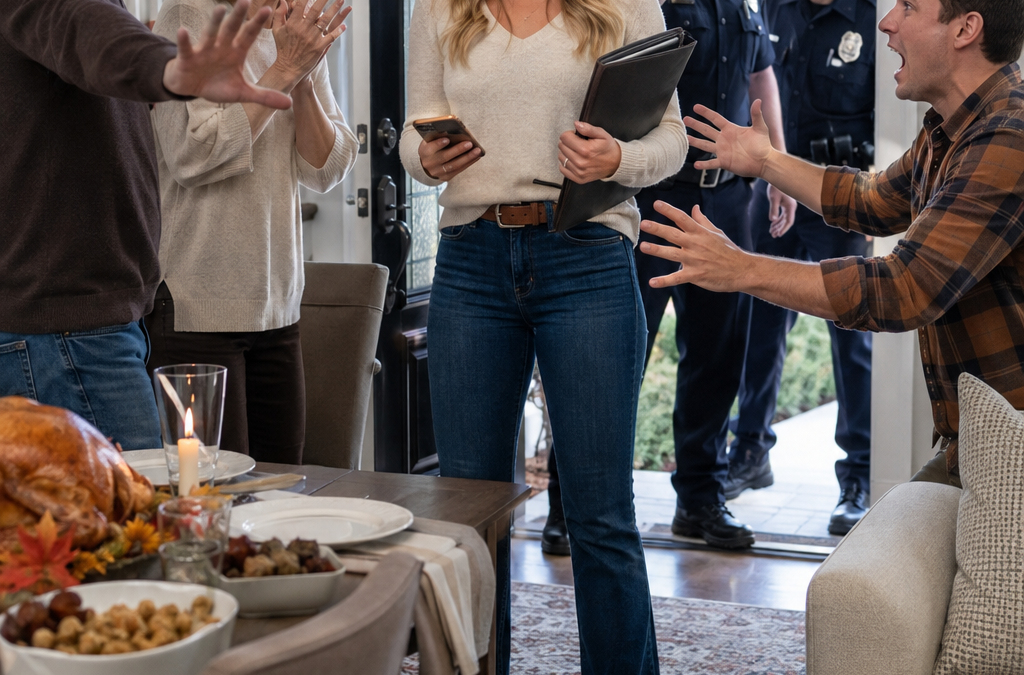
“Out Of This House,” My Father Said Coldly On Thanksgiving. “You Are Not Family Just Because You Pay The Mortgage”
### Part 1
I never imagined Thanksgiving would be the night I finally understood my place in my own family. The turkey was still steaming, cranberry sauce glowed under the dining-room lights, and my mother, Patricia, was complaining that the rolls had gone cold. My younger brother, Evan, sat across from me wearing a new blazer and talking loudly about investors for another company he was supposedly building. Then my father, Daniel, put down his fork and looked straight at me.
“Out of this house,” he said coldly. “Paying the mortgage doesn’t make you family.”
For a second, the room went strangely quiet except for the hum of the refrigerator. I actually thought I had misheard him. Mom didn’t defend me. She barely looked up. “You’ve always been jealous of Evan,” she muttered. That sentence hurt more than Dad’s.
Three years earlier, when Dad needed unexpected surgery, I had emptied a large piece of my savings without hesitation. After that came the overdue mortgage, the leaking roof, property taxes, car repairs, and Evan’s endless “temporary” emergencies. I worked in tech and regularly logged seventy-hour weeks. My coworkers took vacations in Europe. I drove a ten-year-old Corolla with a rattling air conditioner and ate frozen dinners over my laptop.
At family gatherings, none of that mattered. Evan arrived in expensive shoes and talked about growth, expansion, and people who were “interested in his vision.” Mom would beam and say, “Your brother is going places.” Meanwhile, I was the person quietly keeping the lights on in the house where she said it.
A few months before Thanksgiving, I had covered their overdue property taxes. Mom’s response had been, “You’re lucky, Claire. Not everyone has that kind of money to give.” Lucky. I had stared at my microwave dinner that night and wondered when exhaustion had started looking like privilege. Still, I kept helping because I believed family sacrifice eventually came back as love.
At Thanksgiving, I finally learned it didn’t.
I looked around the table. Dad’s jaw was hard. Mom avoided my eyes. Evan leaned back with a faint smile, like he had just won an argument without saying a word. Something inside me became very calm.
I pushed my chair back. “Fine,” I said. “Let Evan cover the eighty-five hundred this time.”
His smile disappeared. Dad frowned. “What are you talking about?”
“The mortgage, utilities, your credit-card minimums, Mom’s insurance, the tax payment. All of it.”
Mom’s face changed. “Claire, don’t be dramatic.”
“I’m not being dramatic. I’m leaving. You asked me to.”
I walked out without my plate, without dessert, and without my coat. Cold November air hit my arms as I crossed the driveway, but I barely felt it. That night, I didn’t cry. I opened my laptop.
One by one, I canceled every automatic payment connected to my parents: electricity, internet, insurance, credit cards, mortgage transfers. Then I deleted years of reminders labeled FAMILY URGENT.
The next morning, Mom called at 9:07. “Sweetheart, the electric payment failed. Can you fix it?” I let it ring. By noon, I had seven missed calls. At four, Evan texted, “Hey, weird charge hit my card. Spot me just this once? I’ll pay you back.”
Just this once. The phrase that had cost me years.
I turned off my phone. Two days later, I logged into my banking dashboard to verify that every family transfer had stopped. That was when I noticed an account I had never opened.
A new credit card. In my name. Balance: $11,742.
And when I clicked the contact information, the email address attached to it belonged to Evan.
### Part 2
I stared at Evan’s email address until the letters blurred. The charges were worse the longer I looked: a luxury hotel in Seattle, electronics, upscale restaurants, a watch that cost more than my monthly rent. None of it was mine. The account used my name, my Social Security number, and my mailing address. Only the email was his.
My hands shook, but I wasn’t scared. I was furious. For years, Evan had treated my money like a family resource. Apparently, Thanksgiving hadn’t ended that entitlement. It had only forced him to become more creative.
I opened another browser tab and searched what to do after discovering identity theft. Then I started building a file: bank statements, transfer records, screenshots of messages saying “urgent,” “family emergency,” and “I’ll pay you back Friday.” By sunrise, my dining table was buried under paper.
I froze my credit, disputed the account, filed a fraud report, and contacted an attorney I had used for work matters. She told me to stop communicating with Evan about the account and preserve everything. That afternoon, I met Detective Marcus Cole at the Portland Police Bureau.
I slid a thick manila folder across his desk. “This is a family matter,” I said automatically.
He read the first few pages, then looked up. “Not anymore.”
That sentence stayed with me. He explained that if the account had been opened using my identity without permission, the relationship between us did not erase the crime. Then he asked the question my family had spent my entire life teaching me to fear.
“Do you want this documented and investigated?”
I thought about Thanksgiving. I thought about Dad saying I wasn’t family while sitting inside a house I had helped save. “Yes,” I said. “I want it on record.”
My phone started exploding before I even got home. Evan wrote, “Claire, call me. It’s not what it looks like.” Mom followed with, “Your brother made a mistake. Please don’t make this bigger.” Dad sent, “This can be handled privately.”
I laughed when I read that one. Privately was where they had handled everything. Privately, I paid. Privately, they praised Evan. Privately, I swallowed it.
Three days later, someone started pounding on my apartment door. “Claire! Open up!” Dad was outside. Mom was crying in the hallway, and Evan was pacing behind them. I let them wait before opening the door halfway.
“You have ten minutes.”
Dad pushed inside as though boundaries were still something that happened to other people. Evan spoke first. “There’s been a misunderstanding.”
“You opened a credit account in my name.”
“I was going to fix it.”
“You spent nearly twelve thousand dollars.”
He looked away.
Dad lowered his voice. “We are family. You do not call the police on family.”
I almost admired the speed of the reversal. “Last week, you told me paying your mortgage didn’t make me family.”
Mom pressed a hand to her chest. “We were upset.”
“No. You were comfortable.”
Evan suddenly snapped. “You’ve always resented me because I’m more successful.”
I looked at his designer shoes, his expensive watch, and the man who had just used my identity to finance his lifestyle. “Successful? You’ve lived off me for years. I funded your rent, your travel, your business plans. You didn’t build a life. You built a costume and sent me the bill.”
His face went red, and he stepped toward me. Dad grabbed his shoulder. “Enough!” Then Dad turned on me. “You’re destroying this family.”
I opened my apartment door wide. “No. I’m finally refusing to finance its destruction.”
Mom reached for me. “Claire, please.”
I stepped back. “You never cried like this when I was drowning.”
They left.
By Friday, Detective Cole called. The credit card wasn’t the only problem. Two former investors and one former business partner had also reported suspicious financial activity tied to Evan.
For the first time, I realized my brother hadn’t simply stolen from me. I might have been the person who finally exposed a pattern.
### Part 3
Once Evan came under investigation, the family silence cracked almost overnight. My aunt Rebecca, Dad’s sister, called first. We hadn’t spoken in years.
“You did the right thing,” she said.
I almost laughed because those were words nobody in my family had ever used when I did something that upset Evan. Rebecca told me people had noticed things for years: questionable loans, borrowed money that never returned, business forms people didn’t remember signing. “But your parents shut everyone down,” she said. “Anyone who questioned Evan became disloyal.”
Then my cousin Hannah called. Then my mother’s brother, Uncle James. Each conversation sounded different but carried the same truth. Evan had always been protected. I had always been expected to absorb the consequences.
The call that unsettled me most came from Lauren, Evan’s ex-wife. She had disappeared from family gatherings after their divorce two years earlier. Mom told everyone Lauren was bitter and unstable. Dad said she had tried to sabotage Evan’s future. I had believed enough of it to stay away.
“I owe you an apology,” I told her.
“You didn’t know,” she said.
Then she told me what happened during their marriage. Their joint savings disappeared into Evan’s projects. A loan appeared with her signature on documents she insisted she had never signed. When she confronted him, he convinced her she was selfish for questioning him.
“And your parents backed him,” she said quietly. “They told me marriage meant supporting his dreams.”
I closed my eyes. Different woman. Same script.
Lauren had left with debt and shame while the family erased her from photographs and conversations. “I thought I was crazy for a long time,” she said.
“You weren’t.”
Neither was I.
That realization changed something in me. I had spent years believing my biggest weakness was that I cared too much. The truth was uglier. They had trained me to confuse usefulness with belonging.
A week before the hearing, prosecutors asked me to organize the timeline again. I sat at my kitchen table with stacks of statements, texts, and transfer confirmations. For once, I didn’t see money. I saw years.
A canceled vacation. A dental procedure I postponed. A Christmas when I told friends I was “too busy” to travel because I had just paid my parents’ property tax. A Saturday spent helping Evan rewrite a pitch deck after covering his rent. Every transaction had a memory attached.
That night Dad called. I almost ignored him, but answered.
“If you testify, you’ll ruin your brother’s future.”
“What about mine?”
Silence.
Then he said, “Your mother hasn’t stopped crying.”
I waited. He never asked whether I had cried.
“We raised you better than this,” he added.
I laughed softly. “No, Dad. You raised me to give, fix, and disappear.”
“That’s not true.”
“You threw me out of your house after I helped pay for it.”
“You’ve always been jealous of Evan.”
There it was again. The family’s favorite explanation for every boundary I ever tried to set. This time, it didn’t hurt. It sounded tired.
“You’re still defending him,” I said.
“He’s your brother.”
“And I’m your daughter.”
Dad said nothing.
That silence answered every question I had carried since childhood.
The next morning, the courthouse smelled like old paper and burnt coffee. Detective Cole gave me a small nod in the hallway. Evan arrived with his attorney. He looked thinner, but when our eyes met, I saw no remorse. Only anger, like I was the one who had betrayed him.
When I took the stand, my hands were steady. I told the truth: the account, the charges, the email, the years of requests that created the opportunity. The prosecutor showed the records one by one, followed by evidence from the other people who had come forward.
My parents sat behind Evan. Mom looked devastated. Dad stared straight ahead. For the first time, neither of them looked powerful.
The judge began reading the findings.
And I realized whatever happened next, I was never going back to being their emergency fund.
### Part 4
Evan was ultimately sentenced to prison and ordered to pay restitution. I didn’t smile when I heard it. I didn’t feel victorious. I felt something much quieter.
Release.
My parents sat behind him as if they were attending a funeral. Mom’s face was gray. Dad looked carved from stone. Neither looked at me when I left the courtroom.
That was fine. For once, I wasn’t looking back either.
My apartment seemed different that evening. Same chipped coffee table. Same cheap floor lamp. Same refrigerator that clicked twice before the motor started. But there were no emergency texts, no invoices waiting for me, no guilt hanging in the air.
I poured a glass of wine, sat on the couch, and listened to silence that belonged entirely to me.
Two weeks later, someone knocked. When I opened the door, my aunt Diane stood there holding a manila envelope. She was my mother’s older sister, and we had barely spoken in years. Her eyes were red.
“Your grandmother Eleanor passed away last week.”
The words folded something inside me.
Grandma Eleanor had been the one person in the family who never measured me against Evan. When I was little, she let me paint crooked flowers on clay pots in her backyard. When I was older, she asked about my work without immediately asking whether I had met someone or planned to have children. She never needed me to prove my value.
Diane came inside and handed me the envelope. “There’s something she wanted you to have.”
Inside was a handwritten letter. I recognized Grandma’s looping handwriting immediately.
“My dearest Claire, I always knew they did not see you the way I did. They saw what you could provide. I saw the woman providing it. They mistook your kindness for an endless supply. I saw how tired you became.”
I swallowed hard and kept reading.
“I wish I had spoken louder when I realized what was happening. But I also knew there would come a day when you chose yourself. Do not feel guilty when that day arrives. Build a life no one can invoice you for. Love, Grandma Eleanor.”
A tear landed near her signature.
Diane placed another document beside the letter. Grandma’s will. She had left me her house, her savings, and the small garden she had cared for almost forty years.
Everything she owned outright.
“Your grandmother was very specific,” Diane said. “She wanted it protected from everyone else.”
The strange thing was, I didn’t think about the money. I thought about Grandma’s kitchen smelling like lemon oil, her blue front door, the squeak on the third stair, the old wooden porch where she used to drink tea in summer.
Two weeks later, I stood in front of that house with the keys in my hand. The paint was chipped. The rose bushes were overgrown. Leaves had gathered against the steps.
It wasn’t impressive.
It was perfect.
Inside, the air smelled faintly of lavender and old books. I ran my fingers over the banister. “Thank you,” I whispered.
That night, I slept there with the windows cracked and the doors locked. Not because I was afraid. Because locking my own door felt like a choice instead of a defense.
The next morning, my phone lit up.
Mom. Dad. Then an email from Evan.
They had learned about the inheritance.
Dad texted first. “Call us. We need to discuss what your grandmother did.”
Mom wrote, “This affects the whole family.”
I stared at those words.
Not congratulations. Not are you okay? Not we’re sorry she’s gone.
This affects the whole family.
Then I understood. They weren’t calling because Grandma had died. They were calling because, once again, something I owned had become something they believed they deserved.
### Part 5
I didn’t answer.
Mom left crying voicemails. Dad texted, “You’re acting like a stranger to your own blood.” Evan sent a message through his attorney complaining that Grandma had always favored me.
None of them mentioned the letter. None of them asked what I planned to do with the house. They only wanted to know what they might receive.
So I gave them the same thing they had given me on Thanksgiving.
Distance.
I changed the locks and moved into Grandma’s house slowly, one box at a time. I scrubbed the kitchen tile until the lemon scent came back. I emptied closets filled with old linens and mothballs. I trimmed the garden until my hands blistered.
Then I painted the front door the same soft blue Grandma had loved.
While sanding the old paint, I remembered being nine years old, standing beside her with a brush twice too large for my hand.
“You missed a spot,” she had teased.
“I like it that way,” I had said.
She laughed. “Then it’s yours.”
At the time, she meant the patch of blue paint. Years later, standing in the same place, I finally understood why the memory hurt so beautifully. She had always given me something my parents never did.
Ownership without obligation.
Months passed. The fraud case moved forward without needing anything more from me. Restitution would take years, and I stopped caring whether I ever recovered every dollar.
Money could be earned again.
Time couldn’t.
That became my new rule.
I stopped working seventy-hour weeks. I took a smaller role at a company I actually liked. Less status, fewer late-night calls, enough income to live comfortably. For the first time, I used my vacation days.
I took a road trip along the Oregon coast by myself and never once checked my family group chat. Eventually, I deleted that chat completely.
Some relatives thought I should forgive my parents. A few said they were getting older. Others told me Thanksgiving had been “one terrible night.”
They were wrong.
Thanksgiving was one honest night.
It was the night my father finally said out loud what the family had spent years showing me.
My value ended where my payments ended.
I didn’t hate them. That surprised people. Hatred would have required energy I no longer wanted to give.
I simply stopped participating.
A year after Grandma died, an envelope arrived with no return address. Inside was an old photograph. Grandma and me at nine years old, both holding paintbrushes in front of the blue door.
On the back, in shaky handwriting, were words she must have written before she died:
“You were always building your own home. I just gave you the key.”
I sat on the porch holding that photograph for a long time. No tears. No dramatic breakdown. Just stillness.
My phone buzzed inside the house.
Dad’s number.
I let it ring.
Then it stopped.
The roses moved slightly in the evening breeze, and somewhere down the block a dog barked while a lawn mower sputtered to life. Ordinary sounds. I loved them.
My life had finally become ordinary in the best possible way.
No financial emergencies. No brother demanding rescue. No mother explaining why my pain was jealousy. No father deciding whether I counted as family.
I had a home, work I liked, neighbors who waved, and a garden that grew slowly without asking me to bleed for it.
People sometimes ask whether I ever forgave my parents. Maybe forgiveness means different things to different people.
For me, healing did not mean reopening the door.
It meant realizing I was allowed to keep it closed.
My father told me, “You are not family just because you pay the mortgage.”
He intended those words to humiliate me.
Instead, they freed me.
Because he was right about one thing.
Money never made us a family.
And once I stopped paying for the illusion, I finally had enough left to build a real life of my own.
THE END!
