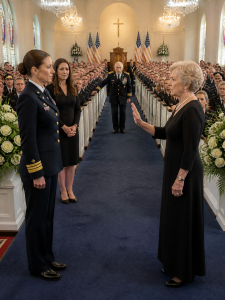
For twelve years, my hometown believed I abandoned my father. My mother made sure everyone thought I chose the Navy over my family, even when I was lying injured in a military hospital and begging to come home. On the morning of Dad’s memorial, she ordered me to remove my uniform in front of the entire church. Then an old veteran stood up with my father’s final letter.
Part 1: The Memorial
My name is Rebecca Carter, and for twelve years, my hometown believed I had abandoned my family.
My mother made sure of it.
On the morning of my father’s memorial, I sat alone in a hotel room outside Willow Creek, Tennessee, staring at my Navy dress uniform laid across the bed. Every crease was sharp. Every ribbon was aligned.
I knew my mother would hate it.
But my father had asked me to wear it in one of the last letters he ever sent.
Rebecca, when they honor me, wear what you earned. Do not wear it for them. Wear it for me.
So I buttoned the jacket and drove to the church.
The First Baptist Church of Willow Creek was packed. Veterans, neighbors, church members, and old family friends had come to honor Colonel Thomas Carter, retired Army officer and respected community leader.
To them, he was a hero.
To me, he was Dad.
The man who taught me to change a tire, put cinnamon in pancake batter, and mailed letters even when he did not know where I was stationed.
I had missed his funeral.
Not by choice.
Six weeks earlier, I had been unconscious in a military hospital in Germany after an overseas attack left me seriously injured. My hometown did not know that.
My mother never told them.
Instead, she told everyone I had stayed away, forgotten my family, and let the military change me.
When I stepped into the church lobby, conversations faded.
People stared at the uniform.
Then I saw my younger sister, Anna.
“Rebecca?” she whispered.
“Hi, Annie.”
Her eyes filled.
“You came.”
Before I could answer, my mother’s voice cut through the room.
“No.”
Elaine Carter stood near the sanctuary doors in a pressed black dress and pearl earrings, her eyes burning.
“You are not wearing that in here,” she said.
The lobby fell silent.
“Mom—”
“No. Your father’s memorial is not about you.”
The words struck harder than I expected.
For a moment, I considered leaving. It would have been easier to return to the hotel, remove the uniform, and let Willow Creek keep believing the story my mother preferred.
Then I remembered Dad’s letter.
“I’m here because Dad wanted me here.”
My mother’s face hardened.
“Then attend dressed appropriately.”
“This is appropriate.”
“Not after what you did.”
“What did I do?”
“You disappeared.”
“I was deployed.”
“You always had an excuse.”
“I was injured when he died.”
Her voice softened into the wounded tone she used when she wanted witnesses on her side.
“Your father waited for you, Rebecca. Even at the end.”
That was not true.
Dad knew I had requested leave. He knew it had been denied twice. He knew I was trying.
But the people around us lowered their eyes, believing her version.
Then an elderly veteran in the front row slowly stood.
“My name is Major William Hayes,” he said. “Before one more word is spoken against that woman, this church deserves the truth.”
My mother went stiff.
“William, this is not the time.”
“No, Elaine,” he replied. “This is exactly the time.”
He turned to the congregation.
“Colonel Carter asked me to speak if Rebecca came home wearing that uniform. He knew someone might try to shame her for it.”
My throat closed.
Major Hayes removed a sealed letter from inside his jacket.
“Rebecca Carter did not abandon her father. She was deployed. Twice, she tried to return when Thomas became ill. Twice, her leave was denied because her unit was supporting active operations. Six weeks before his funeral, she was seriously injured overseas.”
Gasps moved through the pews.
Anna covered her mouth.
Major Hayes unfolded the letter.
“If my daughter walks into that church in uniform, let her stand proud. She has carried wounds many of you cannot see. She has served with honor. If anyone tells her she is unwelcome, then that person is dishonoring me.”
The silence was absolute.
Then Anna stepped away from our mother and came to my side.
One by one, the veterans stood.
They did not applaud.
They simply stood.

Part 2: The Campaign Box
Major Hayes was not finished. He looked at me. “Rebecca, your father left you something else. Something Elaine begged me never to reveal.”
From his jacket, he removed a small brass key. My mother’s face went white.
Behind the altar stood Dad’s memorial display: his dress uniform, medals, folded flag, photographs, and ceremonial sword case. Major Hayes pressed the key against a hidden sensor. A panel opened beneath the display, revealing a cedar campaign box.
I recognized it instantly. Dad had carried that box through several assignments when Anna and I were children. It held letters, maps, photos, and personal items he never trusted to checked luggage.
Major Hayes placed it on the lectern and unlocked it. Inside were bundles of letters tied with green ribbon, a digital recorder, two sealed envelopes marked for me and Anna, a folder labeled CARTER SERVICE FOUNDATION, and dozens of unopened envelopes.
All addressed to Dad. All in my handwriting.
I stopped breathing. I knew those letters. I had sent them over the years from training, ships, bases, and windowless rooms where I could not discuss where I was or what I was doing. Some had been returned. Many had simply vanished.
Major Hayes lifted a bundle. “Thomas found these hidden in a locked cabinet six months before he died. Elaine had intercepted them before he could read them.”
My mother snapped, “That is a lie.”
“Your handwriting is on the notes attached to several envelopes.” He held up one yellow slip. Do not give this to Thomas. It upsets him. Another read: Return to sender if possible.
Anna looked at our mother. “You hid Rebecca’s letters?”
“I protected your father.”
“From what?”
“Disappointment.”
I finally understood. My mother had not only resented my absence. She resented Dad for being proud of it. He had helped me apply to the Naval Academy. He had told me fear did not mean stop. To my mother, every step I took away from Willow Creek felt like betrayal.
Major Hayes revealed more records: leave requests, emergency travel denials, and medical restrictions showing I had not chosen to miss Dad’s funeral.
Anna whispered, “Mom told me you declined military transport.”
“That never happened,” I said.
Then Major Hayes lifted the digital recorder. “Thomas anticipated this.”
He pressed play. Static filled the church speakers. Then my father’s voice entered the room. Older. Weaker. But unmistakable.
“If William is playing this, then Rebecca came home.”
My knees nearly gave way.
“Rebecca, I am sorry I did not understand sooner what was happening. Six months ago, I found your letters in a cabinet Elaine kept locked. I read every one. You wrote about training, loneliness, fear, and the people you could not save. You asked whether the maple tree survived the storm.” A faint laugh entered his voice. “It did.”
Tears blurred the altar.
“I confronted your mother. She said she was protecting me from disappointment. The truth is, she was punishing both of us because you chose a life she could not control.”
My mother shook her head. “No. Thomas never said that.”
His recorded voice continued. “Elaine, do not call my words confusion. William recorded this with my physician and attorney present. I knew exactly what I was saying.”
Dad had written to me through Major Hayes before his final hospitalization. He never mentioned the hidden letters because he wanted our final words to contain love, not accusation.
Then his voice came one last time. “Rebecca, you did not abandon me. You became exactly the person I hoped you would become. Your mother may never forgive you for leaving Willow Creek. That does not mean you did something wrong.”
He also announced the Colonel Thomas Carter Service Foundation, created to support young people from rural Tennessee entering military service, nursing, emergency response, and public service. He appointed me chair. Anna could serve as trustee if she chose.
My mother stepped forward. “No.”
Dad’s voice answered her from the recording. “Elaine believed the foundation should be managed through the church committee. I disagreed. Rebecca understands service without applause. She understands what duty costs.”
The final line broke me.
“My daughters, do not let my death become another weapon between you. Tell the truth. Protect each other when you can. Walk away when you must. Rebecca, wear the uniform.”
Then the recording ended.
Major Hayes saluted me. One by one, the veterans followed. Army. Navy. Air Force. Marine Corps.
I returned the salute with tears in my eyes.

Part 3: The Truth in the Church
Anna wrapped her arms around me, then pulled back when I flinched.
“You’re hurt.”
“I’m recovering.”
“Why didn’t you tell me?”
“I tried to call.”
Her eyes moved toward our mother.
“She changed her number last year,” Anna whispered. “She said you already had it.”
“I didn’t.”
Our mother looked cornered, not sorry.
“I was trying to hold this family together.”
Anna’s voice shook.
“You separated us.”
Mom insisted I had left.
“I served,” I said.
“You left me.”
The words came from a place older than Dad’s illness or the church.
I saw the kitchen again, the day I received my academy appointment, when Mom held the letter and asked why I wanted to escape her.
“You were my mother,” I said. “I was not supposed to remain small so you would feel safe.”
For the first time, she had no answer.
When the service finally began, Anna took my hand.
“You sit with me.”
Mom sat alone in the third row.
I sat beside Anna in the first.
Major Hayes sat on my other side.
When he invited me to speak, I had prepared nothing.
So I told the truth.
“For twelve years, many people here believed I had forgotten where I came from. I allowed that belief to remain because military service is difficult to explain when much of it cannot be discussed. I also believed private family pain should remain private.”
I looked at Dad’s campaign box.
“My father reminded us today that silence can protect dignity, but it can also protect a lie.”
I took a breath.
“I did not abandon my father. I wrote. I called. I requested leave. I tried to come home.”
Then I looked at the people who had repeated my mother’s story without asking me.
“I am not asking anyone to choose sides. I am asking you to be careful with stories that make one person a villain simply because the explanation is convenient.”
My voice broke.
“My father asked me to wear this uniform because he did not want me to arrive ashamed.”
I looked at his photograph.
“I am not ashamed, Dad.”
The congregation rose.
The applause began softly, then grew.
I did not feel victorious.
I felt exhausted, exposed, and deeply loved by a man who had prepared to defend me after death because he had not been sure he could do it in life.
Part 4: The Cabin and the Notebook
After the service, apologies came carefully.
A former teacher admitted she had believed I refused to come home. A neighbor confessed she repeated the story at church. Two veterans asked about my recovery without demanding details.
Later, Major Hayes handed me the cedar box.
“It belongs to you.”
Inside my envelope, Dad had written:
Rebecca,
I knew you loved me. I should have defended you sooner. Your mother loves you, but she often confused love with possession. Do not let her fear become your prison.
The foundation is not a reward. It is work. Accept it only if that work has meaning for you.
The cabin by Millstone Lake is yours. Your mother has the house for the rest of her life, but the cabin was always where you and I told the truth.
There is one last box beneath the floorboard near my desk.
Take William.
Love, Dad.
The cabin.
Dad and I had spent weekends there when I was in high school. It had one bedroom, weak internet, and a porch overlooking dark water.
Mom hated it.
Dad called it quiet.
He had left it to me, not as a fortune, but as a place where truth had always felt safe.
The next morning, Major Hayes drove me there because my doctor had not cleared me for long drives.
Inside, Dad’s coffee mug still sat beside the sink. His reading glasses rested on the desk.
Beneath the floorboard, we found a metal box.
Inside were copies of every letter Dad sent me through Major Hayes, medical records, the foundation charter, childhood photographs, and a notebook documenting the final year of his life.
One entry read:
March 4: Elaine said Rebecca did not call. Phone log shows blocked number. Asked her why. She said accidental.
Another read:
June 20: Confronted Elaine about cabinet. She said letters were upsetting. Told her this must stop.
The final entry was written shakily.
Rebecca will think she failed me.
She did not.
I closed the notebook.
For twelve years, my mother had controlled the story because Dad and I believed love should remain private.
She spoke publicly.
We wrote quietly.
In Willow Creek, the louder version became truth.
The memorial changed that.
Not for everyone.
Some still defended my mother. Some said grief caused her choices. Some said airing family matters in church was wrong.
But they had not objected when the lie was aired publicly for years.
Part 5: The Foundation
The foundation began operating the following spring.
Anna joined the board. Major Hayes served as vice chair. Pastor Collins helped create scholarship partnerships with local schools.
Our first awards went to four students: one entering nursing, one enlisting in the Air Force, one studying wildfire management, and one quiet girl from Willow Creek whose father had died when she was eleven.
After the ceremony, she asked why we had chosen her.
“Because you earned the opportunity,” I said.
“People keep saying I’m brave.”
“Are you?”
She thought about it.
“I’m scared.”
“Those things can exist together.”
Dad taught me that.
I passed it on.
Mom did not attend.
She sent letters accusing the foundation of using Dad’s name to shame her. I did not respond.
Months later, she called.
“I want my family back,” she said.
The sentence could have opened a door.
Then she added, “You need to correct what William said about me.”
“What part?”
“That I intercepted the letters.”
“You did.”
“I was protecting your father.”
“From knowing his daughter loved him?”
Nothing had changed.
“I won’t retract the truth,” I said.
“Then you’ve chosen the town’s admiration over your mother.”
“No. I chose not to lie.”
She hung up.
The old version of me would have called back. I would have explained until my voice failed. I would have offered some smaller falsehood just to keep peace.
This time, I did not.
Dad’s warning stayed with me.
Do not let her fear become your prison.
Part 6: The Letter That Came Later
A year passed before Mom truly apologized.
The first letters blamed illness, grief, and Major Hayes.
I answered none of them.
Then, eighteen months after the memorial, a fourth letter arrived.
Rebecca,
I hid your letters. I silenced calls. I told people you chose not to come home.
I did those things because every time your father spoke proudly of you, I heard proof that he had helped you leave me.
I wanted him to need me more than he missed you. I wanted Anna close, so I made your independence sound like betrayal.
When you were injured, I believed telling people would make them forgive you before I was ready to.
None of that was your fault.
I do not know how to repair what I did.
I am sorry.
There was no demand at the end.
No request that I call.
No accusation disguised as grief.
I read it several times, then placed it beside Dad’s notebook.
I did not forgive her immediately.
But for the first time, she had described the truth instead of defending herself from it.
We began with letters.
That felt right.
Months later, we spoke by phone. Ten minutes at first. Then twenty.
When she slipped into blame, I ended the call.
Gradually, she learned that access depended on respect.
Two years after the memorial, she visited the cabin.
She asked first.
Major Hayes and Anna were both there.
Mom stood on the porch, older than I remembered.
“I cannot change twelve years,” she said.
“No.”
“Do you believe I loved you?”
The question was harder than I expected.
“Yes,” I said. “But love did not make what you did safe.”
She nodded.
Maybe she understood.
Maybe she only understood enough to sit at Dad’s table without rewriting the past.
That was still something.
Part 7: Into the Light
My injuries changed my career.
I moved from operational assignments into training and strategic planning. At first, I considered it a failure.
Major Hayes reminded me that service does not end when a person stops standing closest to danger.
Eventually, I retired from active duty and accepted a civilian role helping military families through deployment, casualty notices, and emergency leave crises.
I knew what silence could do.
I knew how incomplete information could become poison inside frightened families.
I helped parents understand why a son could not call.
I helped spouses navigate emergency requests.
I told service members to preserve letters, name trusted contacts, and make expectations clear before crisis arrived.
Some lessons cost too much not to share.
Five years after Dad’s memorial, Major William Hayes died peacefully at home.
At his service, I wore my Navy uniform one final time.
His daughter asked me to speak.
I told the congregation that Major Hayes had carried my father’s truth when Dad could no longer carry it himself.
I told them courage is not always charging forward.
Sometimes courage is standing in a church and telling an old friend that her grief does not give her the right to destroy her daughter.
Mom attended.
When I walked to the lectern, she stood with the veterans.
Not because the past had disappeared.
Because she finally understood what the uniform meant.
After the service, she touched my sleeve.
“Your father would be proud.”
“He was,” I said.
She lowered her eyes.
“Yes.”
That single word contained years.
People in Willow Creek still tell the story of the day Major Hayes stood inside the church and defended Colonel Carter’s daughter.
They remember the silence.
The letter.
The recording.
The brass key.
Some versions make it sound like the whole town turned against my mother in one dramatic moment.
That is not exactly what happened.
Truth rarely transforms people that neatly.
What changed instantly was not the town’s loyalty.
It was my willingness to carry their judgment.
For twelve years, I thought I needed everyone to understand why I had been gone. I thought I needed my mother to admit I had not abandoned her. I thought I needed the town to recognize that service had cost me something too.
Then Dad’s voice filled the church.
Rebecca will think she failed me.
She did not.
Those words released me from a trial I had been attending in my own mind for years.
My mother believed the uniform represented the life that took me away.
My father understood it represented the life I had chosen with courage, sacrifice, and love.
I wore it for him.
And when Major Hayes handed me the brass key, I did not merely receive a box of letters.
I received my name back.
Not the daughter who abandoned everyone.
Not the selfish officer who stayed away from her father’s funeral.
Rebecca Carter.
Daughter.
Sister.
Officer.
Wounded veteran.
A woman who had loved her father across every mile placed between them.
The uniform did not make that true.
The truth had always been there.
The uniform only made me stand tall enough to stop apologizing for it.
