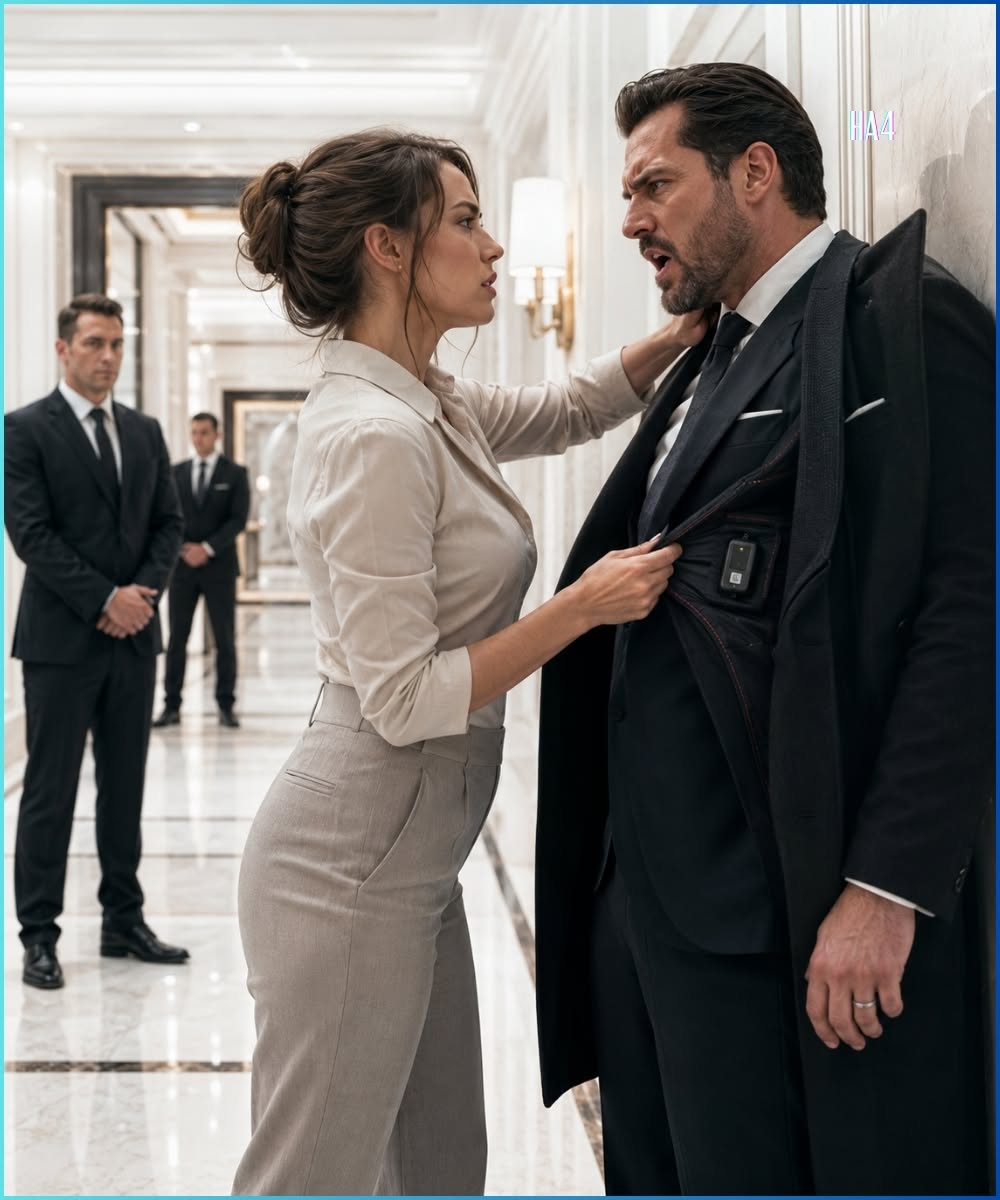
“Here’s what’s clear,” she said. “You’ve run this garage for six years, and five months ago somebody put two bullets through Tae Yun’s car before it left this property. So no, Dae, I don’t think I’m the problem.”
She stood and let him gasp.
“You can hate me from your post.”
By dinner, no one questioned her routes again.
But Tae still did.
“You changed my schedule,” he said one afternoon outside his office.
“I change it every day. That’s the point.”
“I had a dinner.”
“You had a dinner at a restaurant with one exit, no rear alley, and a host who owes you seven million dollars.” She handed him a folder. “You’re having it here. Same menu. Better lighting. Fewer ways to die.”
He threw the folder onto a table.
“I built this organization before you could find Los Angeles on a map.”
“I grew up in Atlanta,” she said. “We had maps.”
His jaw tightened.
“You think you’re funny.”
“No. I think I’m right. Funny is a bonus.”
He hated her.
At least, that was what he told himself.
Three nights later, Tae hosted a private dinner in the residence ballroom. Allies, rivals, lenders, lawyers, men who owed him money and men who wished he would die before collecting it. Brenda stood behind him against the wall, silent and watchful.
Halfway through dinner, Tae decided to remind her and everyone else who ruled the room.
“You’ve all heard about my new bodyguard,” he said, lifting his glass. “She rearranges my life, tells me where to stand, when to sleep, what doors I may use. Quite a talent.”
A few men laughed.
Tae gestured lazily toward the wine bottle.
“Miss Johnson, perhaps you’ll demonstrate another skill. Pour the wine.”
The laughter grew.
Brenda walked forward.
She lifted the bottle, filled Tae’s glass without spilling a drop, then leaned close enough that everyone could hear her.
“Of course,” she said warmly. “Anything for the man who would have walked into a death trap last week if I hadn’t stopped him. The man whose garage failed him, whose jacket was tagged, and who is alive tonight only because the woman pouring his wine refused to let him die from his own pride.”
The room went silent.
Brenda set the bottle down.
“Drink up, gentlemen. He’s still breathing. That means he can afford it.”
From the middle of the table, Marcus Pike laughed.
One by one, the laughter turned.
Not at Brenda.
At Tae.
He looked up at her, pride wounded, eyes burning.
“You’re becoming a problem,” he said quietly.
Brenda returned to her wall.
“I’m the best problem you’ve ever had.”
Part 2
The next time Tae tried to prove he did not need her, he nearly got himself killed.
He went to a nightclub in Koreatown without telling her. Neon, smoke, velvet ropes, music so loud the glass walls trembled. It was the kind of place where men wanted to be seen near him and women wanted to say they had once caught his eye.
He brought four guards.
Brenda found out anyway.
She always did.
The moment she stepped inside, she felt the wrongness before she saw it. Three men near the service hallway moving against the crowd. Hands low. Eyes too still. Their bodies angled toward the VIP platform.
Brenda was already running when the first blade came out.
“Down!” she roared.
The music swallowed most sounds, but not her.
She hit the first attacker so hard he folded across a table. The second slashed low; she caught his wrist, twisted, and drove him into the floor. The crowd exploded into panic.
The third attacker was already past her.
Already at the velvet rope.
Already reaching for Tae.
Brenda dove over the rope, caught Tae by the front of his shirt, and dragged him backward a split second before the blade cut the air where his throat had been.
They hit the floor hard.
She came up over him.
“Stay down,” she breathed. “For once in your life, do what I say.”
For once in his life, he did.
By the time the club guards realized what had happened, three attackers were down, dozens of civilians had been shoved toward exits, and Tae Yun stood untouched in the wreckage because the woman he had humiliated had refused to leave him.
Brenda hauled him up by his collar.
“Next time you decide to die,” she said, breathing hard, “have the courtesy to tell me first.”
He stared at her.
There was blood on her forearm. Not much, but enough. None of it was his.
Something in his face changed.
Just a crack.
Through it, Brenda saw a terrible truth.
Tae had not simply been careless.
Some part of him had been tired enough to welcome the end.
After that night, his men changed.
Owen Park came to Brenda three days later, stiff as a soldier.
“My younger brother was in that club,” he said. “Off duty. He has two kids.”
Brenda waited.
Owen bowed his head.
“I was wrong about you.”
“You were doing your job,” Brenda said. “So was I.”
“We’re good?”
“We’re good.”
Not everyone agreed.
There were conversations that stopped when Brenda entered. Doors that closed too quickly. Smiles that carried poison in their corners.
She noticed everything.
Especially Tae.
He did not thank her. She did not expect him to. But he stopped fighting the schedule changes. He ate what she told him to eat. He stopped standing near windows.
One night, she found him awake at two in the morning, standing in the dark great room with a glass in his hand he had not touched.
“You should sleep,” she said from the doorway.
“So should you.”
“I sleep enough.”
“No, you don’t.” He looked at her reflection in the glass. “You sit outside my door on that cot like a guard dog.”
“The men do the watch they’re assigned,” Brenda said. “I do the watch I’d want done if I were the one in that room.”
“That isn’t in the contract.”
“No.”
“Then why?”
She should have had an answer ready. She always had an answer ready.
But the truth slipped out before she could stop it.
“Because I sleep better knowing the door I’m guarding has you behind it.”
Tae went still.
The city burned silver beyond the windows.
“You’re a dangerous woman, Brenda Johnson.”
“You have no idea.”
She left before either of them could say more.
But once she had seen the man behind the monster, she could not unsee him.
She noticed that his office lights stayed on until dawn. That he sat with his back to walls. That he never let anyone walk behind him. That every doorway became a calculation. That the most feared man in Los Angeles had not felt safe since childhood.
She found him two nights later in a private study no one was supposed to know about.
He was holding a photograph in a silver frame.
“My mother,” he said.
The woman in the picture was elegant and laughing, her eyes bright, her hand resting on the shoulder of a little boy who looked like he was trying very hard to be brave.
“Grace Yun built this,” Tae said. “Not my father. Everyone remembers him because men remember men. But my mother held the family together through wars that would’ve buried anyone else.”
His thumb brushed the frame.
“She died in front of me when I was nine.”
Brenda said nothing.
“I don’t sleep because every time I close my eyes, I’m back there,” he said. “Too small to save her. Too weak to stop it. Uncle Han carried me out that night. He raised me after. Taught me how to survive.”
His laugh was hollow.
“And look what I survived into. A house full of men waiting for the best moment to betray me.”
Brenda sat beside him, close but not touching.
“What was she like?” she asked. “Not the queen. Your mother.”
For a long moment, Tae did not answer.
Then something softened.
“She sang badly,” he said. “Terribly. No rhythm at all. She sang while she brushed her hair in the morning, and she didn’t care who heard. It was the only time this life felt normal.”
Brenda smiled despite herself.
“My mother sang off-key too.”
“Where was she from?”
“Georgia. Atlanta mostly. But she moved around. Worked private security before women were supposed to. She died when I was nineteen.”
“I’m sorry.”
“She told me once she had a friend who saved her life. A Korean woman. She never told me much. Just a name I couldn’t place and a promise I didn’t understand.”
Tae looked at her, curious.
“What name?”
Brenda almost answered.
But years of caution closed her throat.
“I don’t know if I remember it right,” she lied.
He seemed too tired to press.
That night, for the first time since he was nine years old, Tae slept until morning.
And Brenda stayed outside his door, listening to his breathing like it was something precious.
The third attack came on a Tuesday after midnight.
Men came over the east wall during a four-second camera gap no one outside the residence should have known about. They moved like they had been given a map of the property and a prayer that Brenda would be asleep in the guest wing.
She was not.
She had moved her cot outside Tae’s door a week earlier and told no one.
She woke to silence.
The wrong kind.
A guard who should have checked in had not.
Brenda had her gun in hand before she was fully awake. She met the first intruder at the top of the stairs. The second made it halfway down the hall before she stopped him. The third got close enough to see Tae’s bedroom door before Brenda threw it open and shoved Tae into the reinforced safe room she had demanded he build.
He had called it paranoia.
Now he said nothing.
She stood in the doorway while the house erupted.
Eleven minutes later, the surviving attackers fled back over the wall.
Brenda reviewed the footage before sunrise.
The camera gap had been used perfectly.
Not guessed.
Used.
Someone inside had handed them the opening.
She began investigating while Tae slept.
The tracker. The camera gap. The nightclub. The route leaks. The money behind the attacks.
Every thread led toward the same dark center.
Someone close.
Someone old.
Someone no one questioned.
She refused to believe it until she had proof.
Then the road attack happened.
It was meant to look like an accident: a truck, a blind curve near Mulholland, wet pavement, a guardrail, and a black van arriving afterward to finish what the crash did not.
But Brenda had changed the route at the last second.
The truck clipped them instead of crushing them.
The SUV spun. Glass shattered. The driver blacked out.
Brenda dragged Tae out through the wreckage and into the trees, one arm around his waist as he pressed a hand to his bleeding side.
Six men came from the van.
“Stay low,” she whispered, lowering him behind a fallen trunk. “Do not move. Do not come after me.”
“Brenda,” Tae said.
She looked back.
His face was pale, his eyes locked on hers.
“Come back.”
She did.
Four men went down in the dark between the headlights. Two ran. Brenda returned with blood on her sleeve, rain on her face, and hands that shook only after the danger had passed.
She took Tae to a safe apartment in Culver City, one she had rented under a name nobody knew.
His wound was shallow.
Her fear was not.
“You’ll live,” she said, cutting away his ruined shirt.
“You sound disappointed.”
“I’m working. Be quiet.”
But her hands gentled as she cleaned the wound.
He watched her face.
“You’re trembling,” he said.
“I’m not.”
“You are.”
His hand covered hers where it rested against his chest.
“Brenda. Look at me.”
She did.
That was the mistake.
Because once she looked at him, the room became very small. The world narrowed to his hand over hers, the beat of his heart under her palm, and the breath between them that neither of them crossed.
Her phone rang.
The sound shattered everything.
Brenda stepped into the next room and answered.
The contact on the other end had traced the final account.
When she returned, the blood had drained from her face.
“What is it?” Tae asked.
She looked at him, at the man who had finally let one person past the wall.
“Tae,” she said, and her voice shook for the first time since he had met her. “The tracker. The camera gap. The money. The attacks. All of it leads to one person.”
His face closed.
“Who?”
She made herself say it.
“Ellis Han.”
For a long moment, Tae did not move.
Then something broke behind his eyes.
“No.”
“Tae—”
“No.” His voice became very quiet. “He carried me out of my mother’s funeral.”
“I know.”
“He is the only family I have left.”
“I know.”
“You’re wrong.”
“I wish I was.”
He stared at her like she had driven the knife herself.
“Get out.”
Brenda did not move.
“Get out before I say something I can’t take back.”
She left the room, but she did not leave the job.
Two days later, she walked into his office and laid a folder on his desk.
“Sit down,” she said.
His eyes were dead tired. “Don’t do this.”
“I’m doing it because nobody else will.”
She opened the folder page by page.
Financial transfers hidden through shell companies. Maintenance orders authorizing the camera gap. A tailor on Han’s payroll. Secret meetings with rival crews. A leaked route sent to only one person outside the car.
“Every attack,” Brenda said. “Every single one. He knew where you’d be because you told him. Because you trusted him more than your own eyes.”
Tae swept the folder off his desk.
Papers scattered across the floor.
“You don’t understand loyalty,” he said, voice cracking. “You come from nowhere. You belong to no one. You sell your skills to whoever pays. How could you possibly understand what he is to me?”
Brenda stepped closer.
“I understand loyalty better than you do. Real loyalty is telling someone the truth they hate, knowing it may cost you everything.”
His jaw trembled.
“You’re asking me to be alone for the rest of my life.”
“No,” she said softly. “I’m asking you to stay alive long enough not to be.”
He looked away.
And she knew then he still did not trust her.
That hurt worse than any wound she had taken for him.
“I never wanted anything from you,” Brenda said.
The silence after that was enormous.
She gathered the papers, placed the folder back on his desk, and walked to the door.
“When he betrays you,” she said without turning, “don’t say I didn’t warn you.”
Part 3
Brenda went back to the Culver City apartment and began packing.
She had survived by never letting anyone close enough to break her heart. Now she had broken her own rule for a man who would rather believe a beautiful lie than an ugly truth.
But as she folded her last shirt, her hand brushed the silk scarf at the bottom of her case.
Inside was the old photograph her mother had kept until the day she died.
Brenda took it out.
Two young women stood together under a bright green tree. Her mother, Lila Johnson, laughing with her arm around a Korean woman whose head was tipped back in mid-laughter. On the back, written in her mother’s careful hand, were two words and a year.
Grace Yun, 1991.
Brenda stopped breathing.
She turned the photo over again.
The woman beside her mother was Tae’s mother.
The same smile. The same lifted chin. The same light in her eyes from the silver frame in his study.
Her mother’s dying whisper came back.
Find Grace’s boy if the debt ever calls.
Brenda had never understood.
Now she did.
This was not a contract.
It had never been a contract.
Her mother had once been saved by Grace Yun. Somehow, across an ocean of silence and years, that old debt had placed Brenda in front of Grace’s son on the night he needed someone who would not bow.
She did not finish packing.
Tae did not sleep for three nights.
He read Brenda’s folder again and again. Each time, he told himself it meant nothing. Each time, he believed that less.
Then Uncle Han came to him with peace in his hands and murder behind his smile.
“My boy,” Han said, settling into the chair across from Tae’s desk. “This business with the woman has poisoned you. Let me end it.”
He slid a phone across the desk.
“We found the crew behind the attacks. A rival faction at a warehouse near the Port of Los Angeles. They meet tonight. We can finish this before sunrise.”
Tae looked at the man who had raised him.
The man who had taught him to tie a tie. To hide grief. To never let enemies see his hands shake.
“What men are going?” Tae asked.
“Only a handful. Quiet is better.”
“Brenda?”
Han’s smile thinned.
“She has done enough damage.”
Tae made the worst decision of his life.
“All right, Uncle,” he said. “Tonight.”
The warehouse was too quiet.
Tae knew it the moment he stepped inside.
No rival faction. No meeting. No noise except water slapping against the dock and the hum of distant cranes.
Han stepped backward.
Not fast.
Not guilty.
Just far enough to avoid blood.
“Uncle,” Tae said. “What is this?”
The shadows moved.
Faces appeared from behind crates and support beams.
Men Tae knew.
Men who had eaten at his table.
Han sighed.
“You should have died months ago,” he said. “But then that woman came along.”
Tae’s men raised their weapons.
Half of them turned on him.
The first shot hit the concrete beside his foot.
Tae ran.
Not because he was afraid.
Because Brenda’s voice lived in his head now.
Stay alive first. Be angry later.
He fought his way through the warehouse, took a blow to the ribs, fired only when he had no choice, and made it outside with blood in his mouth and betrayal burning through every bone in his body.
Two men dragged him toward the edge of the dock.
He heard Han’s voice behind him.
“I loved your mother,” Han said. “That was my weakness. She chose your father. Then she chose peace. She wanted to make the family legitimate. She would have taken everything from me and called it mercy.”
Tae looked up from his knees.
“You killed her.”
Han’s soft face changed.
“At last,” he said. “You understand.”
The world tilted.
Thirty years of love curdled into poison.
Han leaned close.
“She died because she forgot what power is. You are dying because you inherited her softness.”
A gunshot cracked.
Not Han’s.
The man holding Tae dropped.
Then the second.
Brenda Johnson stepped from the fog rolling off the harbor, gun raised, face colder than the ocean wind.
“I told you,” she said, “not to die without telling me.”
Tae almost laughed.
Almost broke.
Han turned slowly.
“You should have left town.”
“I tried,” Brenda said. “Turns out I had family business.”
Chaos erupted.
Brenda moved through it with brutal precision, not like a woman seeking revenge, but like one ending a long illness. Owen Park came through the side entrance with loyal men. Marcus Pike followed with old soldiers who had served Grace Yun and never stopped loving what she had tried to build.
The warehouse became the place where Han’s careful empire cracked open.
Tae reached Brenda in the middle of it all.
“You came,” he said.
“You didn’t listen.”
“No.”
“You were an idiot.”
“Yes.”
A bullet slammed into a crate behind them.
Brenda shoved him down.
“We can discuss your emotional growth later.”
Together, they pushed through the last line of Han’s men until Han himself stood cornered near the loading doors, his gun lowered, his smile gone.
Tae aimed at him.
For one terrible second, Brenda thought he would kill the old man.
She would not have blamed him.
But Tae’s hand lowered.
“No,” he said. “My mother wanted this family out of blood. You used her death to keep us drowning in it. I won’t honor her by becoming you.”
Police sirens rose in the distance.
Han stared, stunned.
“You called the police?”
Brenda lifted her phone.
“Federal agents too. Financial crimes, homicide, conspiracy. I sent them everything.”
Han’s face twisted.
“You think courts can hold me?”
Marcus Pike stepped beside Tae.
“No,” Pike said. “But the truth can.”
Han looked around and saw it then. Not just enemies. Witnesses. Men who had believed him. Men who now looked at him like something rotten finally dragged into daylight.
His power had not vanished because of a gun.
It had vanished because no one believed him anymore.
When the agents stormed the warehouse, Han did not weep. Not at first.
He saved that for the cameras.
But this time, nobody applauded.
Six months later, the Yun residence no longer felt like a fortress.
The illegal operations were gone, dismantled piece by piece under federal agreements, testimony, and deals Tae accepted because survival without change was just a slower form of death. The legitimate businesses his mother had started were reorganized under a foundation bearing her name. Marcus Pike chaired it. Owen Park ran security the right way. Men who wanted the old blood back were invited to leave.
Some left.
Some were carried out by the law.
Tae stayed.
So did Brenda.
Not as his employee.
That arrangement had ended the day he walked into the garden behind the residence, found her watching the sunrise, and said the words he should have said before everything burned.
“I’m sorry.”
Brenda did not make it easy.
“For which part?”
“For not trusting you. For throwing your truth on the floor. For making you stand alone when you were the only person standing with me.”
She looked at him for a long moment.
“You were grieving.”
“That explains it. It doesn’t excuse it.”
“No,” she said. “It doesn’t.”
He nodded.
“I don’t know how to love anyone without waiting for them to leave.”
Brenda’s expression softened.
“That’s not love. That’s fear wearing a nice coat.”
He laughed quietly.
“You always do that.”
“What?”
“Say the thing that ruins me and saves me at the same time.”
She finally smiled.
“Someone has to.”
A week later, Tae took Brenda to Forest Lawn, where his mother was buried under a stone shaded by an old oak tree.
Brenda brought the photograph.
They stood together in the morning light, two children of two women who had loved each other before violence stole the shape of their lives.
“My mother wrote your mother’s name on the back,” Brenda said. “She told me to remember it. I didn’t know why.”
Tae held the photo like it might disappear.
“Grace used to say she had one friend who taught her softness was not weakness.” His voice broke. “That was your mother.”
Brenda swallowed hard.
“Then I guess both of them were stubborn.”
“My mother would have liked you.”
“Mine would have told you to eat more and stop brooding.”
He laughed, and this time it sounded real.
Spring came.
Then summer.
The house changed slowly. Windows opened. Music played sometimes. Tae slept. Not perfectly, not always, but enough to discover mornings did not have to feel like punishments.
Brenda still woke at small sounds.
Tae still sat with his back to walls.
Healing did not erase the past.
It simply taught them they did not have to stand inside it alone.
One evening, under the same oak tree at Forest Lawn, Tae took Brenda’s hand.
“I spent my whole life thinking power meant never needing anyone,” he said. “Then you slammed me into a wall and proved I’d been wrong about almost everything.”
“That is the most romantic thing anyone has ever said about assault.”
“I deserved it.”
“You did.”
He smiled, nervous in a way she had never seen.
“My mother gave me a kingdom I nearly lost. Your mother gave you courage I needed more than air. Somehow they gave us to each other.”
Brenda’s eyes filled.
“Tae.”
He lowered himself to one knee.
“I don’t want a throne. I don’t want fear. I don’t want a room full of men waiting for me to become stone.” He looked up at her. “I want a home. With you. Only if you choose it. Only if you want it too.”
For once, Brenda Johnson had no clever answer.
She thought of the night she had pinned him to a wall and found death stitched into his jacket.
She thought of the club, the road, the safe house, the folder scattered across his office floor.
She thought of two mothers laughing in an old photograph.
Then she laughed through her tears.
“Yes.”
Tae stood, and she stepped into his arms beneath the tree beside his mother’s grave, both of them held by the strange mercy of a promise made before they ever met.
Later, as they walked down the hill hand in hand, the wind moved clean through the grass.
“The strongest person in the room,” Tae said, “isn’t the one who shouts the loudest.”
Brenda glanced at him.
“No?”
He squeezed her hand.
“It’s the one who refuses to bow.”
She smiled.
“Now you’re learning.”
And for the first time in his life, Tae-han Yun did not look over his shoulder when he walked toward home.
THE END
