By the time Marissa turned onto Ridge Hollow Lane that afternoon, she was only thinking about avocados.
The firm had let everyone leave early because the server went down just before four, and she had stopped at the market almost on instinct.
Caleb liked guacamole on Thursdays.
That was such a small, married thought that it almost hurt her later.
She bought avocados, limes, cilantro, and the expensive tortilla chips he always complained were too salty but finished before dinner anyway.
The paper bag was too full, and one of the twisted handles cut a red groove into her fingers as she walked up the driveway.
Nothing about the house looked wrong from the front.
The sprinklers ticked over the strip of grass between the sidewalk and the mailbox.
The curtains in the upstairs bedroom were half open.
Caleb’s new $64,000 truck was in the driveway, clean enough to reflect the sky.
The truck had been another argument disguised as a celebration.
He said he deserved it after a brutal quarter at work.
Marissa said a person could deserve something and still need to count the money.
Caleb had smiled then, kissed her forehead, and told her she worried beautifully.
That was one of his tricks.
He made condescension sound like affection.
They had been married long enough for Marissa to recognize his tones, but not long enough, apparently, for her to stop excusing them.
Ridge Hollow was the kind of subdivision where people pretended privacy existed because the fences were tall.
It did not.
Everyone knew who got a new car.
Everyone knew whose dog barked too much.
Everyone knew Vanessa from number 218 came over every Tuesday to borrow sugar, even though she hosted dinner parties with desserts that looked like magazine covers.
Vanessa had been easy to like at first.
She was the kind of neighbor who remembered birthdays, complimented patio plants, and laughed at the exact volume that made a person feel included.
She had brought banana bread when Marissa had the flu.
She had watered the basil once when Marissa and Caleb went to Austin for a long weekend.
She knew the gate code because Marissa had given it to her herself.
That was the part Marissa would replay later.
Not the pool.
Not the bikini.
The gate code.
Betrayal rarely kicks the door in.
Sometimes it waits for you to hand it a key and call that kindness.
The backyard smelled like chlorine when Marissa opened the kitchen door.
It was the clean, sharp smell that always rose from the pool on hot days, mixed with warm stone and the green peppery scent of basil near the grill.
The sun hit the glass doors hard enough to make the patio glare.
For half a second, she could not see clearly.
Then the water slapped the tile.
Once.
Twice.
Steady.
Wrong.
Caleb was in the pool.
Vanessa was in his arms.
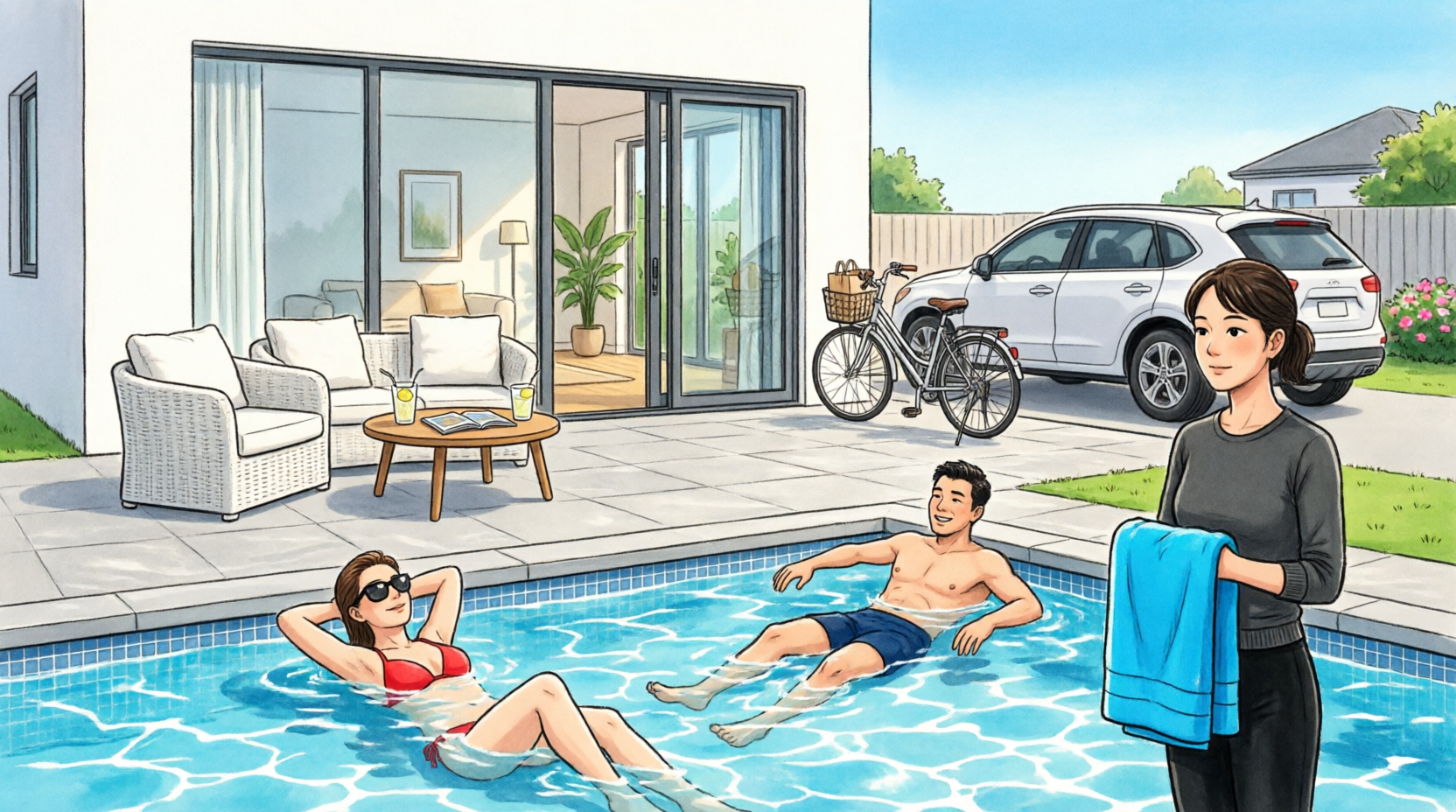
Her black bikini top was on Marissa’s patio chair.
His linen pants were beside it, folded in a way that suggested nobody had been in a hurry until the door opened.
Caleb saw her first.
His hands left Vanessa’s waist so fast that the water jumped around them.
“Marissa,” he said.
He said her name like a problem.
Vanessa sank lower until only her shoulders and mouth stayed above the water.
Her lipstick was red and smeared at the corner, the same shade Marissa had seen on a coffee cup the week before.
That memory came back with a clarity that made Marissa feel almost stupid.
Vanessa had stood at Marissa’s kitchen island that Tuesday, holding the mug with both hands, asking whether Caleb was still working late so often.
Marissa had answered honestly.
She had trusted the question because she trusted the woman asking it.
Now there were wet footprints leading from Marissa’s kitchen door to the pool.
Not from the side gate.
Not from the guest path.
From the kitchen.
The paper grocery bag sagged in Marissa’s hand.
She thought, absurdly, that the cilantro would wilt.
Then she set the bag on the outdoor counter because some part of her still refused to make a mess in her own house.
One avocado rolled out.
It tapped against the stainless-steel sink.
The sound was small and final.
“Don’t make a scene,” Caleb said.
That was when the marriage ended.
Not when she saw his hands on Vanessa.
Not when she saw the clothes.
Not even when she noticed Vanessa’s phone glowing with three missed calls from her husband.
It ended when Caleb looked at his wife standing in the doorway with groceries in her hand and decided his first concern was volume.
Marissa did not scream.
She did not cry.
She walked to the lounge chairs.
Caleb’s shirt was damp at the collar.
His belt was looped once through itself.
His keys were under the towel.
Vanessa’s sundress had fallen partly onto the stone.
Her sandals were turned sideways as if she had stepped out of them laughing.
Her phone lit again.
Mark.
That was Vanessa’s husband.
Marissa gathered everything slowly.
She folded each piece over her arm.
Vanessa whispered, “Please. We can explain.”
Marissa looked at the wet footprints.
“You already did.”
Caleb moved toward the pool edge.
“Don’t be dramatic.”
There it was again.
The performance he had already cast her in.
If she raised her voice, she would be unstable.
If she cried, she would be hysterical.
If she demanded answers, she would be humiliating him.
Men like Caleb did not simply betray you.
They reserved the right to review your reaction.
Marissa’s fingers tightened around the clothes until the wet fabric pressed cold against her skin.
She noticed her own wedding ring.
It looked strangely separate from her hand.
The red emergency button was beside the kitchen entrance.
It sat on the security panel Caleb had mocked for months.
Marissa had paid $2,700 for that system after a rash of break-ins two streets over, and Caleb had called her paranoid at least six times.
He had made jokes about it at dinner parties.
He had told Vanessa, once, while Vanessa laughed over a glass of wine, that Marissa was turning the house into a bank vault.
The system connected the side gate camera, the pool camera, the front doorbell, and the patrol dispatch.
It also sent automatic alerts to the monitoring company and pushed emergency notices into the Ridge Hollow community app.
Caleb knew all of that.
That was why his face changed before she pressed it.
“Marissa. No.”
She pressed once.
The siren tore through the backyard.
It was not a polite alarm.
It was sharp, brutal, and designed to be impossible to ignore.
Dogs erupted down the block.
Curtains moved in front windows.
A garage door lifted two houses away, groaning into the noise.
Mrs. Palmer leaned over her fence wearing gardening gloves, one hand still muddy.
The old man across the street stepped onto his porch holding a coffee mug.
Two teenagers stopped their bikes near the curb.
A delivery driver froze beside his open van with one box tucked against his hip.
For a few seconds, the entire subdivision paused around the sound.
A sprinkler kept ticking across someone’s lawn.
Mrs. Palmer’s mouth opened, but no words came out.
One of the teenagers looked at the ground, then back toward the fence.
Nobody moved.
Caleb shouted, “Turn it off!”
Marissa stood beside the alarm panel with their clothes over one arm.
“Why?” she asked.
Her voice was steadier than she felt.
“You brought this five feet from my kitchen.”
Vanessa covered her face with both hands.
The water could hide skin, but it could not hide facts.
Caleb tried to climb out.
Then he remembered he had nothing to climb out in.
Marissa’s phone buzzed.
Security Company: Emergency alert confirmed. Patrol notified.
Then the Ridge Hollow community app lit up.
Backyard alarm at 214 Ridge Hollow Lane.
That alert mattered more than Caleb understood.
It created a timestamp.
It created witnesses.
It created a public record of the exact minute the story stopped belonging only to the person who had been hurt.
At 5:42 p.m., the lie became an event.
Marissa reached into Caleb’s pants pocket.
She found the key fob to his new $64,000 truck.
Caleb’s mouth opened.
She held it between two fingers.
“This,” she said, “is the last thing of yours going into my pool.”
Then she dropped it into the deep end.
The fob disappeared under the rippling blue water.
For the first time, Caleb had nothing to say.
Vanessa turned toward the side gate.
Then another car door slammed out front.
The sound cut through the siren in a way that made Vanessa’s face collapse.
A black SUV stopped at the curb.
Vanessa whispered, “Mark.”
Marissa did not move.
She tightened her grip on the clothes.
The driver’s door opened.
The siren kept screaming.
Mark came up the front walk slowly.
He was not running.
That was somehow worse.
A running man still has hope that he can interrupt something before it becomes real.
Mark walked like a man who already knew he was arriving after the truth.
Marissa’s phone buzzed again.
Doorbell camera.
Motion clip saved: Front entry. 5:39 p.m.
She looked down.
The thumbnail showed Caleb and Vanessa at the kitchen door.
Caleb’s hand rested low on Vanessa’s back as he guided her inside.
Three minutes before Marissa came home.
Not the side gate.
Not the patio entrance.
The kitchen.
The same kitchen where Vanessa had borrowed sugar.
The same kitchen where Marissa had left coffee for Caleb on early mornings.
The same kitchen where she had trusted both of them to stand.
Marissa opened the clip.
There was no audio from inside, only the small camera view from the porch angle, but the image was enough.
Caleb glanced behind him before entering the code.
Vanessa laughed.
He kissed her once before the door opened.
It was quick.
Careless.
Familiar.
Marissa felt something in her chest go quiet.
Not numb.
Organized.
That was the word.
The hurt did not leave.
It arranged itself.
Vanessa saw Marissa’s face and whispered, “What?”
Marissa turned the screen toward Caleb.
He stared at the video.
His expression did not show guilt first.
It showed calculation.
That hurt more than guilt would have.
“Marissa,” he said, lowering his voice under the siren. “Don’t show him that.”
The doorbell rang.
The sound came through the backyard speaker, absurdly clean and polite.
Marissa looked at Caleb in the pool.
Then she looked at Vanessa.
Then she answered through the camera.
“Mark.”
His face filled the screen.
He was pale, but his voice was controlled.
“Marissa, before you open this door, tell me one thing.”
She waited.
“How long has my wife been using your kitchen door?”
Vanessa made a sound behind her.
Small.
Broken.
Marissa did not answer immediately.
She looked down at the saved clip again.
Then she scrolled.
There were more motion events from earlier Tuesdays.
Not all of them showed anything dramatic.
Some showed Vanessa arriving with an empty measuring cup.
Some showed Caleb opening the door when Marissa was not home.
Some showed Vanessa leaving with sunglasses on and her hair different from when she arrived.
The camera had not known what it was saving.
That was the cruel mercy of machines.
They do not understand betrayal.
They simply keep the time.
Marissa opened the front door.
Mark stood there in a dark polo shirt, one hand braced against the frame as if he had needed it to steady himself.
The siren screamed behind her.
The patrol vehicle had not arrived yet, but the whole block was already watching.
“I’m sorry,” Marissa said.
It was the first useless thing she had said all afternoon.
Mark looked past her toward the backyard.
Then he heard Vanessa sob.
His face changed.
He walked through the house without asking permission.
Marissa followed.
When he stepped onto the patio, Vanessa covered her mouth.
“Mark,” she said.
He did not answer her.
He looked at Caleb first.
Then he looked at the clothes over Marissa’s arm.
Then he looked at the patio chair, the bikini top, the linen pants, the phone, the wet footprints, and the glowing security panel.
The scene explained itself with humiliating efficiency.
Caleb tried to speak.
“Mark, listen—”
Mark raised one hand.
Caleb stopped.
That single gesture did what Marissa’s pain had not been allowed to do.
It silenced him.
The patrol officer arrived six minutes after the alarm confirmation.
By then, three more neighbors were outside.
Mrs. Palmer had retreated from the fence but still watched through the slats.
The teenagers had rolled their bikes farther down the curb without actually leaving.
The officer asked whether there was an intruder.
Marissa said no.
Then she looked at Vanessa, still in the pool, and Caleb, still gripping the edge.
“Not the kind you can arrest today.”
The officer took a report because the emergency alarm had dispatched patrol.
He recorded the timestamp.
He recorded that Marissa was the homeowner.
He recorded that two people had been found in the backyard pool without clothing readily available.
He recorded that one of them had entered through the kitchen door shortly before the alarm.
Caleb hated that part.
Marissa could see it.
He kept trying to move the conversation toward privacy, misunderstanding, marital issues, anything soft enough to blur.
The officer kept writing.
Paper has a way of offending people who depend on charm.
Mark asked for Vanessa’s phone.
She hesitated.
That hesitation answered more than the phone ever could.
Marissa handed him the clothes instead.
Vanessa climbed out wrapped in a towel the officer gave her from the outdoor storage bench.
Caleb had to wait until Marissa tossed him his shirt and pants, one at a time, without stepping closer.
Nobody laughed.
That almost made it worse.
The neighborhood had seen enough to talk for years, but in that moment, nobody treated it like entertainment.
Even Mrs. Palmer looked away when Caleb pulled on his clothes.
Humiliation can be deserved and still ugly.
Marissa did not need to enjoy it.
She only needed not to protect him from it.
When the siren finally stopped, the silence felt enormous.
Caleb turned toward her.
“Can we talk inside?”
Marissa almost laughed then.
Inside.
After everything, he still thought the kitchen was neutral ground.
“No,” she said.
Caleb looked at the neighbors, the officer, Mark, Vanessa, the wet tile, the patio chair, the empty place where his truck key used to be.
“Marissa, please.”
She looked at him for a long moment.
This was the man who had stood beside her when the pool was installed.
The man who had complained about the $18,000 cost and then invited everyone over to admire it.
The man who had called her careful when he meant boring.
The man who had called her paranoid when he meant inconvenient.
“I’m done discussing my marriage in rooms where you bring other women,” she said.
Mark drove Vanessa home in silence………………………
PART 2-At 5:42 P.M., I Found My Husband in Our $18,000 Backyard Pool With the Neighbor Who Borrowed Sugar Every Tuesday — He Whispered, “Don’t Make a Scene.” So I Picked Up Their Clothes, Pressed One Button, and Let the Entire Subdivision Hear the Truth
Caleb’s truck remained in the driveway because the key fob was somewhere at the bottom of the deep end.
That detail traveled faster through Ridge Hollow than the alarm had.
By 7:10 p.m., Marissa had changed the gate code.
By 7:32 p.m., she had downloaded every saved camera clip from the security system.
By 8:04 p.m., she had emailed them to herself, her sister, and a divorce attorney whose name she had once saved for a friend and never expected to use.
She did not sleep much that night.
Caleb slept in the guest room after realizing she had locked the bedroom door.
He texted her from across the hallway.
We need to handle this carefully.
She stared at the message.
Carefully.
That word again.
Careful was what he called secrecy once he was caught.
Careful was what he wanted from her after he had been reckless with everything that mattered.
The next morning, Marissa called a pool service.
The technician arrived before noon and retrieved the key fob with a net and a long pole.
It did not work.
Caleb stood on the patio watching the technician shake water from the dead plastic shell.
Marissa signed the service invoice.
She kept a copy.
That was petty, maybe.
It was also documentation.
Over the next week, Caleb tried every version of apology.
He tried shock.
He tried shame.
He tried blaming Vanessa.
He tried blaming stress.
He tried saying the pool incident made everything worse, as if the siren had betrayed their marriage and he had only been nearby.
Marissa listened once.
Only once.
Then she played the 5:39 p.m. doorbell clip.
Caleb went quiet when he saw his own hand on Vanessa’s back.
He went quieter when the next clip loaded.
A Tuesday.
Then another.
Then another.
Not all proof is explosive.
Some of it is repetitive.
Some of it ruins you by pattern.
Mark sent Marissa a message three days later.
It was short.
Thank you for not letting them make us both stupid.
She sat at the kitchen island and cried when she read it.
Not because of Mark.
Because he understood the specific injury.
The cheating was one wound.
The staging was another.
Caleb and Vanessa had used ordinary neighborly life as camouflage, and then expected the people they hurt to feel embarrassed for noticing.
The divorce was not clean, because divorces rarely are.
Caleb wanted the house listed immediately.
Marissa refused.
Her attorney pointed to the records, the camera clips, the patrol report, the alarm timestamp, and Caleb’s own messages afterward.
The $2,700 security system he had mocked became one of the cleanest timelines in the file.
The backyard pool became less a luxury item than a witness stand.
Marissa did not get everything.
Nobody does.
But she got the house through temporary agreement, then through settlement.
Caleb got the dead key fob back in a plastic bag because his attorney insisted personal property should be returned.
Marissa mailed it with tracking.
She allowed herself that one smile.
Vanessa and Mark sold their house before the end of the season.
Mrs. Palmer left a basil plant on Marissa’s porch two weeks later with a note that said, For the grill.
Marissa stood in the doorway holding it for a long time.
People surprised her after that.
Some were nosy.
Some were kind.
Some pretended they had not watched from their windows, which was kinder than admitting they had.
The teenagers stopped biking past her house for a while.
The delivery driver waved once from his van and looked immediately embarrassed.
Marissa learned that public humiliation is not the same as justice, but sometimes it is the only way to stop a private lie from swallowing you whole.
Months later, she swam in the pool alone for the first time.
The water was cold at first.
The tile still made that same slapping sound.
The basil had grown back thicker.
She floated under the afternoon light and looked at the kitchen door.
For a moment, she remembered herself standing there with grocery bags cutting into her fingers, watching two people wait for her to become small.
She had not become small.
She had pressed one button.
People liked to ask afterward whether she regretted making the whole neighborhood look.
Marissa always gave the same answer.
Caleb brought it five feet from her kitchen.
All she did was refuse to keep it quiet.
PART 1 — THE BUTTON THAT MADE THE WHOLE SUBDIVISION LOOK
At 5:42 p.m., I learned that a marriage can die in complete silence before anyone screams.
It did not begin with shouting.
It did not begin with broken glass.
It did not even begin with the woman in my pool.
It began with the sound of water.
That sharp, steady slap against blue tile.
Again.
Again.
Again.
The kind of sound I had heard a thousand times in my backyard and never once feared.
Until that afternoon.
My name is Marissa Cole.
I was thirty-six years old.
I had been married to Caleb for nine years.
And up until the moment I opened my kitchen door with grocery bags cutting red lines into my fingers, I still believed our house was a home.
That is the cruelest thing about betrayal.
It does not always arrive looking like a monster.
Sometimes it waits inside the place where you keep your coffee mugs.
Sometimes it walks through the door you unlocked for it.
Sometimes it borrows sugar every Tuesday and smiles at your kitchen island while learning the rhythm of your life.
I had left work early that day because the server at the firm crashed just before four.
Everyone groaned.
People packed laptops.
My manager told us to finish from home if the system came back up.
I remember feeling lucky.
Lucky.
That word still makes me sick when I think about it now.
I stopped at the market on the way home.
Caleb liked guacamole on Thursdays.
That was the kind of small married thought that still lived in me then.
Avocados.
Limes.
Cilantro.
The expensive tortilla chips he said were too salty but somehow always finished before dinner.
I bought all of it.
I even bought the basil plant by the checkout because the one near the grill had started looking tired.
Caleb once told me basil made the patio feel “like home.”
Home.
That word would become an insult before sunset.
The paper grocery bag was too heavy.
The handle cut into my fingers as I walked up the driveway.
Caleb’s $64,000 truck sat polished under the late sun.
The truck had been another argument wrapped in a celebration.
He said he deserved it.
I said we needed to count the money.
He kissed my forehead and told me I worried beautifully.
That was one of Caleb’s tricks.
He could make condescension sound like romance.
For years, I mistook that for charm.
The sprinklers clicked across the narrow lawn between our mailbox and the sidewalk.
Mrs. Palmer’s dog barked twice next door.
Then stopped.
I remember that part clearly.
Even the dog seemed to know something was wrong.
Nothing looked unusual from the front.
Not the curtains.
Not the truck.
Not the mailbox.
Not the porch.
That was what made the next moment feel so violent.
The house looked normal.
Only my life was not.
I opened the front door.
The cool air from inside brushed my face.
I carried the groceries through the hallway toward the kitchen.
One avocado rolled loose inside the bag.
I remember thinking I should set everything down before it bruised.
Normal thought.
Normal house.
Normal wife.
Then I heard the water.
Not laughter.
Not conversation.
Not music.
Just the pool.
Slap.
Slap.
Slap.
Steady.
Wrong.
I stepped into the kitchen.
The glass doors to the patio were glowing with late sunlight.
Every fingerprint shone on them.
Every streak.
Every smudge.
The backyard beyond the glass looked too bright.
Too exposed.
The chlorine smell came first.
Then the warm stone.
Then the basil.
Then the truth.
Caleb was in the pool.
Vanessa from number 218 was in his arms.
Her black bikini top was draped over my patio chair.
His linen pants were folded beside it.
His belt curled on the stone like a snake.
Her sundress lay half on the lounge chair and half on the patio floor.
Her sandals were tipped sideways as if she had stepped out of them laughing.
Her phone was faceup.
Three missed calls from Mark.
Her husband.
For one strange second, my mind refused to understand what my eyes were seeing.
It separated everything into objects.
Pool.
Chair.
Shirt.
Belt.
Phone.
Woman.
Husband.
Then the picture assembled itself.
And once it did, there was no taking it apart again.
Caleb saw me first.
His hands left Vanessa’s waist so fast the water jumped around them.
“Marissa,” he said.
Not my wife.
Not I’m sorry.
Not wait.
Just my name.
Like my name was a spill he had to clean before it stained.
Vanessa sank lower into the water until only her shoulders and red mouth stayed above the surface.
That red lipstick.
I knew that red lipstick.
I had seen it on the rim of a coffee cup in my kitchen the week before when she came over to borrow sugar.
Again.
For the third Tuesday in a row.
That was what almost made me laugh.
Sugar.
Not because anything was funny.
Because betrayal had worn such a stupid costume.
Vanessa had stood at my kitchen island smiling.
She had asked if Caleb was still working late.
I had told her yes.
I had trusted the question because I trusted the woman asking it.
Now there were wet footprints leading from my kitchen door to the pool.
Not from the side gate.
Not from the patio path.
From my kitchen.
The grocery bag sagged in my hand.
One avocado slipped out and rolled across the outdoor counter when I set the bag down.
It tapped against the stainless-steel sink.
A tiny sound.
A final sound.
Caleb cleared his throat.
“Don’t make a scene.”
That was the moment something inside me went cold.
Not broken.
Cold.
Because suddenly I understood what kind of man I had married.
He was not terrified that he had hurt me.
He was terrified I might become loud about it.
He was already managing the story.
Already assigning me the role.
If I screamed, I would be hysterical.
If I cried, I would be dramatic.
If I demanded answers, I would be embarrassing him.
If I exposed him, I would be cruel.
Men like Caleb do not just betray you.
They reserve the right to judge your reaction.
I looked at him.
Then at Vanessa.
Then at the clothes.
Then at the kitchen door.
For a moment, rage moved through me so fast I almost saw red.
I imagined throwing his keys over the fence.
I imagined ripping her sundress in half.
I imagined screaming loud enough for the whole subdivision to hear.
Then I stopped.
Because he wanted that.
Not really.
But later.
Later, he would need it.
He would need my screaming.
He would need my tears.
He would need my shaking hands.
He would need proof that I had lost control so he could pretend the problem was my reaction and not his betrayal.
So I gave him nothing.
No scream.
No slap.
No crying.
I walked to the lounge chair.
Vanessa whispered, “Please.”
Her voice was small.
Panicked.
“We can explain.”
I looked at the wet footprints from my kitchen.
“You already did.”
I picked up Caleb’s shirt.
Then his belt.
Then his pants.
Then his keys.
Then Vanessa’s sundress.
Then her sandals.
Then her phone.
I folded each piece over my arm slowly.
Caleb gripped the edge of the pool.
“Marissa.”
I did not answer.
“Don’t be dramatic.”
There it was again.
The script.
The label.
The warning.
My fingers tightened around the wet fabric until it pressed cold against my skin.
Then I saw the red emergency button beside the kitchen entrance.
The security panel.
The one I had paid $2,700 to install after break-ins two streets over.
The one Caleb had mocked for months.
The one he called “overkill.”
The one wired to the side gate camera, the pool camera, the doorbell, the patrol alert, and the Ridge Hollow community notification system.
I remembered him laughing about it at dinner.
I remembered Vanessa laughing too.
“She’s turning the house into a bank vault,” Caleb had said.
I remembered smiling.
I remembered pretending it did not bother me.
But at 5:42 p.m., overkill became documentation.
Caleb saw my hand move toward the panel.
His face changed before I pressed it.
“Marissa.”
His voice sharpened.
“No.”
I pressed once.
The siren tore through the backyard.
Sharp.
Brutal.
Impossible to ignore.
Dogs erupted down the block.
Curtains shifted.
Garage doors lifted in staggered little groans.
Mrs. Palmer leaned over her fence with gardening gloves on, one hand still muddy.
The old man across the street stepped onto his porch holding a coffee mug.
Two teenagers stopped their bikes near the curb.
A delivery driver froze beside his open van with a box still tucked under one arm.
For a few seconds, the entire subdivision stopped breathing around the sound.
A sprinkler kept ticking across someone’s lawn.
Vanessa covered her face with both hands.
Caleb shouted, “Turn it off!”
I stood beside the alarm panel with their clothes over my arm and my wedding ring still on my finger.
“Why?” I asked.
My voice sounded calmer than I felt.
“You brought this five feet from my kitchen.”
Caleb tried to climb out of the pool.
Then remembered he had nothing to climb out in.
My phone buzzed.
Security Company: Emergency alert confirmed.
Patrol notified.
Then the Ridge Hollow community app lit up.
Backyard alarm at 214 Ridge Hollow Lane.
There it was.
Address.
Timestamp.
Record.
The kind of thing Caleb could not charm, deny, or edit later.
At 5:42 p.m., the lie became public.
I reached into Caleb’s pants pocket and pulled out the key fob to his new truck.
His mouth opened.
I held it between two fingers.
“This,” I said, “is the last thing of yours going into my pool.”
Then I dropped it into the deep end.
The fob vanished beneath the rippling blue water.
For the first time, Caleb had nothing to say.
Vanessa turned toward the side gate.
Then another car door slammed out front.
A black SUV stopped at the curb.
Vanessa whispered one word.
“Mark.”
That was her husband’s name.
And she said it like a warning.
Not a prayer.
The siren kept screaming.
My phone buzzed again.
Motion clip saved: Front entry.
5:39 p.m.
I looked down.
The thumbnail showed Caleb’s hand on Vanessa’s lower back as he guided her through my kitchen door three minutes before I got home.
Not the side gate.
Not the patio.
My kitchen.
I opened the clip.
No audio.
Just the image.
Caleb looking over his shoulder.
Vanessa laughing.
His hand on her body.
The door opening.
My house swallowing both of them.
Vanessa saw my face change.
“What?” she whispered.
I turned the screen toward Caleb.
He stared at it.
His expression did not show guilt first.
It showed calculation.
That hurt worse than guilt would have.
“Marissa,” he said quietly.
“Don’t show him that.”
The doorbell rang.
The sound came through the backyard speaker system, clean and polite under the alarm.
I opened the live camera feed.
Mark leaned close to the lens.
His face was pale.
His voice was calm.
Too calm.
“Marissa,” he said.
“Before you open this door, tell me one thing.”
I waited.
His jaw tightened.
“How long has my wife been using your kitchen door?”
And that was when I realized the alarm had only exposed the first lie.
The rest of them were still waiting inside the cameras.
PART 2 — THE TUESDAY FILES
The siren continued screaming.
Not because anybody forgot to turn it off.
Because I wanted it screaming.
For years, I had been quiet.
For years, I had swallowed concerns.
Ignored instincts.
Explained away strange behavior.
Accepted convenient excuses.
At 5:42 p.m., I was done helping lies stay comfortable.
Mark stood on my front porch staring into the camera.
The black SUV idled at the curb.
The engine ticked softly.
The subdivision watched from windows, fences, and driveways.
Nobody knew exactly what was happening yet.
But they knew enough.
People always know enough.
They just wait for confirmation.
I looked at the live feed.
Then at Caleb.
Then at Vanessa.
Then back at the screen.
“How long has my wife been using your kitchen door?”
The question hung in the air.
Heavy.
Dangerous.
Because I suddenly realized something.
I didn’t know.
I honestly didn’t know.
Maybe weeks.
Maybe months.
Maybe longer.
The thought made my stomach twist.
Not because of what I knew.
Because of what I didn’t.
The unknown parts are always worse.
I walked through the house.
The siren echoing behind me.
Mark stood on the porch when I opened the door.
For a second we simply looked at each other.
Two people connected by the same betrayal.
Two people realizing their lives had just been divided into before and after.
“I’m sorry,” I said.
Mark nodded slowly.
“Me too.”
Nothing else.
No dramatic speech.
No yelling.
No threats.
Just two wounded people standing in the doorway of a house that suddenly felt unfamiliar.
Then his eyes moved past me.
Toward the backyard.
Toward the pool.
Toward the life we both thought we had.
And whatever restraint he had been carrying disappeared.
Not violently.
Quietly.
Which was somehow worse.
He walked through the house.
Past the dining room.
Past the kitchen.
Past the family photos hanging on the hallway wall.
Photos of birthdays.
Vacations.
Christmas mornings.
Normal memories.
Beautiful lies.
The siren still screamed.
The sound followed us all the way to the backyard.
Mark stepped outside.
Vanessa saw him.
The color disappeared from her face.
“Mark.”
No answer.
She took a step toward the pool edge.
“Mark, please.”
Still nothing.
He looked at the clothes folded over my arm.
Then at Caleb.
Then at the pool.
Then at the wet footprints leading directly from my kitchen.
The scene explained itself.
No words required.
Caleb finally spoke.
“Listen—”
Mark raised one hand.
Caleb stopped talking.
The silence afterward felt enormous.
Because for the first time all afternoon…
nobody was listening to Caleb.
Nobody cared what explanation he had prepared.
Nobody wanted the polished version.
The edited version.
The convenient version.
They wanted reality.
And reality was standing in a swimming pool.
Half naked.
Caught.
Then my phone buzzed again.
Security notification.
Additional footage archived.
Additional footage.
The words hit me immediately.
Because suddenly I remembered something.
The cameras.
Not just today.
Every day.
Every week.
Every month.
The security system never forgot.
My pulse quickened.
I opened the app.
Scrolled.
The camera history stretched backward.
Hundreds of clips.
Thousands maybe.
Motion events.
Door openings.
Vehicle detections.
Package deliveries.
Normal life.
Until it wasn’t.
I selected Tuesday.
The previous Tuesday.
The day Vanessa borrowed sugar.
The video loaded.
The timestamp appeared.
2:14 p.m.
My breath caught.
The footage showed Vanessa arriving.
Nothing unusual.
She smiled at the camera.
Walked toward the door.
Exactly what I expected.
Then another clip loaded.
2:58 p.m.
My stomach tightened.
Vanessa leaving.
Except she wasn’t carrying sugar.
She wasn’t carrying anything.
And Caleb wasn’t at work.
He appeared in the doorway.
Watched her leave.
Then looked up and down the street before closing the door.
My pulse accelerated.
I loaded another Tuesday.
Then another.
Then another.
Every clip felt like another crack forming beneath my feet.
The pattern emerged quickly.
Painfully quickly.
Vanessa arriving.
When I wasn’t home.
Vanessa leaving.
Forty minutes later.
An hour later.
Sometimes two hours later.
Always through my kitchen.
Always when Caleb claimed to be working remotely.
Always when I trusted both of them.
The room seemed smaller.
The air heavier.
Because betrayal doesn’t hurt once.
It hurts repeatedly.
Every memory gets rewritten.
Every innocent moment becomes suspicious.
Every explanation becomes questionable.
I kept scrolling.
Clip after clip.
Tuesday.
Tuesday.
Tuesday.
Then I found one from six weeks earlier.
And that was the one that broke me.
Not because it showed kissing.
Not because it showed touching.
Because it showed laughing.
The camera captured them standing in my kitchen doorway.
Laughing together.
Comfortable.
Relaxed.
Familiar.
Like two people who had done this many times.
Too many times.
I stared at the screen.
Unable to look away.
Unable to stop.
Then Mark quietly asked:
“What are you looking at?”
I turned the phone toward him.
His face changed immediately.
Not anger.
Recognition.
The terrible recognition that comes when a suspicion finally becomes proof.
He watched the clip.
Then another.
Then another.
Neither of us spoke.
What was there to say?
The cameras were speaking now.
And cameras never get emotional.
Never exaggerate.
Never forget.
They simply remember.
Behind us, the patrol officer finally arrived through the side gate.
The siren still screamed.
Neighbors still watched.
Dogs still barked.